
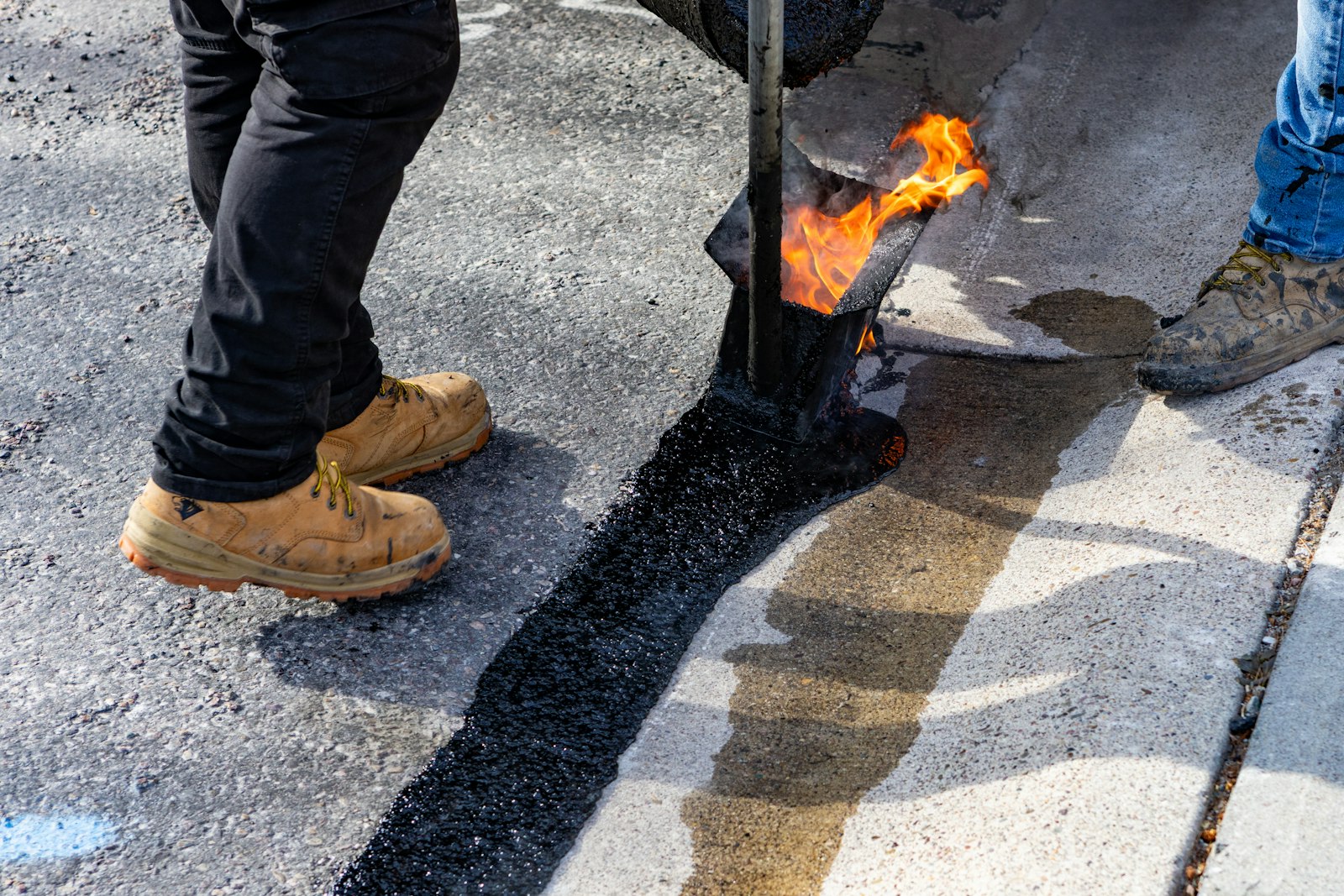
Asphalt paving crews work on top of a mat that arrives at 275–325°F and lose 4.8–6 grams of sodium across a summer shift — the blacktop radiates heat up while the sun beats down. A 3 oz pickle brine shot delivers 570 mg of sodium and triggers a neural reflex that quiets a cramping muscle in about 85 seconds (Miller 2010). It is the dosed off-switch when a calf locks up behind the screed. The full mat-day protocol is below.
Paving is the only trade where the crew works standing on the heat source. Hot mix leaves the plant at 275–325°F, the screed deck runs hotter, and the fresh mat stays above 200°F through the compaction window. A black surface in direct June sun adds radiant load from below at the same time the sun loads from above — rakers and screed operators routinely work in an effective microclimate 10–30°F hotter than the air temperature the weather app shows. By the last truck of the day, the luteman has lost more sodium than a marathoner running in the same heat.
This page is the mat-day protocol: the five paver-specific cramp drivers, the 85-second mechanism, sodium density vs Gatorade / Powerade / Sqwincher / LMNT, and the 5-stage protocol adapted for the paving train. It pairs with pickle juice for concrete crews, pickle juice for roofers, and pickle juice for landscapers — same family of trade workers, different cramp triggers.
The Blacktop Stack: Why Paving Crews Cramp Differently
OSHA's heat-illness data puts road construction near the top of the risk table, and the reason is the stack: air heat plus radiant heat off a 300°F mat plus the pace of the paving train. The paver does not stop because a raker is tired. Trucks are cycling from the plant, the mat has a compaction temperature window, and the rollers have to finish their passes before the mat cools through roughly 175°F. Every minute of delay is density lost — so crews push through the exact conditions where every other trade would break.
That pace doubles the sweat cost. Published work-shift sweat-loss data from Bates and Schneider (2008, PMC2267797) put trade-worker sodium losses at 4.8–6 grams per shift — equivalent to 10–15 grams of table salt. A raker pulling mix behind the screed on a July highway job hits the top of that range by early afternoon. Water alone replaces the volume, not the salt, which is why the cramp shows up after the water break, not before it.
Five Paver-Specific Cramp Drivers
Generic heat-safety advice covers water, rest, and shade. Paving crews need a sweat-and-sodium model built around the train itself. These five drivers stack on every mat day:
- Radiant heat from below. Fresh mat at 200–300°F radiates upward through boots and pant legs. Surface temps stay paving-hot through the entire compaction window, so the screed operator and rakers stand in a heat plume no canopy can shade. Calves and feet take conductive load all day — the calf cramp on the walk back to the truck is the classic paving cramp.
- The train does not stop. Concrete crews finish a pour; paving crews chase plant trucks until the tonnage is laid. Skipped breaks are structural, not a discipline problem. Lost break time means lost rehydration windows, and the sodium deficit compounds load after load.
- The raker's lunge. Lutemen and rakers work bent forward, lunging and pulling mix at the joint and around structures for hours. Hamstrings, lower back, and forearms do continuous isometric work — the same muscle pattern that locks into a hamstring cramp when the deficit catches up at 2 p.m.
- High-vis, long sleeves, and gloves. Class 2/3 high-vis over long sleeves blocks evaporative cooling the same way a welder's leathers do, just one notch lighter. Sweat soaks instead of cooling. By late morning the shirt under the vest is saturated and the cooling channel is mostly shut.
- Night-to-day whiplash. Summer schedules mix night paving with day jobs. A crew that paved until 2 a.m. shows up at a day job pre-depleted and under-slept — both are documented cramp multipliers. OSHA's own fatality reviews show most heat deaths hit workers who were not acclimatized to that day's load.
The 85-Second Mechanism: Why Brine Beats Water
The reason a 3 oz pickle brine shot works on an active cramp faster than water, salt tablets, or sports drinks is that the brine does not need to be absorbed to work. The original Miller 2010 study at North Dakota State University (published in Medicine & Science in Sports & Exercise, PubMed 19997012) showed that pickle brine quiets an electrically-induced cramp in about 85 seconds — far too fast for sodium to reach the bloodstream from the stomach.
The current explanation: acetic acid hits sour-taste receptors (TRP channels) in the back of the throat and esophagus, which fires a vagal-nerve reflex that resets the misfiring motor neurons causing the cramp. The cramp signal stops at the spinal cord, not at the muscle. That is why brine works on a cramp now, while the 570 mg of sodium does its slower job replacing the deficit over the next 30–60 minutes.
Two takeaways for paving crews:
- An active cramp on the mat is a brine-shot problem. Step off the mat, take the shot, give it 85 seconds. The neural reflex needs liquid brine on the tongue and throat — salt tablets do not trigger it.
- The daily sodium deficit is a volume problem. Brine is the off-switch, not the gallon. For the 10-hour drain, the crew also needs water plus an electrolyte beverage at the OSHA cadence of 8 oz every 15–20 minutes.
Sodium Density: The Paving Crew Comparison
The number that matters for an active cramp is sodium per serving — how much salt arrives with the brine reflex. The number that matters for the daily drain is total sodium per hour. Here is how a 3 oz Fast Pickle shot stacks against what is usually in the crew-truck cooler:
| Product | Serving | Sodium | Sugar | Onset |
|---|---|---|---|---|
| Fast Pickle (3 oz shot) | 3 oz / 89 ml | 570 mg | 0 g | ~85 sec (cramp reflex) |
| Sqwincher Lite (powder, 8 oz) | 8 oz | 120 mg | 0 g | 20–30 min (absorption) |
| Gatorade Thirst Quencher (20 oz) | 20 oz | 270 mg | 34 g | 20–30 min |
| Gatorade Endurance (20 oz) | 20 oz | 620 mg | 22 g | 20–30 min |
| Powerade (20 oz) | 20 oz | 250 mg | 34 g | 20–30 min |
| LMNT (packet in 16 oz) | 16 oz | 1,000 mg | 0 g | 20–30 min |
| Liquid IV (packet in 16 oz) | 16 oz | 510 mg | 11 g | 20–30 min |
| Salt tablet (1 g NaCl) | 1 tablet | 390 mg | 0 g | 30–60 min, no reflex |
The shot is not competing with the cooler jug — it is the highest sodium-per-ounce option on the table with the only sub-2-minute onset, in a 3 oz format a raker can take without leaving the train for more than thirty seconds.
The Mat-Day Protocol (5 Stages)
Built on the same structure as the concrete pour-day protocol, adapted for the paving train:
1. Night before any 90°F+ mat day
Salt dinner deliberately and drink a full glass of water with it. If yesterday was also a mat day, take one 3 oz shot with dinner — crews stack deficits across a heat wave, and tomorrow's first cramp is usually yesterday's unpaid sodium bill. Skip alcohol on back-to-back paving nights; it is a diuretic working against an already-short tank.
2. Pre-shift (before the first truck, 5–6 a.m.)
Breakfast with real sodium — eggs, bacon, salted potatoes — plus 16–24 oz of water. A crew that starts the first pull already topped up pushes the first cramp window from mid-morning to afternoon. New hires and anyone back from days off get flagged here: they are the least acclimatized bodies on the train and OSHA's fatality data says they take the worst of the heat.
3. Mid-morning bundle (after the first long pull, 9–10 a.m.)
One 3 oz shot plus 8–12 oz of water at the truck-cycle gap. This is maintenance dosing — 570 mg of sodium back in the tank before the deficit becomes a cramp. Pair it with the OSHA cadence (8 oz of water every 15–20 minutes) for the rest of the morning.
4. Acute cramp (any time, any pull)
The calf seizes behind the screed, or the hamstring locks mid-rake. Step off the mat, take a 3 oz shot, give it 85 seconds. Do not try to walk it off on hot mat and do not chase it with a salt tablet — that is how a small cramp becomes a fall onto 300°F asphalt, and a burn on fresh mat is an EMS call, not a first-aid-kit fix.
5. End-of-shift (after the last roller pass)
One more shot or a salted meal within an hour of shutdown, plus fluid. This is the stage crews skip most and it is the one that decides whether tomorrow starts at zero or in a hole. Night-paving crews flip this protocol: the "night before" stage becomes the afternoon before the shift.
Five Paving-Day Mistakes That Cost Tonnage
- Stocking the cooler with water only. Water replaces volume, not the 4.8–6 grams of sodium a mat day pulls out. The all-water crew is the one cramping at 1 p.m. with three trucks still cycling.
- Skipping breakfast sodium. Coffee and an energy drink is a diuretic stack on an empty sodium tank. The first pull starts the drain at deficit.
- Trying to walk a cramp off on the mat. A locked calf on a 300°F surface is a fall-and-burn risk, not a toughness test. Step off, shot, 85 seconds.
- Treating the shot as the all-day plan. It is the off-switch and the densest sodium top-up on the truck — it is not the gallon of fluid the day still requires.
- Putting yesterday's cramper on the screed today. The crew member who cramped yesterday is the most depleted body on the train. Rotate them off the hottest position, start them on stage 1–2 dosing, and watch them through mid-morning.
Pack-Size Picks for Paving Crews
- 24-Pack ($49.99, $2.08/shot) — the crew-truck default. Foreman stocks one in the crew-truck cooler next to the water. Covers a 5–7 person train for a hot week on the bundle + acute-cramp pattern. Same SKU used by concrete crews and fab shops.
- 12-Pack ($28.99, $2.42/shot) — the personal lunchbox stock. For the raker or roller operator who wants their own supply in the pickup. Ships free.
- 6-Pack ($14.99, $2.50/shot) — the first-try size. One heat wave's worth for a skeptic or a new hire's first season.
Frequently Asked Questions
Can I take a shot mid-pull without leaving the train?
Yes — it is 3 oz, two swallows, under thirty seconds. But step off the fresh mat first. The reflex works standing at the truck just as fast as anywhere else, and standing still on 200°F+ mat is its own hazard.
Does the vinegar cause GI issues during a hot day?
For most workers, no — 3 oz is a dosed amount, not a jar of brine. If you are sensitive, take it with a few ounces of water. The Miller protocol used roughly this volume on working subjects without GI events.
Can the shot replace water?
No. The shot replaces sodium and fires the cramp reflex; water replaces volume. A mat day needs both — OSHA's guidance is 8 oz of water every 15–20 minutes in high heat, and the shot rides alongside that cadence.
How is the shot different from a salt tablet?
A salt tablet delivers about 390 mg of sodium through absorption (30–60 minutes). The shot delivers 570 mg of sodium plus the 85-second neural reflex from the brine itself. For an active cramp the reflex is the faster path; tablets do not trigger it.
I take blood-pressure medication. Is 570 mg of sodium safe?
For most workers without a clinical sodium-restriction diagnosis, 570 mg per shot is well within standard intake (the FDA daily reference is 2,300 mg) — especially on a day you are sweating out multiples of that. If you have hypertension, kidney disease, or heart failure and your doctor has you on a low-sodium diet, talk to them before adding any high-sodium product, including sports drinks and salt tablets.
Will the shots survive the crew truck in summer?
Yes. Fast Pickle is shelf-stable and does not need refrigeration. The dash, the gang box, or the cooler are all fine even at 120°F. Cold shots are nicer to drink; warm shots work the same on a cramp.
I run the crew. What pack size do I stock?
The 24-pack is the right crew-truck default — one box per train, two during a heat wave or on double-shift schedules. Same logic the concrete crew page uses for trailer coolers.
Does this fit an OSHA heat-illness prevention program?
OSHA's proposed Heat Injury and Illness Prevention rule requires employers to provide hydration, shade, and rest breaks above trigger temperatures. Fast Pickle is a hydration/electrolyte product that fits inside that framework alongside water and shade — it is not a substitute for the rest-break and shade requirements.
What about night-paving crews?
Night paving cuts the solar load but keeps the 300°F mat, the train pace, and the PPE — sweat losses stay high, and sleep-shifted crews cramp more easily. Run the same 5-stage protocol shifted to the night schedule: the "night before" stage becomes the afternoon before, the pre-shift meal is dinner.
What is the difference between this and heat-exhaustion treatment?
Heat exhaustion (dizziness, nausea, confusion, body temp over 103°F) is a medical emergency — get the worker off the mat into shade or AC, cool the body actively, and call EMS if symptoms persist. The shot is for the muscle-cramp piece of the heat-illness spectrum, not for heat exhaustion or heat stroke.
*These statements have not been evaluated by the Food and Drug Administration. This product is not intended to diagnose, treat, cure, or prevent any disease. Talk to your doctor before adding any high-sodium product to your regimen if you have hypertension, kidney disease, heart failure, or are on a sodium-restricted diet.