
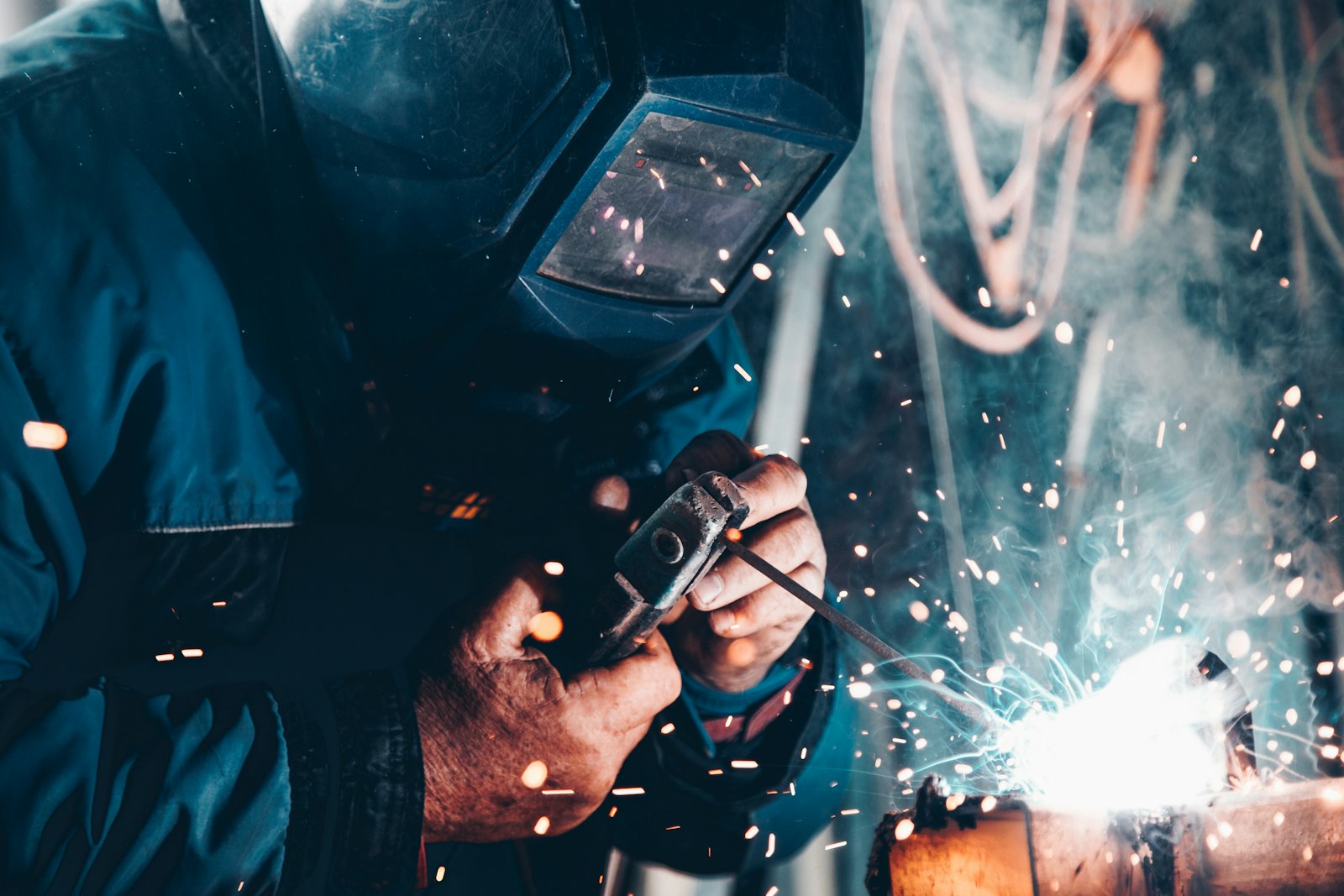
Welders lose 4.8–6 grams of sodium across a hot-work shift — arc heat, helmet, leathers, and gloves trap the body at 100°F+ even when the shop is 85°F. A 3 oz pickle brine shot delivers 570 mg of sodium and triggers a neural reflex that quiets a cramping muscle in about 85 seconds (Miller 2010). It is the dosed off-switch when a calf or forearm locks up under the hood. The full hot-work protocol is below.
Welders are the hardest-hit trade in summer because the heat stack is layered: the arc itself (5,500–10,000°F at the puddle), the radiated heat off the work piece, the helmet and shroud that trap exhaled air against the face, and the leather jacket, sleeves, gloves, and bibs that block evaporative cooling. The hood alone can sit 20–50°F hotter than ambient by the second pass. By the end of an 8-hour fab-shop day in July, the welder under the hood has lost more sodium than a marathoner running in the same heat.
This page is the hot-work-day protocol: the five welder-specific cramp drivers, the 85-second mechanism, sodium density vs Gatorade / Powerade / Sqwincher / LMNT, and the pour-day-style 5-stage protocol adapted for stick / MIG / TIG work. It pairs with pickle juice for concrete crews, pickle juice for HVAC techs, and pickle juice for linemen — same family of trade workers, different cramp triggers.
The Hot-Work Stack: Why Welders Cramp Differently
OSHA categorizes welding as one of the highest-risk heat-stress occupations because the protective gear required to do the job safely is the same gear that prevents the body from cooling itself. A 90°F summer day in an unconditioned fab shop becomes a 110–120°F microclimate inside the hood, jacket, and gloves — and the welder cannot remove any of it while the arc is live without taking burns, UV flash, or fume exposure.
That microclimate doubles the sweat rate. Published work-shift sweat-loss data from Bates and Schneider (2008, PMC2267797) put trade-worker sodium losses at 4.8–6 grams per shift — equivalent to 10–15 grams of table salt. A welder running stick on heavy plate in July hits the top of that range by lunch. Water alone replaces the volume, not the salt, which is why the cramp shows up after water break, not before it.
Five Welder-Specific Cramp Drivers
Generic heat-illness advice covers volume and shade. Welders need a sweat-and-sodium model that accounts for the actual gear they wear. These five drivers stack on every hot-work day:
- Helmet and hood microclimate. The flip-down hood traps exhaled CO2 and radiant heat off the puddle against the face. Internal hood temp rises 20–50°F over ambient. Sweat pours into the eyes inside the hood and cannot be wiped without breaking the arc. Cooling tech (powered air-purifying respirators with active cooling) can drop hood temp by up to 50°F — most shops do not have it.
- Leather jacket, sleeves, and bibs. Leather is mandatory PPE against UV flash and spatter. It is also nearly impermeable to evaporative cooling. The welder sweats inside the jacket but the sweat does not cool the skin — it just soaks the cotton t-shirt underneath. By 11 a.m. the jacket is heavy with retained sweat and the cooling channel is shut.
- Heavy gloves and forearm strain. TIG gloves are thinner, MIG and stick gloves are heavy gauntlets. The forearm muscles work continuously to hold the gun or rod steady — the muscle that holds a tight bead is the same one that locks into a cramp at 2 p.m. when sodium is gone. Welders cramp in the forearm more than any other trade because of this.
- Standing or kneeling on hot steel. Pipeline welders, structural welders, and shipyard welders kneel or lie on the work piece itself. Steel plate in direct sun reads 130–150°F by mid-morning. Conductive heat into the knees and shins is constant. The calf cramp shows up when the welder stands up at break.
- Hot-side ventilation and shop fans. Most fab shops run fans, not AC. Fans move 95°F air across the welder — that is convective heating, not cooling, once ambient is above body temp. The welder feels "wind" and assumes cooling, but core temp keeps rising. This is the same trap that catches roofers on a windy hot day.
The 85-Second Mechanism: Why Brine Beats Water
The reason a 3 oz pickle brine shot works on an active cramp faster than water, salt tablets, or sports drinks is that the brine does not need to be absorbed to work. The original Miller 2010 study at North Dakota State University (and the follow-up in Medicine & Science in Sports & Exercise, PubMed 19997012) showed that pickle brine quiets an electrically-induced cramp in about 85 seconds — far too fast for sodium to reach the bloodstream from the stomach.
The current explanation: acetic acid hits sour-taste receptors (TRP channels) in the back of the throat and esophagus, which fires a vagal-nerve reflex that resets the misfiring motor neurons causing the cramp. The cramp signal stops at the spinal cord, not at the muscle. That is why brine works on a cramp now, while sodium does its slower job replacing the deficit over the next 30–60 minutes.
Two takeaways for welders:
- An active cramp under the hood is a brine-shot problem. Break the arc, set the stinger down, take the shot. The neural reflex needs liquid brine on the tongue and throat — salt tablets do not trigger it.
- The daily sodium deficit is a sports-drink-volume problem. Brine is the off-switch, not the gallon. For the 8-hour drain, you also need a quart or two of an electrolyte beverage you will actually finish.
Sodium Density: The Welder Comparison
The number that matters for an active cramp is sodium per serving — how much salt arrives with the brine reflex. The number that matters for the daily drain is total sodium per hour. Here is how a 3 oz Fast Pickle shot stacks against what is usually in a fab-shop cooler:
| Product | Serving | Sodium | Sugar | Onset |
|---|---|---|---|---|
| Fast Pickle (3 oz shot) | 3 oz / 89 ml | 570 mg | 0 g | ~85 sec (cramp reflex) |
| Sqwincher Lite (powder, 8 oz) | 8 oz | 120 mg | 0 g | 20–30 min (absorption) |
| Gatorade Thirst Quencher (20 oz) | 20 oz | 270 mg | 34 g | 20–30 min |
| Gatorade Endurance Formula (20 oz) | 20 oz | 620 mg | 22 g | 20–30 min |
| Powerade (20 oz) | 20 oz | 250 mg | 34 g | 20–30 min |
| LMNT (1 stick in 16 oz) | 16 oz | 1000 mg | 0 g | 20–30 min |
| Liquid IV Hydration Multiplier (16 oz) | 16 oz | 510 mg | 11 g | 20–30 min |
| Salt tablet (1 g NaCl) | 1 tablet | 390 mg | 0 g | 30–60 min |
The mechanism difference is the reason the shot is on every Fast Pickle trade page. Sqwincher and Gatorade are fine for the slow drain. Neither one will quiet a cramped forearm under a hood in the time it takes to finish a weld. The shot will.
The Hot-Work Day Protocol (5 Stages)
This is the same shape as the protocol on pickle juice for concrete crews and pickle juice for HVAC techs, adjusted for the arc-and-hood rhythm of welding.
1. Night before any 90°F+ shop day
Eat a salted dinner. Add an extra teaspoon of salt to the rice, the eggs, the soup — whatever the meal is. The sodium stores you carry into a hot shop day are built the night before, not at 6 a.m. Hydrate to clear urine before bed.
2. Pre-shift (6–7 a.m.)
Eat breakfast that includes sodium — eggs with salt, breakfast sandwich, salted oatmeal. Drink a quart of water with a pinch of salt or a sports-drink mix. Skip the iced coffee as your only morning liquid — caffeine is a mild diuretic and you start the shift in the red.
3. Mid-morning bundle (after the first hot pass, usually 9–10 a.m.)
This is the inflection point. After your first heavy stick or MIG pass on plate, take one 3 oz Fast Pickle shot with a quart of water or an electrolyte beverage. The shot covers the morning sodium debt; the water covers the volume. Do this before you feel the cramp, not after.
4. Acute cramp (any time, any pass)
The forearm seizes mid-bead. The calf seizes when you stand up from a kneel. Stop the arc, set the stinger down, flip the hood up, take a 3 oz shot. The brine reflex starts working in about 85 seconds. Do not chase it with a salt tablet or try to muscle through — that is how a small cramp becomes a torn calf muscle and a hospital visit for rhabdo.
5. End-of-shift (4–5 p.m.)
Take one more shot with a quart of water before the drive home. The freeway-cramp pattern (calf locks up on the brake pedal in stop-and-go traffic at 5:30 p.m.) shows up because the welder finally cools down enough for the deficit to bite. Replace the salt while the sweat is still active.
Five Welding-Day Mistakes That Cost Production
- Drinking only water all day. Volume goes up, sodium concentration goes down. Cramps and headaches get worse, not better. Add salt to every quart after the second one.
- Skipping breakfast sodium. A welder who shows up after a sausage biscuit and coffee is fine. A welder who shows up after just coffee is already two hours from the first cramp.
- Waiting until a full lockup to take the shot. The shot works on an active cramp, but it works faster on the first twitch. If the forearm starts pulsing under the hood, that is the moment to dose, not 20 minutes later when the muscle is in a knot.
- Treating the shot as a daily plan. One 3 oz shot is 570 mg of sodium. A welder loses 4.8–6 grams per shift. The shot is the dosed off-switch and the morning bundle — not the entire sodium budget. Sports drinks, salted food, and salty snacks (jerky, salted nuts, pickles) cover the rest.
- Sending yesterday's crampers into today's hottest job. A welder who cramped Tuesday is the most-at-risk person on Wednesday. Their sodium store is not refilled overnight; it takes a day of normal eating and rest. Put them on lighter cuts or a cooler station for one day. Foremen who do this lose less time to call-outs.
Pack-Size Picks for Welders
The right SKU depends on whether the cooler belongs to one welder, a small crew, or a whole fab shop.
- 24-Pack ($49.99, $2.08/shot) — the shop-cooler default. Foreman or shop owner stocks one in the welding-bay cooler or trailer. Covers a 4–6 welder shop for a hot week with the morning-bundle + acute-cramp pattern. Same SKU used by concrete crews and HVAC service vans.
- 12-Pack ($28.99, $2.42/shot) — the personal lunchbox. One welder, one box, two weeks of hot-day coverage. Fits a standard lunch cooler. Right pick for a journeyman who supplies his own.
- 6-Pack ($17.99, $3.00/shot) — the first-try. Apprentice trying it for the first time, or a welder running a single hot job site (a roof-mounted weld, a one-day pipe repair). One week of standard coverage.
Frequently Asked Questions
Can I take a shot under the hood while welding?
No. Break the arc, set the stinger down, flip the hood up, take the shot. Treat it like any drink — you do not drink under a live arc. The shot works in 85 seconds, which is faster than the time it takes to walk back to the weld anyway.
Does the vinegar in pickle juice cause GI issues during a hot day?
For most people, a 3 oz shot is well-tolerated even on an empty stomach. If you have severe acid reflux, take it with food or after a few sips of water. The shot is small enough (3 oz / 89 ml) that it does not bloat or slosh during physical work.
Can the shot replace water?
No. The shot replaces salt and triggers the cramp reflex. Water replaces volume. On a hot welding day you need both — usually one shot per 2–3 quarts of water or sports drink.
How is the shot different from a salt tablet?
A salt tablet delivers about 390 mg of sodium and works through absorption (30–60 minutes). The shot delivers 570 mg of sodium plus the 85-second neural reflex from the brine itself. For an active cramp the reflex is the faster path; salt tablets do not trigger it.
I take blood-pressure medication. Is 570 mg of sodium safe?
For most welders without a clinical sodium-restriction diagnosis, 570 mg per shot is well within standard intake (the FDA daily limit is 2,300 mg). If you have hypertension, kidney disease, or heart failure and your doctor has put you on a low-sodium diet, talk to them before adding any high-sodium product, including sports drinks and salt tablets.
Will the shots survive a hot shop or truck cooler?
Yes. Fast Pickle is shelf-stable and does not need refrigeration. The shop trailer or gang box is fine even at 120°F. Cold shots are nicer to drink, but warm shots work the same on a cramp.
I am a shop owner. What pack-size do I stock?
The 24-pack is the right shop-cooler default for most fab shops — one box per welding bay or one in the break-room cooler. For a shop running 6+ welders through a heat wave, stock two. Same logic the concrete crew page uses for trailer coolers.
Is this OSHA-compliant heat-illness gear?
OSHA's 2024 proposed Heat Injury and Illness Prevention Rule (HIIPP) requires employers to provide hydration, shade, and rest breaks above certain thresholds. Fast Pickle is a hydration / electrolyte product that fits into that framework alongside water and shade — it is not a substitute for the rest breaks and access-to-shade requirements of the rule.
Can welders apprentices and helpers take the shot too?
Yes. Apprentices and helpers carry, fit, grind, and stage in the same heat as the journeyman. They are often the first to cramp because they have less acclimatization. Same dose, same protocol.
What is the difference between this and heat exhaustion treatment?
Heat exhaustion (dizziness, nausea, confusion, body temp over 103°F) is a medical emergency — get the welder into shade, remove the gear, cool the body actively, and call EMS if symptoms persist. The shot is for the muscle-cramp piece of the heat-illness spectrum, not for heat exhaustion or heat stroke.
*These statements have not been evaluated by the Food and Drug Administration. This product is not intended to diagnose, treat, cure, or prevent any disease. Talk to your doctor before adding any high-sodium product to your regimen if you have hypertension, kidney disease, heart failure, or are on a sodium-restricted diet.