
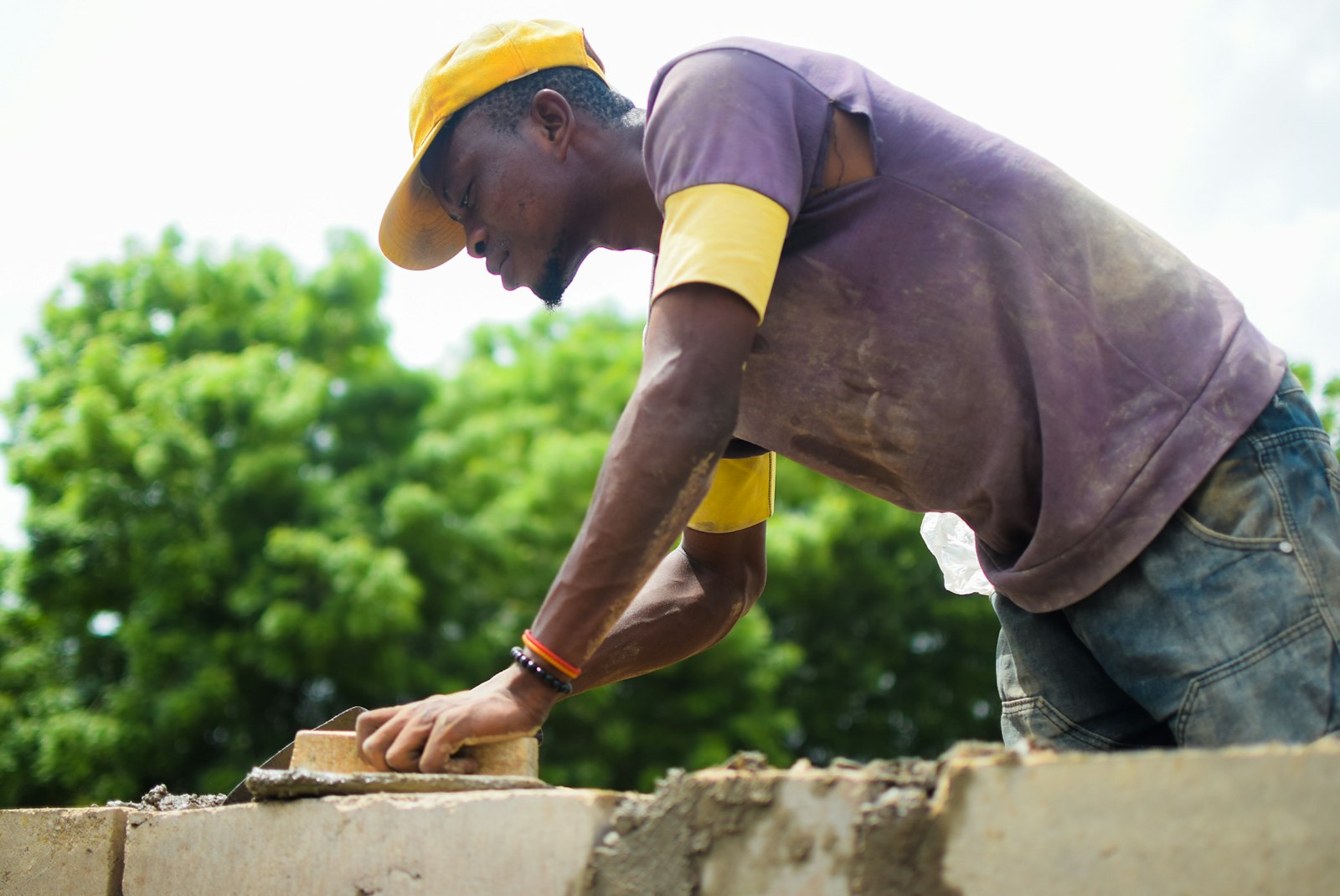
Masons cramp because the job stacks the two worst things you can do to a muscle in summer on top of each other: thousands of repetitions of loaded lifting — block, mud, block, mud — in front of a wall that radiates the sun straight back at you. A full shift in the heat can pull 4.8 to 6 grams of sodium out in sweat, and a calf, hamstring, or forearm that's depleted and overworked is exactly the muscle that locks. A 3 oz pickle brine shot delivers 570 mg of sodium and fires a neural reflex that quiets a cramping muscle in about 85 seconds (Miller 2010) — which is why it rides in the gang box next to the line blocks, not in a gym bag. The full course-day protocol is below.
The cramp that drops you a knee on the scaffold board, or the calf that knots at midnight after a corner-lead day, never shows up on the daily safety log. It gets walked off in the mud bed, cursed at on the mortar board, and pushed through — because the lead course still has to top out before the mud sets and the tender already cut the next batch. But that cramp wasn't built in the last hour. It was built across the whole day: the breakfast that was a gas-station biscuit, the morning the wall already read 110°F in the sun by nine, the steady drain that nobody felt because you were too busy keeping the course rate up.
This page is the jobsite version of the protocol: the five mason-specific cramp drivers, the 85-second mechanism, sodium density vs what's actually sitting in the jobsite cooler, and a 5-stage course-day plan that runs from the morning coffee to the bunk. It pairs with pickle juice for concrete crews, pickle juice for roofers, and pickle juice for heat exhaustion — same heat-illness family, different trade.
The Wall Radiates Back: Why Masonry Heat Is Worse Than The Forecast
The thermometer on the truck says 92°F. The face of the wall you're laying against says a lot more. Brick, block, and the concrete slab you're standing on absorb sunlight all morning and re-radiate it straight at your body for the rest of the day — so a mason works inside a pocket of heat that runs hotter than the air temperature the forecast quotes. Add a steel scaffold frame baking in the sun, a mud mixer throwing off heat at the tender's station, and zero shade once the wall passes head height, and the microclimate a mason actually stands in can run 10–20°F above ambient.
That heat is what turns the day's lifting into cramps. Sweat carries roughly 1 gram of sodium per liter, and field studies of men working in summer heat predict average sodium losses of 4.8 to 6 grams over a single shift — the equivalent of 10 to 15 grams of table salt walking out of you in a day. Heavy or salty sweaters lose more; if your shirt and ball cap dry stiff with white rings, that's you. Replace that loss with plain water alone and you dilute the sodium that's left — the classic setup for the misfiring motor neurons behind exertional heat cramps. Masonry crews already know the back half of this story: during the worst of summer, most can't hold full production for a clean eight hours, and heat exhaustion is a standing item on the morning toolbox talk.
Five Mason-Specific Cramp Drivers
Generic hydration advice assumes steady conditions, open air, and a body that gets to rest between efforts. A course-laying day breaks all three. These five drivers stack on every summer wall:
- Block-and-mud repetition. A standard concrete block runs 30 to 38 pounds, and a mason sets hundreds of them a day — each one a lift, a placement, and a tap into the mud. Brick is lighter but you handle thousands. That volume of loaded, repeated effort fatigues the forearms, grip, low back, and calves long before you notice, and a fatigued muscle short on sodium is the one that cramps.
- The radiant-heat pocket. The wall, the slab, and the scaffold steel throw stored heat back at you all afternoon. You are not working in the shade of a number on a phone — you're working in a hotter pocket the forecast never sees, which is why the dose sneaks up faster than the crew expects.
- The rising course line. As the wall grows, the lift height climbs with it — by the top courses you're hoisting 35-pound block to chest and shoulder height off a scaffold board. Lifting height drives the biomechanical load on a mason's back and shoulders, and the heaviest, highest lifts tend to land late in the day on the most depleted body.
- The tender's haul. Mixing mud, loading the board, hauling block and bag up the scaffold, running the wheelbarrow — the laborer and tender positions are pure sustained output next to a heat-throwing mixer, often with even fewer scheduled breaks than the mason on the line.
- The course-rate push. Masonry is paid and tracked by the course, and mud has a working clock — once it's on the board you're racing it before it sets up. That pressure compresses water breaks out of the afternoon exactly when the heat and the deficit are at their worst. The cramp hits on the fourth course of the afternoon, not the first of the morning.
The 85-Second Mechanism: Why Brine Beats Water
The reason a 3 oz pickle brine shot works on an active cramp faster than water, salt tablets, or sports drinks is that the brine does not need to be absorbed to work. The original Miller 2010 study at North Dakota State University (published in Medicine & Science in Sports & Exercise, PubMed 19997012) showed that pickle brine quiets an electrically-induced cramp in about 85 seconds — far too fast for sodium to reach the bloodstream from the stomach.
The current explanation: acetic acid hits sour-taste receptors (TRP channels) in the back of the throat and esophagus, which fires a vagal-nerve reflex that resets the misfiring motor neurons causing the cramp. The cramp signal stops at the spinal cord, not at the muscle. That is why brine works on a cramp now, while the 570 mg of sodium does its slower job replacing the deficit over the next 30–60 minutes.
Two takeaways for the scaffold:
- An active cramp at height is a get-down-safe-first problem. If a calf or hamstring locks while you're on a scaffold board or topping out a lead, get your feet planted and get to a stable, lower position before anything else — a locked leg three boards up is a fall risk, not a hydration question. Then take the shot: the reflex needs liquid brine on the tongue and throat, which is why salt tablets and powders don't trigger it.
- The day-long deficit is a volume problem. The shot is the off-switch and the densest sodium top-up in the gang box — it is not the water and steady drinking the day still requires. Cooler water plus a shot beats either one alone.
Sodium Density: The Jobsite-Cooler Comparison
The number that matters for an active cramp is sodium per serving — how much arrives with the brine reflex. The number that matters for an all-day wall in the sun is total sodium replaced per stop. Here is how a 3 oz Fast Pickle shot stacks against what usually rides in the jobsite cooler:
| Product | Serving | Sodium | Sugar | Onset |
|---|---|---|---|---|
| Fast Pickle (3 oz shot) | 3 oz / 89 ml | 570 mg | 0 g | ~85 sec (cramp reflex) |
| Gatorade Thirst Quencher (20 oz) | 20 oz | 270 mg | 34 g | 20–30 min (absorption) |
| Powerade (20 oz) | 20 oz | 250 mg | 34 g | 20–30 min |
| Energy drink (16 oz) | 16 oz | ~200 mg | 54 g | Caffeine works against you |
| Liquid IV (1 stick in 16 oz) | 16 oz | 500 mg | 11 g | 20–30 min |
| LMNT (1 stick in 16 oz) | 16 oz | 1,000 mg | 0 g | 20–30 min |
| Salt tablet | 1 tablet | ~215 mg | 0 g | 30+ min, no reflex |
Per ounce, nothing in the cooler comes close: 190 mg of sodium per ounce vs 13.5 mg for Gatorade and effectively nothing in the energy-drink can. The shot is also the only option on the table that fires the 85-second reflex, because the reflex needs the vinegar, not just the salt. For stop-to-stop rehydration, cooler water and a sports drink or electrolyte mix are the right companions — the 12-pack is the acute tool and the densest top-up, not a replacement for the cooler.
The 5-Stage Course-Day Protocol
Stage 1 — The night before and the morning
A salted breakfast and real fluid before the first course — not just the travel mug of coffee. If yesterday ended with a calf cramp in bed, you're starting today already in deficit; the nighttime leg-cramp protocol covers the 2 a.m. wake-up, and stage 1 is where you pay that debt back before the wall compounds it.
Stage 2 — Before the wall gets above your head
Pre-load while it's still easy to get to the cooler: 16–20 oz of water before you start setting, and again before you climb the scaffold for the upper courses. Once you're on the boards keeping a course rate, the water break is the first thing the mud clock steals — so bank the fluid before you're up there.
Stage 3 — On the line and on the boards
Treat the end of every course or every scaffold lift as a fluid checkpoint. If a muscle is twitching or has already locked, take the shot first: get down to a stable position, 3 oz, give it about 85 seconds, then keep drinking. Shots are shelf-stable at any temperature a jobsite can throw at them, so the box lives in the gang box next to the line blocks and levels, not in a fridge at home.
Stage 4 — Through the afternoon
Tie fluid to the course count: one bottle finished every few courses, on the clock, not on thirst. The breeze on the scaffold will tell you you're fine — the white rings drying on your shirt are the honest signal. Thirst lags hours behind the deficit, so on a hot top-out day, drink on the schedule, not the sensation.
Stage 5 — Shutdown
One shot or a salted meal within an hour of tools-down, plus fluid — especially after a corner-lead or full top-out day. This is the stage that decides whether the cramp shows up at midnight or not at all. After a brutal one, the shutdown shot is the cheapest insurance in the truck.
Five Jobsite Mistakes That End In Cramps
- Running the day on coffee and energy drinks. Caffeine pulls fluid out, the can is mostly sugar, and neither puts meaningful sodium back. By the second batch of mud the deficit is already half-built.
- Skipping the pre-climb bottle to keep the course rate up. The mud clock always wins that trade in the moment and costs you the afternoon. Bank the water before you're on the boards, every time.
- Rehydrating with water only after a hot top-out. Plain water on top of multi-liter sweat loss dilutes the sodium that's left. Pair the water with real sodium — shot, electrolyte mix, or salted food.
- Trying to stretch out a cramp on the scaffold. Stretching helps, but it doesn't fix the misfiring motor neuron — and a locked leg on a board is a fall risk. Down to stable footing, shot, 85 seconds, then stretch.
- Treating Friday like Monday. The deficit rolls forward through a hot week. The mason who cramped Wednesday night is the most depleted body on the crew Thursday morning — front-load stages 1–2.
Pack-Size Picks for Masons
- 12-Pack ($28.99, $2.42/shot) — the gang box. Lives in the truck or the gang box next to the cooler: one shot at the first twitch, one at shutdown after the top-out days, and it ships free. The right size for one mason through a hot season.
- 24-Pack ($49.99, $2.08/shot) — the crew unit. For the foreman stocking a wall crew — same pattern the concrete crew page uses for jobsite coolers. One box in the cooler, grab two on the way up the scaffold.
- 6-Pack ($14.99, $2.50/shot) — the first-try size. One hot week's worth for a skeptic, or an apprentice mason's first summer on the wall.
Frequently Asked Questions
What do I do if a cramp hits while I'm up on the scaffold?
Get down safe first: plant your feet, ease the leg into a position you can move with, and get to stable, lower footing before anything else — a locked leg on a scaffold board is a fall risk, not a hydration question. Then take the shot: 3 oz, give it about 85 seconds, then keep drinking water. Don't try to finish the course with a locked muscle at height.
Can the shots live in the gang box through summer?
Yes. Fast Pickle is shelf-stable and does not need refrigeration — a gang box baking in the sun is fine. Cold shots from the cooler are nicer to drink; warm shots work the same on a cramp.
My forearms and grip cramp, not just my legs. Same fix?
Same mechanism. Troweling, tooling joints, and gripping block all day is high-volume forearm and hand work, and a depleted forearm cramps for the same reason a calf does. The 85-second reflex resets the misfiring motor neurons wherever the cramp is — and the day-long sodium and water still does the slower work underneath.
Why do my legs cramp at night, not on the wall?
During the work, the muscle is loaded and the deficit is still building. At rest, a fatigued, sodium-depleted calf is exactly the setup for the misfiring motor neurons behind nocturnal cramps. The stage 5 shutdown shot exists for this — and the nighttime cramp page covers the bedside version.
How is the shot different from the sports drink in my cooler?
The sports drink is absorption-based: 20–30 minutes to arrive, good for steady rehydration between courses. The shot is reflex-based: liquid brine on the throat fires the ~85-second neural off-switch, and its 570 mg of sodium follows behind. Different tools — the cooler is the drip, the shot is the switch. Run both.
I'm watching my blood pressure. Is 570 mg of sodium safe?
For most masons without a clinical sodium-restriction diagnosis, 570 mg per shot is well within standard intake (the FDA daily reference is 2,300 mg) — especially on a day you sweat out multiple grams on the wall. But if you have hypertension, kidney disease, or heart failure, or your doctor has you on a sodium-restricted plan, talk to them before adding any high-sodium product — including sports drinks and salt tablets.
What's the difference between a heat cramp and heat exhaustion?
Heat exhaustion (dizziness, nausea, confusion, heavy sweating with cool clammy skin) is a medical event — that means down off the scaffold, into shade, active cooling, and no going back up, not a brine shot. The shot is for the muscle-cramp piece of the heat-illness spectrum. See our heat-exhaustion page for the warning signs — and up on a hot wall with block in your hands, err toward getting down early.
When is leg pain not a cramp?
A cramp is a hard, visible knot that releases within minutes. Pain or swelling in one calf that does not release — especially with warmth or redness — can be a sign of a blood clot (DVT) rather than a cramp. That is a same-day medical visit, not a brine shot.
Can our company buy in bulk for the crew?
Yes — the 24-pack is the crew unit, and the 1-gallon jug covers dispensing for big crews and hot-weather workdays. Companies and contractors can reach out through the site for wholesale.
*These statements have not been evaluated by the Food and Drug Administration. This product is not intended to diagnose, treat, cure, or prevent any disease. Talk to your doctor before adding any high-sodium product to your regimen if you have hypertension, kidney disease, heart failure, or are on a sodium-restricted diet.