
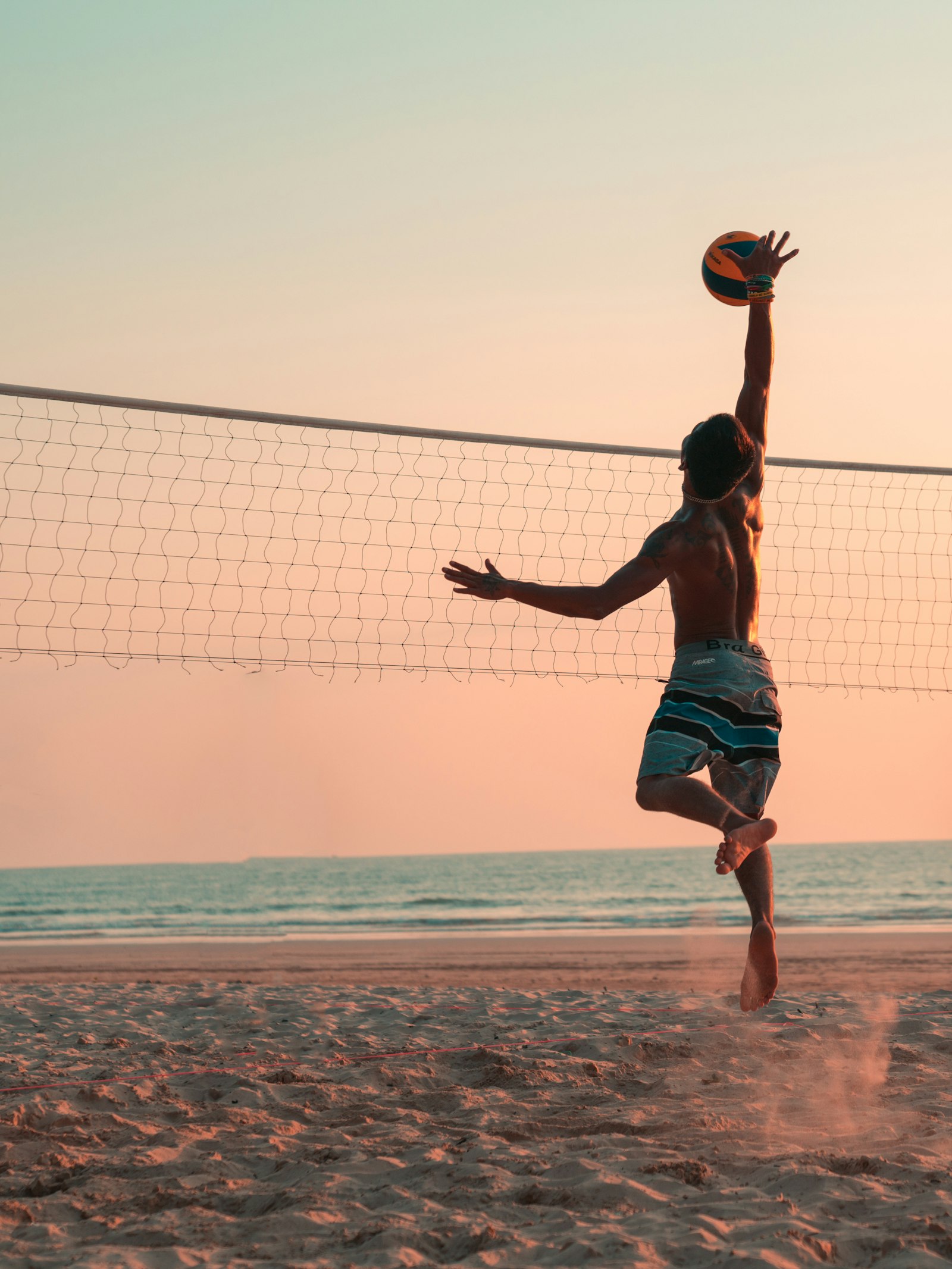
Yes — pickle juice helps volleyball players head off the calf, hamstring, and forearm cramps that hit late on tournament day. A 3 oz shot delivers 570 mg of sodium with zero sugar and triggers a vinegar-driven neural reflex that quiets cramping muscle within about 85 seconds (Miller, 2010). For indoor club, beach pairs, and AVP-style sand play, the protocol is one shot 30–60 minutes before warm-ups and a second between matches once sweat losses stack up.
Volleyball is one of the most sodium-punishing sports nobody talks about. A two-hour beach match in 90°F sun can pull 2,500 mg of sodium out of you. An indoor club tournament — four to six matches over eight hours in a hot gym — is worse, because the air is still and the breaks are short. The cramps almost always show up in the same places: the calf on push-off, the hamstring on a deep dig, the forearm on a hard pass. By set three of match four, your body is running on fumes.
This is the dosing protocol, the comparison math, and the tournament-day plan that volleyball players from juniors club through AVP qualifiers use to keep cramps off the court.
Why Volleyball Causes So Many Cramps
Most cramp advice — drink water, eat a banana, stretch — is built around running. Volleyball doesn’t look like running. But the cramp drivers are actually worse than most endurance sports, for four specific reasons:
- Long tournament days. A club tournament is rarely one match. It’s a pool of three, then a bracket of two-to-four. That’s six to ten total games of effort, often inside the same six-hour window. Sweat losses stack across the day in a way they don’t in a single 90-minute soccer game.
- Hot, still-air indoor gyms. Most club gyms are not air-conditioned for play, and the ceilings trap heat. Sweat rates inside a gym in July routinely hit 1.5 L/hr — higher than most outdoor running.
- Beach volleyball under direct sun. Sand reflects heat upward, doubling radiant load on your legs. AVP pros routinely report sodium losses over 2,500 mg per match on a hot Saturday in Manhattan Beach.
- Repeated maximal jumps and explosive lateral cuts. Volleyball is closer to a sprint sport than people realize. Hitters can jump 100+ times in a single match. Each maximal contraction is an opportunity for a fatigued, sodium-depleted muscle to lock up.
Cramping in volleyball is mostly a sodium and fatigue problem, not a hydration problem. The fix has to address sodium delivery and the neural-fatigue cramp signal — not just liquid volume. A 3 oz Fast Pickle shot does both.
The 85-Second Reflex: How Pickle Juice Actually Stops Court Cramps
The science that powers Fast Pickle for volleyball is the same neural reflex documented in Kevin Miller’s 2010 study at North Dakota State University — but the application is built for the sport’s rhythm of explosive sets.
When you drink 3 oz of pickle brine, the vinegar (acetic acid) hits sensory neurons in your throat and esophagus. Those neurons fire a signal up the vagus nerve, which then quiets the alpha-motor-neuron firing that’s driving the muscle into a locked cramp. In the original study, cramping subjects relaxed in a median of 85 seconds — faster than any volume of water or sports drink could possibly absorb.
Key point: the reflex doesn’t require the sodium to reach your bloodstream. The relief is neural, not absorptive. That’s why pickle juice works during a side-out timeout — long before any drink could be digested.
Underneath the reflex, the 570 mg of sodium in a Fast Pickle shot is also re-stocking what your sweat pulled out. That’s the second layer of cramp prevention: fix the reflex now, replace the loss for the next set.
The Five Cramp Drivers Specific to Volleyball
1. The third-set cramp (indoor club, tournament play)
This is the most common volleyball cramp story. You played a tight first set, dropped the second, and you’re running ten points into the third when your calf seizes on a left-side approach. The fatigue clock and the sodium-loss clock both ran out at the same moment. Protocol: one Fast Pickle shot at the start of warm-ups, a second between sets two and three if it’s hot.
2. The hot-gym tournament marathon
Club coaches know the math: pool play on a hot Saturday is the cramp battleground. By match four, half the team has had at least one cramp scare. The fix is preemptive, not reactive — start dosing sodium before the first match, not after the first cramp. A 12-pack covers a full tournament for one player or a pair-team for the day.
3. Beach play in direct sun
Beach is harder than indoor on the sodium front. Sand radiates heat, there’s no shade between points, and matches are usually no-timeout best-of-three with one technical break. A standard sand sweat test on a 90°F day pulls 1,200–2,500 mg sodium per match. Protocol: one shot 30 minutes before the warm-up, one in the cooler for the technical break, one for after if you have a second match in the bracket.
4. Jump-heavy positions (middles, outsides, opposites)
If your job description is “jump as high as possible 80+ times,” you’re also signing up for late-match calf and hamstring fatigue. Sodium loss compounds with eccentric load — the lengthening contraction every time you land — so middles tend to cramp earlier in the day than back-row defenders. A pre-warm-up shot blunts the curve.
5. Setter forearm and wrist cramps
Less obvious, more demoralizing. A setter who handles 200+ touches in a match can get hand, forearm, or even neck cramps as small muscles fatigue. Same fix, same protocol — the reflex doesn’t care which muscle is cramping.
Fast Pickle vs Other Sideline Options — Sodium Per Ounce
The fastest way to understand why Fast Pickle is the volleyball pick is to compare what’s in your bag. Sodium per ounce, sugar load, and onset speed are the three numbers that matter on the sideline:
| Drink | Sodium | Sugar | Onset |
|---|---|---|---|
| Fast Pickle (3 oz) | 570 mg | 0 g | ~85 sec (reflex) |
| Gatorade Thirst Quencher (20 oz) | 270 mg | 34 g | 20–30 min |
| Gatorade Endurance (20 oz) | 620 mg | 32 g | 20–30 min |
| LMNT stick (in 1 L water) | 1,000 mg | 0 g | 20–40 min |
| Liquid IV stick (in 16 oz) | 500 mg | 11 g | 20–40 min |
| Salt tabs (1 cap) | ~340 mg | 0 g | 30–45 min |
| Plain water (20 oz) | 0 mg | 0 g | n/a |
Fast Pickle wins on three numbers volleyball players care about most: highest sodium per ounce, zero sugar (no GI risk before a jump), and onset measured in seconds, not minutes. A bottle of Gatorade still has a role for replacing carbs after a long day — but it’s not the right call between sets when a cramp is already firing.
For deeper head-to-heads, see our breakdowns of pickle juice vs Gatorade, pickle juice vs Liquid IV, and pickle juice vs LMNT.
The Volleyball Day Protocol — When To Take A Shot
The single biggest mistake players make is waiting for a cramp before dosing. Cramping in volleyball is a fatigue-plus-sodium curve that you cross around match three or set three. The fix is pre-loading, not reacting.
The 5-stage tournament day
- Morning of, with breakfast. One Fast Pickle 3 oz shot alongside breakfast tops up sodium before you walk into the gym. Skip this and you start the day in a deficit.
- 30–60 minutes before first whistle. Second shot during warm-up. This is the most important dose — it puts the reflex on standby and pre-loads sodium for the first sweat.
- Between matches. One shot in the 15–30 minute break between pool matches. Sip water alongside; don’t chug a liter at once or you’ll feel sloshy.
- If a cramp fires mid-match. One shot during the next side-out, timeout, or technical break. Relief usually comes in under two minutes.
- Post-tournament. One shot with a real meal helps recovery sodium and primes you for the next day’s play.
A typical indoor club Saturday is four shots. A two-day beach finals weekend is six to ten. A 12-pack covers a player for a full tournament with shots to spare.
Tournament & Event Settings
Volleyball plays out across a handful of formats, and each one has a slightly different cramp window. Quick adjustments for each:
Club volleyball tournaments (USAV juniors, AAU)
Two days, 6–10 matches, hot gyms. The biggest mistake is no morning dose — players show up for an 8 a.m. first whistle running on a coffee and a granola bar. Lay shots out the night before so you don’t forget.
High school and college season matches
Usually one match per night, two if there’s a tournament weekend. Single-shot pre-warm-up is enough for most players. Carry one in your kit for between sets if it’s a long five-setter.
Beach pairs (AVP Tour, USAV beach, FIVB)
Hot, sandy, no subs, no timeouts beyond technical breaks. Two-shot day minimum: one pre-warm-up, one in the cooler. Add a third for a same-day bracket.
Coed leagues and grass tournaments
Often the most forgiving — shorter matches, more recovery, but easy to under-dose because the vibe is social. Still take a pre-game shot; a cramp on a coed Saturday is just as game-ending.
Practice (two-a-days, summer camp)
Summer camp two-a-days are sneaky brutal. Three to five hours of court time in a hot gym is comparable to a tournament. One shot before each session; a third with dinner if your urine’s dark.
5 Common Mistakes Volleyball Players Make With Pickle Juice
- Waiting until a cramp hits. By that point you’ve already lost the point and the cramp will keep flaring. Dose preemptively at warm-up.
- Using a giant brine bottle from the grocery store. Cooking brine isn’t formulated for performance — sodium varies wildly and there’s usually added sugar. Fast Pickle 3 oz shots are dosed for athletes and individually portioned for sideline use.
- Chasing it with a liter of water. Water dilutes the sodium you just took in. Sip 6–8 oz alongside the shot, then save the bigger drinks for the bench break.
- Replacing food. Pickle juice isn’t a meal. Long tournament days still need carbs — bagels, peanut butter sandwiches, bananas, energy chews. Pickle juice covers the sodium and reflex; food covers the fuel.
- Forgetting recovery. The shot you take after match four with your post-tournament meal is the one that lets you not cramp on Sunday morning. Recovery sodium matters as much as in-event.
Pick Your Pack
For volleyball players, the right pack depends on how much you play and whether you’re sharing with a teammate or partner:
- Fast Pickle 6-Pack ($14.99 / $2.50 per shot) — covers a one-night high school match plus a tournament Saturday for a solo player. Good entry pack.
- Fast Pickle 12-Pack ($28.99 / $2.42 per shot) — the tournament-day default. Covers a full two-day club or beach event, or a player + partner for a beach weekend.
- Fast Pickle 24-Pack — for whole teams, coaches stocking a cooler, or club programs running a summer of two-a-days.
- 3-Pack Sampler (try it free, $4.99 shipping) — if you’ve never used pickle juice before, this is the no-risk way to try it before a tournament weekend.
Volleyball Cramps FAQ
Does pickle juice work for beach volleyball cramps?
Yes — beach play, if anything, has a stronger cramp signal than indoor because of sand-reflected heat and no substitutions. Use the same protocol: one shot pre-warm-up, one in the cooler for technical breaks, one between matches.
How fast does pickle juice work during a volleyball match?
The neural reflex from a 3 oz shot starts to quiet cramping muscle within about 85 seconds, based on the Miller 2010 study. In practice that means you can dose at a side-out and be back at full effort by the next serve.
How much pickle juice should a volleyball player drink during a tournament?
For an indoor club Saturday with 4–6 matches, plan on 3–4 shots across the day. For a two-day beach event, 5–8 shots total. A 12-pack covers a full tournament with shots to spare.
Will it cause stomach issues during a match?
For most players, no. A 3 oz shot has zero sugar and under 1 g of carbs, so there’s nothing to ferment. If you’re new to it, try the 3-Pack Sampler at practice first so you know how your stomach reacts before a tournament.
Is it better than salt tablets for volleyball?
For mid-match cramping, yes — the vinegar reflex from a shot kicks in seconds faster than salt absorbed through the stomach. Salt tabs can still play a role for slow background sodium between matches, but the shot is the in-event tool.
What about hyponatremia from overhydration on a hot beach day?
This is real. Drinking a gallon of plain water during a hot tournament can drop blood sodium dangerously low. Fast Pickle’s 570 mg per shot is concentrated specifically to push more sodium into a fluid plan, which is what hot-day pairs need.
Can my middle-school or high-school player use this?
Yes — it’s just pickle brine with sea salt and vinegar, no stimulants, no caffeine, no artificial dyes. Many club programs stock it in team coolers. The 12-pack is the most common team purchase.
Does it work for setter forearm or hand cramps?
Yes. The reflex isn’t muscle-specific — it quiets alpha-motor neuron firing wherever the cramp is. Setters who handle 200+ touches in a match report the same fast relief as hitters with calf cramps.
Where can I read more about how pickle juice works for athletes?
Start with our deep-dive on how pickle juice stops muscle cramps, or see the sport-specific guides for pickleball, tennis, and basketball — all racket-and-court sports with overlapping cramp profiles.
*These statements have not been evaluated by the FDA. Fast Pickle is not intended to diagnose, treat, cure, or prevent any disease. Individual results may vary. Consult your physician before changing your hydration or sodium plan, especially if you have high blood pressure or kidney disease.