
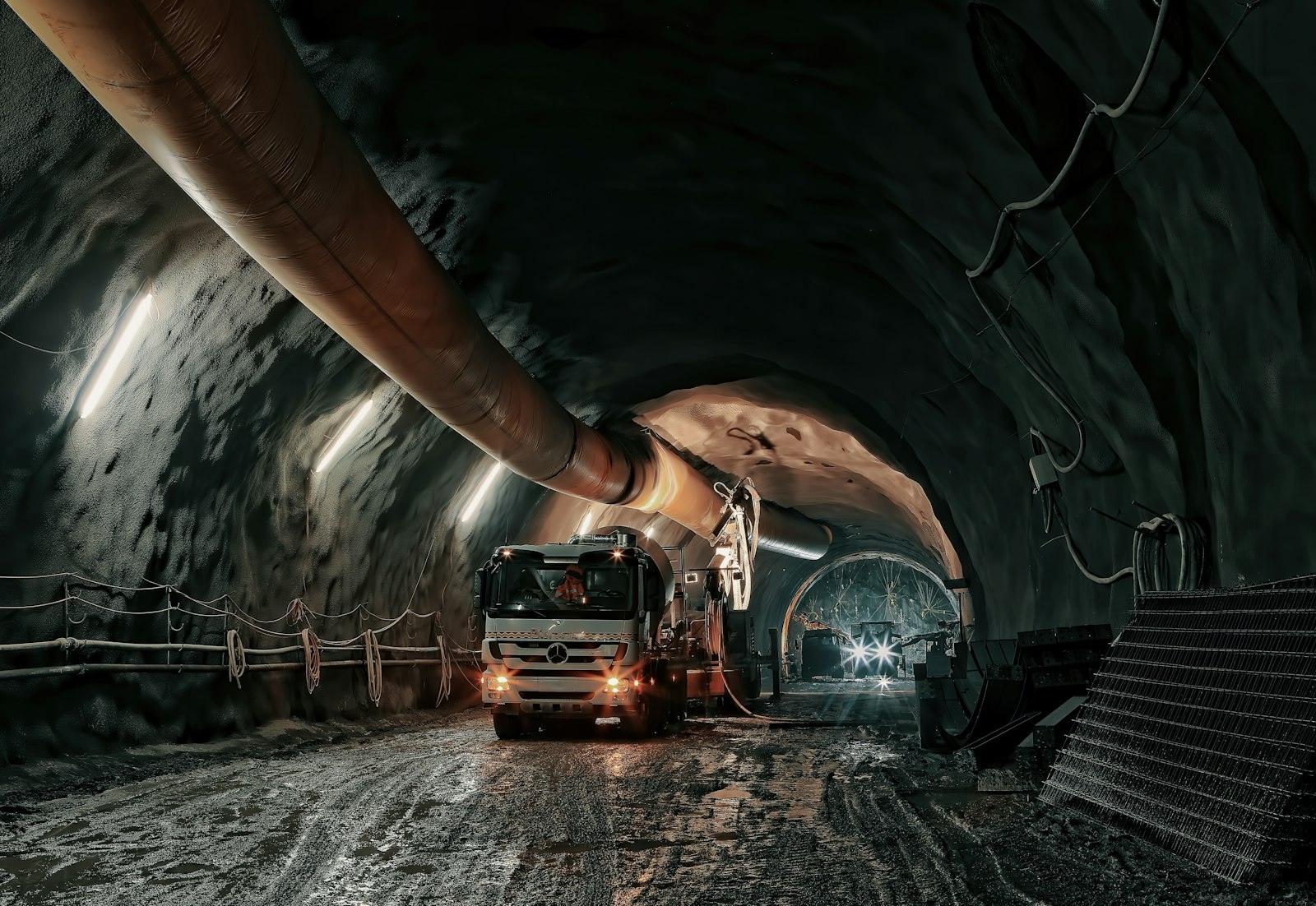
Tunnel workers cramp because the heat underground comes out of the rock and the equipment, not out of the weather, and because the air at the heading is close to saturated. When relative humidity approaches 100%, sweat stops evaporating, which means it stops cooling you, so the body keeps pouring out fluid and sodium for almost no return. A crew ten hours into a heading shift can be several thousand milligrams of sodium down with nothing but water going back in. A 3 oz pickle brine shot carries 570 mg of sodium and triggers a reflex in the mouth and throat that releases a cramping muscle in roughly 85 seconds, which is why a shot in the shirt pocket beats a jug of water sitting back at the portal.
Every trade in this series fights heat. Tunnel crews fight a version of it that most heat-safety material does not describe, because almost all of that material starts with a weather forecast.
Underground, the forecast is irrelevant. It can be 45°F and raining at the portal and 95°F at the face, and it will be the same 95°F at the face in January. The heat is coming out of the ground, out of the diesel, out of the cutterhead, and out of the concrete curing behind you. The only thing standing between that heat and the crew is ventilation.
And when the vent line is stretched thin at the end of a long drive, the thing that gives out first is not the equipment. It is the hands on the shift before yours.
The Heat Comes From The Rock, Not The Forecast
Rock gets hotter as you go deeper. That is the geothermal gradient, and it is not a small effect at tunneling depths.
Research on deep underground construction has documented surrounding rock above 40°C, roughly 104°F, once depth passes about 1,000 meters, with air temperature near 36°C, about 97°F, and relative humidity approaching 100%. On the Gotthard Base Tunnel, rock temperatures near 40°C forced the contractor to pipe chilled water many kilometers in from the portal to feed air conditioning at the working areas, with the heat carried back out to cooling towers at the surface. For ordinary maintenance work in that tunnel, the operating limit is 35°C and 70% relative humidity across a seven-hour shift.
Most North American work is shallower than that, and most crews are not in a 40°C heading. But the principle holds at every depth, and the rock is only part of the load. The rest of it you bring with you:
- Diesel. Loaders, haul trucks, and locomotives dump the large majority of their fuel energy into the air around you as heat, in a space with one way in and one way out.
- The machine. A TBM cutterhead grinding rock converts that work into heat directly at the face, along with hydraulics, motors, and the conveyor running behind it.
- Concrete and grout. Shotcrete and cast-in-place linings generate heat as they cure. A freshly shot arch is warming the air the crew is standing in.
- Water. Groundwater inflow is frequently warm, and when it hits the invert it evaporates into air that has nowhere to put the moisture.
- Lighting and compressors. Small individually, constant collectively, and never off.
OSHA's underground construction rules recognize the equipment side of this directly. Under the compressed air provisions in 29 CFR 1926 Subpart S, the temperature in working chambers under air pressure has to be held at or below 85°F using after-coolers or other suitable devices, and whenever heat-producing machines such as moles or shields are used in compressed air tunnel work, the employer has to provide a positive means of removing the heat build-up at the heading.
Read that last clause again. The regulation assumes the heading will build up heat unless somebody actively removes it. That is the job.
Why Near-Saturated Air Breaks Your Cooling System
This is the part that separates a tunnel from a hot parking lot at the same temperature, and it is the reason experienced hands say the heat down there feels different.
Sweat does not cool you. Sweat evaporating cools you. The phase change from liquid to vapor pulls a large amount of heat off the skin, and that transfer is driven by the difference in water vapor pressure between your wet skin and the surrounding air. When the air is dry, that gradient is steep and evaporation is fast. As humidity climbs, the gradient flattens. The maximum evaporative capacity of the environment drops, and so does sweating efficiency, meaning a larger share of what you produce simply runs off you instead of taking heat with it.
At the face of a wet heading, you are working in air that is close to saturated. The practical consequences stack up fast:
- You sweat more, not less. Core temperature keeps rising, so the body keeps signaling for more sweat, and it keeps failing to cool you. The fluid and sodium leave anyway.
- You cannot tell how much you have lost. Above ground, a salt-crusted shirt is a gauge. In a tunnel you are wet from the moment you walk in, from groundwater, from the mist off shotcrete, from condensation. Soaked stops meaning anything.
- Your gear finishes the job. Rain gear, rubber boots, gloves, a hard hat, hearing protection, and a respirator in dusty ground all block the skin surface that had any chance of evaporating.
- Thirst lags. Thirst is a poor real-time gauge of fluid balance under heavy work, and it is a worse one when you are already wet and cannot feel yourself sweating.
So the crew loses the two signals that normally tell a worker to drink, and loses them in the environment where the losses are highest.
The Sweat Math On A Heading Shift
Sweat is not just water. It carries sodium, and the amount varies a lot between individuals.
Sweat sodium concentration in working adults commonly falls between roughly 400 and 1,800 mg per liter. The people at the high end are the ones whose hard hat suspension goes white and whose shirts dry stiff. Sweat rate under sustained moderate-to-heavy work in warm conditions commonly runs between about 0.5 and 1.5 liters per hour, and heavy work in hot, humid, still air sits at the top of that range.
Put that against a real shift:
- A moderate sweater at 0.8 L/hr is losing roughly 500 to 900 mg of sodium every hour.
- A heavy, salty sweater at 1.2 L/hr in a hot heading can clear 1,500 to 2,000 mg per hour.
- Across a ten or twelve-hour shift, with a long ride in and a long ride out on either end, the total runs into several thousand milligrams.
Now look at what goes back in. Tunnel work has a structural replacement problem that has nothing to do with anyone being careless about hydration:
- Water is at the portal, or on the man car, or wherever the last resupply left it. The heading is where you are.
- Walking back is not a two-minute trip on a long drive. It can be a serious chunk of a shift.
- There is no clean, dry place to set anything down at the face.
- Bathroom logistics underground discourage drinking, and every crew knows it.
So the common pattern is very little for hours, then a large volume of plain water at lunch or at the end of the shift. Plain water replaces the volume and none of the sodium. Taken in quantity on top of a large sodium deficit, it dilutes what is left, which is the opposite of the direction you need to move.
That is the shape of the cramp that shows up in week three of a drive rather than on day one. It is not one bad shift. It is a running deficit that finally gets called, usually during the hardest task of the day, usually with your hands on something.
What Pickle Brine Actually Does
There are two separate things happening here, and running them together is how this subject gets oversold.
The fast one is a reflex. In 2010, Kevin Miller and colleagues published a study in Medicine & Science in Sports & Exercise in which cramps were induced electrically and then treated. Cramps resolved in roughly 85 seconds with pickle juice, about 37% faster than with water. The critical detail is the timing: relief arrived far too quickly for any of the sodium to have been absorbed and delivered to the muscle. Blood electrolyte levels had not meaningfully changed.
The accepted explanation is that the acetic acid and the sharp taste stimulate receptors in the mouth and throat, and that signal travels up and dampens the runaway motor neuron firing that is holding the muscle locked. The brine is not fixing the muscle. It is interrupting the signal telling the muscle to stay clenched.
That is why the shot works at the heading, where nothing else does. You do not need to get anywhere. You do not need to wait on absorption. You take it standing where you are.
The slow one is replacement. Separately from the reflex, each 3 oz shot carries 570 mg of sodium, which addresses the deficit that made the muscle twitchy in the first place. This part works on ordinary digestive timelines, the same as any other sodium source.
Both things are worth having. They are not the same thing, and the honest version is that the reflex is the emergency tool and the sodium is the daily one.
Why Not Just Keep Sports Drinks At The Portal
Because the numbers do not work, and because the logistics are worse than the numbers.
A standard 20 oz sports drink carries on the order of 270 mg of sodium, along with a large dose of sugar. A crew losing 1,500 mg an hour would need several of them per hour to keep pace, and nobody is drinking six sugary bottles at a heading. The sugar load alone is a problem on a twelve-hour shift.
Then there is the physical reality of the space. A case of bottles has to be carried in, kept somewhere, and carried back out. A 32 oz glass jar of pickles, which is the old-school version of this fix that plenty of hands have used, has no business anywhere near a heading. A sealed 3 oz shot fits in a shirt pocket under your rain gear, rides in without ceremony, needs no ice, and is the same known dose every single time. Jar brine varies widely between brands and batches because it is formulated for flavor, not for this.
Salt tablets are the other traditional answer, and they have a real drawback: dropping concentrated salt into an empty stomach is a common way to end up nauseated, and nausea underground on a long shift is its own hazard.
The Heading Protocol
Before you go down
Start the shift already topped up. Salt your food at the meal before the shift rather than relying on catching up later. If you are a heavy, salty sweater, treat that as a known fact about yourself and plan for it instead of finding out at hour nine.
Carry it in, on your body
Whatever your plan is, it has to survive the trip to the face. A shot in a chest pocket goes where you go. Anything staged at the portal is not part of your plan, it is a wish.
Drink on a schedule, not on thirst
Thirst is unreliable in the heat and it is worse when you are already soaked. Set an interval you can actually hold to given the work, and take fluid on that interval whether or not you want it.
The moment a cramp starts
Take the shot at the first twitch, not after the muscle has been locked for five minutes. The whole advantage of the reflex is speed, and you get the most out of it early. Stop the task, take the shot, let the muscle release, then gently stretch it. Do not power through a cramping forearm on a piece of equipment.
Long drives and doubles
On a heavy schedule with back-to-back shifts, the deficit accumulates across days. This is where a steady daily sodium habit matters more than anything you do in the moment, and it is the argument for a 12-pack in the gang box rather than one shot in a pocket.
Coming out
The ride out and the shower are not the end of the fluid problem. A significant share of nighttime cramps in heavy trades land hours after the shift, in bed. Replacing sodium before you sleep is the cheapest way to avoid being woken up by your own calf.
What Not To Do
- Do not drink a large volume of plain water fast to catch up. On top of a big sodium deficit that makes the dilution worse, not better.
- Do not rely on feeling wet as a gauge. Underground you are wet regardless. It tells you nothing about what you have lost.
- Do not treat the first cramp of the shift as the baseline. A cramp at hour four on a job you have done for years is information about the whole shift ahead of you.
- Do not stretch through a locked muscle aggressively. Cramped muscle tears. Release it first.
- Do not assume acclimatization carries over. Coming back from a week off, or moving from surface work to a hot heading, resets you. The first several shifts are the highest risk.
When It Is Not Just A Cramp
Muscle cramps are unpleasant and they are usually just cramps. Heat illness is a different thing, and it kills people.
Get the worker out of the heat and get medical help if you see confusion, slurred speech, stumbling, a stopping of sweating, skin that has gone hot and dry, vomiting, fainting, or a headache with nausea. Underground, treat any of those as an emergency immediately, because your evacuation time is long and the environment offers no relief while you wait.
Cramping that will not release, dark urine that does not clear with fluids, or muscle pain and weakness out of proportion to the work also deserve a medical evaluation rather than another shot and another shift.
A pickle shot is for a muscle cramp. It is not a treatment for heat exhaustion or heat stroke, and nothing in a bottle substitutes for getting a person cooled down and evaluated.
Common Questions
How fast does it actually work?
In the controlled study, electrically induced cramps resolved in roughly 85 seconds, about 37% faster than with water. In the field, most people describe the grip letting go inside the first minute or two. Taking it at the first twitch works better than taking it once the muscle has been locked for several minutes.
Does it need to stay cold?
No. It travels at room temperature, which is most of why it fits this job. A sealed 3 oz shot rides in a pocket to the face and works when you open it. There is no cooler to maintain and nothing to melt.
Why do my hands and forearms cramp instead of my legs?
Because cramps land in the muscle that is fatigued and working. If your day is grip work on a drill, on tools, on rebar, or on a hose, the small muscles of the hand and forearm are doing repeated near-maximal work, and that is where it shows up. It does not mean the cause is different.
Is the humidity really the problem, or is it the temperature?
Both, and they multiply. The same air temperature is far more dangerous when the humidity is high, because evaporation is what actually removes heat from you. That is why a 90°F heading with saturated air is harder work than a 100°F day in dry air on the surface.
Can I just drink brine out of a pickle jar?
You can, and hands have for decades. The problem is consistency and practicality. Jar brine varies widely in sodium and acidity between brands and batches because it is built for flavor, and a glass jar does not belong underground. A 3 oz shot with a known 570 mg is the same dose every time.
Will it help with cramps that wake me up at night?
A lot of workers in heavy trades report that it does, and the same reflex is the likely reason. Nighttime cramps following a hot shift are extremely common. Keeping a shot on the nightstand is a normal use of it.
Is 570 mg of sodium a problem?
570 mg is roughly a quarter of general daily guidance, taken by somebody who just sweated out several times that amount. For a healthy person doing heavy work in heat, that is replacement. If you are on a sodium-restricted diet, or you are managing blood pressure, kidney issues, or heart failure, check with your doctor first.
6-pack or 12-pack for a tunnel crew?
For one person testing it, the 6-pack is the cheaper way to find out. For a crew, a heading, or a gang box that has to cover multiple shifts on a long drive, the 12-pack is the right call at $2.42 per shot. Resupply underground is the hard part, so carry more than one shift's worth.
The Short Version
The heat in a tunnel does not come from the weather, so watching the forecast tells you nothing. It comes out of the rock, the diesel, the machine, and the curing concrete, and it is trapped in air that is close to saturated.
Near-saturated air breaks evaporative cooling, which means the sweat keeps coming and the cooling does not. Sodium leaves at 500 to 2,000 mg an hour, replacement underground is structurally difficult, and the deficit builds across a drive until a muscle finally locks.
A 3 oz shot carries 570 mg of sodium against the deficit, and the acetic acid trips a reflex that releases a cramping muscle in about 85 seconds without waiting on absorption. It fits in a pocket, it needs no ice, and it works where you are standing.