
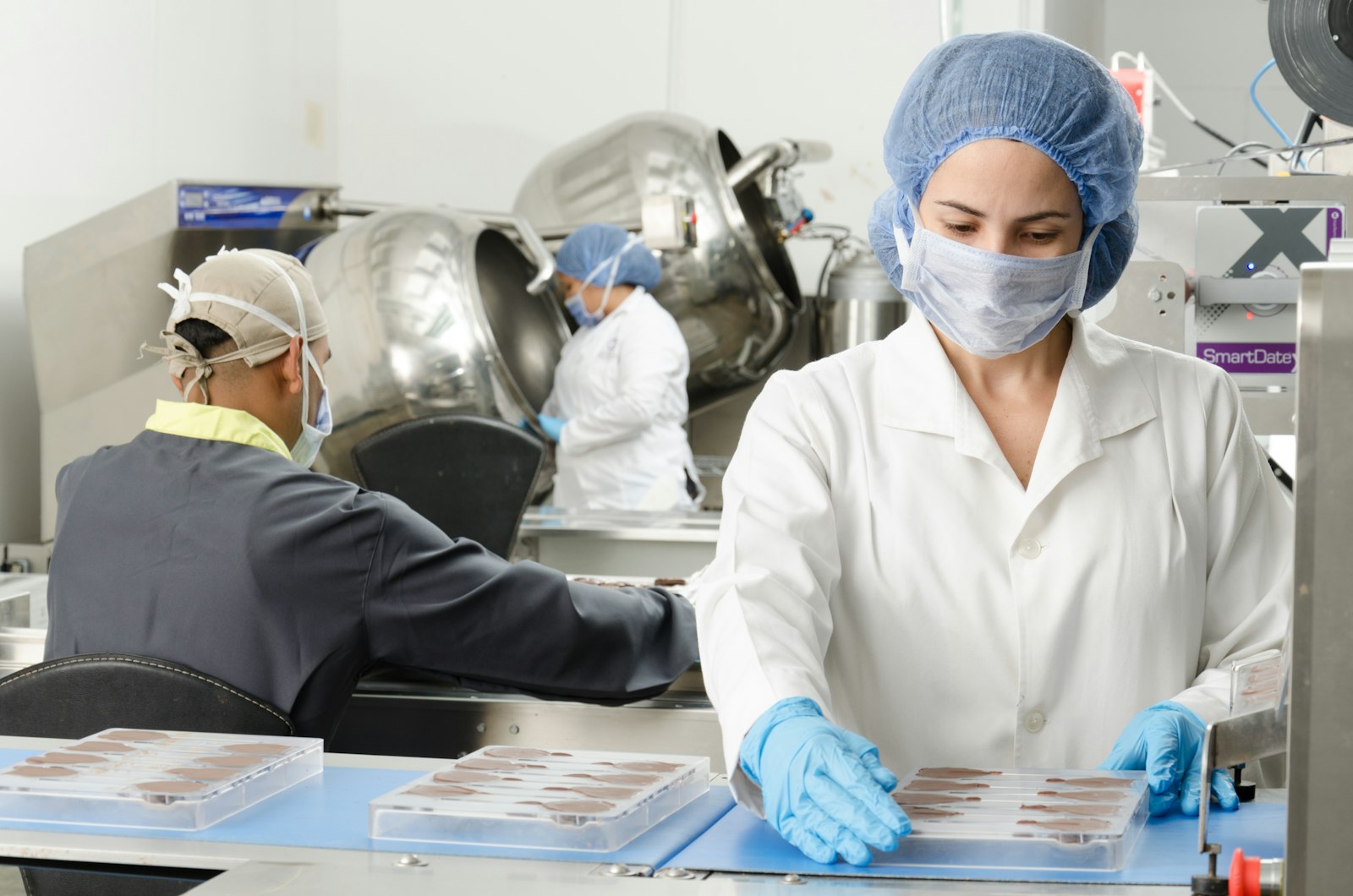
Yes — meatpacking and meat processing workers lose real sodium even on a 34°F cutting floor, because insulated coveralls and rubber gear trap sweat instead of letting it evaporate, and most shifts also include stretches in the rendering room, the loading dock, or a hot-water sanitation wash-down where OSHA's own heat inspection program specifically targets meat plants. A 3 oz Fast Pickle shot carries 570 mg of sodium, more per ounce than a sports drink from the break room cooler, in a format that fits in a coverall pocket and takes about eight seconds on a fixed line break.
Tell someone you work in a meatpacking plant and they picture one temperature: cold. The cutting floor runs in the mid-30s, the coolers are colder still, and new hires are handed an insulated coverall before they're handed a knife. That picture is accurate, and it's also the reason the heat problem in this industry gets missed. A body working hard inside insulated gear still produces sweat — it just doesn't evaporate the way it would in a T-shirt, so it soaks into a base layer instead of cooling anyone down. And a meatpacking shift is rarely spent entirely on the cold side of the plant.
A Cold Room Doesn't Mean a Cold Body
Sweat cools you down through evaporation. Trap the sweat under a rubber apron, an insulated coverall, cut-resistant sleeves, and rubber boots, and that cooling mechanism mostly stops working — the moisture has nowhere to go. Add the actual physical work: repetitive knife strokes at production-line pace, lifting and repositioning carcasses or boxed product, standing for a full shift on a wet floor, and the body is generating heat internally that the cold room air can only partially pull away.
This is a known category of exposure. Occupational health researchers describe it as effort-driven heat strain, and it shows up in refrigerated environments across food processing, not just meatpacking — anywhere workers are bundled in insulating layers and moving at a set pace. The room thermometer reads cold. The body underneath the gear does not necessarily agree.
Where the Heat Actually Lives in a "Cold" Plant
No meatpacking shift stays on the cutting floor the whole time, and the areas outside it are where the real heat shows up. OSHA's National Emphasis Program on heat, which covers both outdoor and indoor work, explicitly lists meat processing among its enforcement targets — and not just the refrigerated production areas. The program calls out rendering operations, maintenance areas, loading docks, warehouses, and live-animal handling as the specific hot zones inspectors are watching. Rendering in particular runs hot by design: it's a cooking process, running large volumes of animal byproduct through heated equipment, often in a building with limited airflow.
Sanitation crews carry their own version of the same problem. Overnight cleaning in a meat plant means breaking down blood, fat, and grease with hot water and steam lines, in a room that was built to stay cold during the day shift and was never designed with a sanitation crew's heat load in mind. The people running that hose are working in rising humidity and rising temperature inside a room with a cold-storage reputation.
Since 2023, OSHA has ramped up heat-related inspections industry-wide from roughly 200 a year to about 2,400 a year under the renewed heat program, and meat and poultry facilities remain a named target regardless of which administration is in office, according to workplace safety attorneys tracking the enforcement pattern. That's not a sign the industry is uniquely hot. It's a sign regulators have caught up to something workers on rendering and sanitation crews already knew.
The Line Doesn't Wait for a Water Break
A meatpacking floor runs on the belt, not on how anyone feels. A federal watchdog report on meat and poultry worker safety found that in April 2020, USDA approved line-speed waivers letting 15 poultry plants increase from 140 birds a minute to 175 — a 25% jump in pace for the same crew size. Workers interviewed for that same report described standing with less than two feet between each person while keeping up with a fixed production quota. Injury and illness rates for meat and poultry workers have stayed higher than the rate for all manufacturing workers, according to the same federal review.
On a line moving that fast, hydration happens on the clock's schedule, not the body's. You drink on the fixed break, or you don't drink until the next one. That structure is exactly why a shot that works in seconds, not minutes, matters more here than a sports bottle meant to be sipped over an hour you don't have.
Sodium Per Ounce: What Fits In A Break
| What you drink | Typical serving | Sodium | Sodium per oz |
|---|---|---|---|
| Water | 20 oz | 0 mg | 0 mg |
| Coconut water | 11 oz | 60 mg | about 5 mg |
| Powerade | 20 oz | 250 mg | about 13 mg |
| Gatorade Thirst Quencher | 20 oz | 270 mg | about 14 mg |
| Pedialyte | 12 oz | 370 mg | about 31 mg |
| Liquid I.V. stick in water | 16 oz | 500 mg | about 31 mg |
| LMNT stick in water | 16 oz | 1,000 mg | about 63 mg |
| Fast Pickle 3 oz shot | 3 oz | 570 mg | 190 mg |
The per-ounce column is the one that matters when your break is fixed and short. A 3 oz shot carrying 570 mg of sodium holds more sodium than a full 20 oz sports drink, in roughly a sixth of the volume, and it's gone in about eight seconds — no bottle to recap, no cup to carry back onto a wet floor.
Why 3 oz Works on a Reflex, Not on Absorption
The math looks suspicious at first. If a shift under insulated gear costs you thousands of milligrams of sodium, how does 570 mg in one shot matter? It matters because of what it's doing, not how much of it there is.
In Miller et al. 2010, published in Medicine & Science in Sports & Exercise, researchers electrically induced muscle cramps in dehydrated subjects and found that a concentrated hypertonic saline solution eased the induced cramping in about 85 seconds — roughly 37% faster than plain water, and well before the sodium could have been absorbed into the bloodstream. The leading explanation is a neural reflex: concentrated sodium hitting receptors in the mouth and throat appears to interrupt the misfiring nerve signal that's driving the cramp, independent of the slower process of gut absorption. That reflex is why a small, concentrated shot can act fast even though it can't fully restock what a heavy shift already cost you.
How Much Sodium Does a Meatpacking Shift Actually Cost You?
Sweat sodium concentration varies by person, but a review of sweat studies across roughly 500 people puts the range at 460 to 1,840 mg per liter, with a mean around 826 mg per liter. Layer that onto a shift that mixes a cold cutting floor with hot stretches in rendering, the dock, or sanitation, and the totals add up fast:
- 1 liter of sweat, a full shift working hard in insulated gear on the cutting floor alone: 460 to 1,840 mg of sodium out.
- 2 liters of sweat, adding a rotation through rendering or the loading dock during a summer week: 920 to 3,680 mg of sodium out.
- 3 liters of sweat, an overnight sanitation shift running hot water and steam lines start to finish: 1,380 to 5,520 mg of sodium out.
No 3 oz shot closes a gap that size, and this page won't pretend one does. Closing it takes salt at meals, sodium in what you drink through the whole shift, and enough food before you clock in. What the shot is for is the specific moment a calf, hand, or forearm locks up mid-shift, when the fastest documented response plus 570 mg back in the tank is worth more than a slower fix you don't have time for.
Frequently Asked Questions
Does working in a cold room really cause heat stress?
It can, and occupational health researchers have a name for it: effort-driven heat strain. Insulated PPE traps the sweat that would normally evaporate and cool you down, and hard physical work at production-line pace keeps generating heat the room air can't fully carry away. The thermometer on the wall doesn't measure what's happening under the coverall.
If the cutting floor is cold, why would I need electrolytes at all?
Because most meatpacking shifts aren't spent entirely on the cutting floor. Rendering, loading docks, warehouses, and sanitation wash-downs run genuinely hot, and OSHA's heat program names all of them as inspection targets inside meat plants specifically. Add the sweat you're already producing under insulated gear on the cold side, and the sodium losses stack up across a full shift either way.
Is this a substitute for water on the job?
No. Water handles ongoing hydration across a shift. A Fast Pickle shot is for the specific moment a muscle locks up and you need the fastest documented response available, in a size that survives a coverall pocket through a wet, cold shift.
Which pack size makes sense for a crew or a full week of shifts?
The 12-pack is built for a full work week or a small crew sharing a case in the break room. The 6-pack is a reasonable way to try it before committing a crew order to it.
Does it need refrigeration, or will it survive a locker?
It ships and stores shelf-stable at room temperature, which matters when your break-room storage is a shared locker or a bag, not a fridge.
Is there anyone who shouldn't add extra sodium to their routine?
If you're on a sodium-restricted diet for blood pressure or kidney reasons, talk to your doctor before adding any sodium product to your routine. For most people doing hard physical work in a food processing plant, 570 mg in a single shot is a small fraction of daily intake.
The Short Version
A meatpacking plant looks cold from the outside, and the cutting floor genuinely is. What that picture leaves out is insulated gear that traps sweat instead of releasing it, a production line that sets the pace instead of the worker, and rendering rooms, loading docks, and sanitation shifts that run hot enough for OSHA to name them specifically in its heat enforcement program.
A 3 oz Fast Pickle shot carries 570 mg of sodium — more per ounce than anything in the break room cooler — in a shelf-stable format built for a fixed, short break. Load sodium through the shift, and keep a shot within reach for the moment a cramp shows up mid-cut rather than at a convenient time.
Related reads: pickle juice for data center technicians, which covers the same cold-building, hot-zone split in a different industry, and pickle juice for warehouse workers, which covers end-of-shift cramping in another cold-and-hot industrial setting.
*These statements have not been evaluated by the Food and Drug Administration. This product is not intended to diagnose, treat, cure, or prevent any disease. Individual results may vary.