
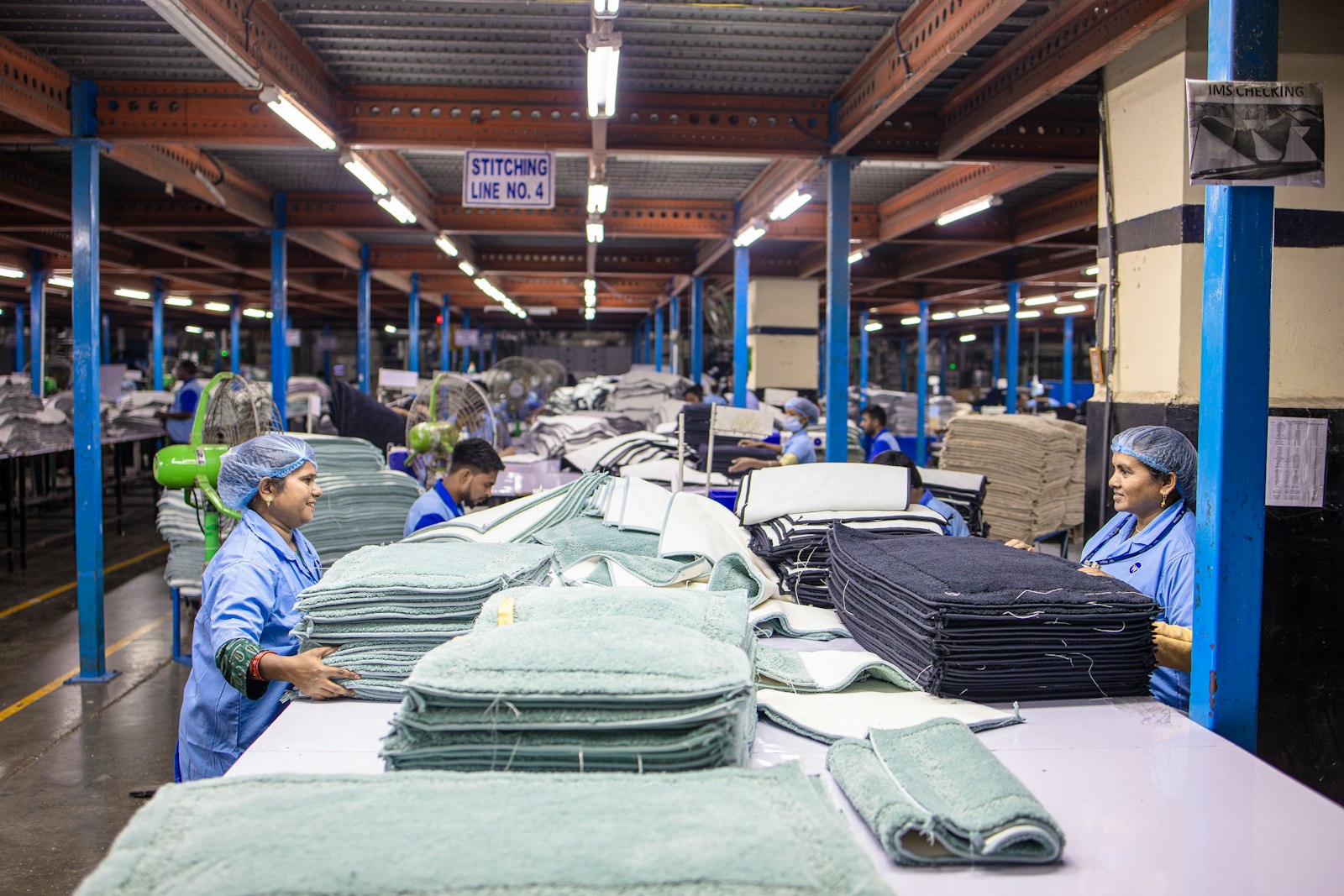
Commercial laundry workers cramp because the plant runs its own heat season, and that season never ends. Flatwork ironers hold surface temperatures in the 300 to 350°F range and tunnel dryers vent hot, wet air straight into an enclosed room, so a laundry floor can be punishing in January as easily as July. OSHA lists laundry services among the 55 high-risk industries in its heat National Emphasis Program, and its laundry guidance tells employers in plain language to educate workers to replace the fluids and salt lost through perspiration. A 3 oz Fast Pickle shot carries 570 mg of sodium and triggers a nerve reflex that quiets cramp signaling in roughly 85 seconds, which is faster than any sports drink can absorb.
Ask anyone who has run a feeder station on an ironer line what the hardest part of the job is and nobody mentions the season. They mention hour six. They mention the towel that comes off the roll hot enough to make you flinch. They mention the cramp that shows up in the forearm or the calf right when the load count is climbing and there is nobody to tap in.
This article covers why the cramp pattern inside a commercial laundry behaves differently from an outdoor trade, what the sodium math actually looks like across a ten-hour shift, and why a 3 oz brine shot fits a plant where a cooler cannot follow you to the feeder.
A Heat Season That Never Ends
Every heat article written for the trades assumes the same thing: that heat is weather, and that weather goes away. A roofer gets October. A paving crew gets November. A laundry plant gets nothing, because the heat on the floor is not coming from the sky. It is coming from the equipment, and the equipment runs every shift of every month.
That single fact reorganizes the entire problem. Outdoor trades manage heat seasonally: they acclimatize in spring, peak in August, and stand down in the fall. A laundry plant has no off-season to recover in and no forecast to plan around. The hot day is Tuesday, and so is the next one.
Regulators have caught up to this. OSHA's updated National Emphasis Program on outdoor and indoor heat hazards uses Bureau of Labor Statistics data to direct inspection priorities toward 55 high-risk industries, and laundry services is on that list. General guidance holds that a workplace above 70°F can present a heat hazard once the workload is moderate or heavier, and 82°F indoors is the point at which employers are expected to be actively protecting workers. Most production floors clear both numbers before the first break.
Where the Heat Actually Comes From
A commercial laundry is not one environment. It is a series of stations with very different heat loads, and one worker can rotate through several of them in a shift.
The ironer line. This is the hottest place a person stands all day. Industrial flatwork ironers operate with chest and roll surfaces commonly run between 300 and 350°F, because anything cooler will not dry and finish the linen at line speed. Feeders and folders work within arm's reach of that surface for hours, taking radiant heat continuously from one side.
Washers, presses, and tunnel dryers. Tunnel washers move heavy loads through high-temperature wash cycles, and the dryers behind them exhaust hot, humid air. In plants where that exhaust is not fully ducted out, the room itself becomes the heat sink. Humidity is the part people underestimate: as moisture load climbs, sweat stops evaporating, and sweat that does not evaporate does not cool you.
Soil sort. Gowns, cut-resistant gloves, sleeves, aprons, and in healthcare linen operations sometimes respiratory protection. Every layer is another barrier between your skin and the air. Sort work is often the station with the least airflow and the most PPE at the same time.
Finish and pack. Cooler ambient air, but the product itself is hot. Stacking and wrapping warm linen for hours is a low-grade, continuous heat exposure that never registers as dramatic and still adds to the day's total.
The practical result is that a hydration plan built on the thermostat in the office will systematically under-deliver, because the office is not where the heat is.
Why Water Alone Leaves You Cramping
The default answer on most floors is a water cooler and a reminder to use it. Water is necessary. It is also incomplete, and OSHA says so directly. Its laundry heat stress guidance lists, among recognized work practices, educating employees to recognize the need to replace fluids and salt lost through perspiration. Salt is in the guidance because sweat is salty, and replacing only the water half of what you lost moves you toward dilution rather than recovery.
Two other items in that same OSHA guidance matter more in laundry than people expect. The first is acclimatization: the body needs up to two weeks of graduated exposure to build heat tolerance. Laundry is a high-turnover industry, which means a meaningful share of any given shift is made up of people who have not completed that adaptation and are working the hottest stations anyway. The second is caffeine. OSHA advises against caffeine in hot work environments, which puts the 5 a.m. energy drink on the wrong side of the ledger for a first-shift plant that starts before dawn.
The Sodium Math on a Ten-Hour Shift
Sweat rates in moderate to heavy indoor work commonly land between roughly half a liter and a liter and a half per hour. Sweat sodium concentration varies widely between individuals, with typical figures spanning several hundred to well over a thousand milligrams per liter. Put conservative numbers on the ironer line and you land somewhere around 600 to 1,200 mg of sodium lost per hour.
Run that across a ten-hour shift with overtime and you are looking at several grams of sodium out the door. A water-only plan replaces exactly none of it. That gap is the reason the cramp shows up in hour six or seven rather than hour one: it is cumulative, and it does not care how much water you drank.
The other half of the problem is format. Whatever you use has to survive a wet concrete floor, a bin-fed workstation, gloved hands, and a break clock measured in minutes. A 3 oz shot takes about four seconds and needs no bottle, no mixing, and no clean water source.
Sodium Per Ounce: What Is Actually in the Break Room
Total sodium on a label is only half the story. What matters on a production floor is how much sodium you get per ounce you have to swallow, because the constraint is time and volume, not shelf space.
| Option | Serving | Sodium | Sodium per oz | Added sugar |
|---|---|---|---|---|
| Fast Pickle 3 oz shot | 3 oz | 570 mg | 190 mg | 0 g |
| LMNT (mixed) | 16 oz | 1,000 mg | 63 mg | 0 g |
| Liquid I.V. (mixed) | 16 oz | 500 mg | 31 mg | 11 g |
| Gatorade Thirst Quencher | 20 oz | 270 mg | 14 mg | 34 g |
| Water | 16 oz | 0 mg | 0 mg | 0 g |
A 3 oz shot carries more than twice the sodium of a 20 oz bottle of Gatorade in one-seventh the volume. On a floor where your break is short and your hands are full, density is the whole argument.
The Neural Reflex Behind a 3 oz Shot
The reason a small volume of brine works faster than a large volume of sports drink has nothing to do with absorption. It is a nerve response, and it was measured directly.
In a 2010 study published in Medicine & Science in Sports & Exercise, Miller and colleagues induced cramps in hypohydrated subjects and compared pickle juice against deionized water. Cramp duration after pickle juice averaged 84.6 seconds, compared with 133.7 seconds after water. Critically, the researchers concluded the effect could not be explained by restored fluids or electrolytes, because the timeline was far too short for the sodium to have been absorbed and distributed.
What they proposed instead was a reflex originating in the oropharyngeal region, the back of the mouth and throat, triggered by the acetic acid in the vinegar. That reflex reduces firing in the alpha motor neuron pool serving the cramping muscle. In plain terms: the sour hit at the back of your throat tells the overfiring nerve to settle down. The sodium arriving behind it addresses the underlying deficit on a slower clock.
That two-stage behavior is why format matters more than volume. You do not need to drink a liter to get the reflex. You need the brine to reach the back of your throat. A 3 oz Fast Pickle shot is built for that: small enough to ride in an apron pocket, fast enough to take without leaving the line for long, and carrying 570 mg of sodium behind the reflex.
What Does Not Work on the Plant Floor
Water alone. Addresses volume, not sodium. Drinking heavily from a water-only source while losing most of a gram of sodium every hour pushes you toward dilution, which is its own problem on a long shift.
Sugary sports drinks. A 20 oz bottle delivers 14 mg of sodium per ounce and 34 g of added sugar. You are drinking a lot of volume and a lot of sugar for very little of the mineral you actually lost.
Salt tablets. Tablets deliver sodium and nothing else, they are rough on an empty stomach, and they do nothing for the reflex that shortens an active cramp. They also require water you may not have within reach.
Powder sticks. Fine at a desk. On a plant floor they need a clean bottle, a clean water source, and 60 to 90 seconds of shaking with gloves off. The bottle then lives on a wet surface next to soiled linen for the rest of the shift.
Just take a break. Breaks and cool-down areas are required and they work, and they are still not sodium. Rest lowers your core temperature. It does not put back what you sweated out.
Quick Reference: Laundry Shift Protocol
- Before the shift. Water with a salted meal. If you are new, on your first week back, or coming off a stretch of days off, treat yourself as unacclimated and plan for the hotter stations accordingly.
- Hours one through four. Water on a schedule, not on thirst. Thirst lags the deficit, especially in humid air where you cannot feel yourself sweating.
- Mid-shift, before the cramp. One 3 oz shot around the halfway mark of a hot rotation. This is the sodium replacement piece, taken while you still feel fine.
- At the first twitch. Take a shot immediately. The reflex works best on early signaling, not on a locked muscle you have been fighting for ten minutes.
- End of shift. Water plus a salted meal. Recovery for tomorrow starts with what you replace tonight, and in a plant there is always a tomorrow.
- If symptoms escalate. Dizziness, nausea, blurred vision, confusion, or skin that has stopped sweating are not cramp problems. Leave the floor, get to a cool area, and get medical help.
Frequently Asked Questions
How fast does a pickle shot work on a cramp?
In the Miller 2010 study, cramp duration after pickle juice averaged about 85 seconds, versus roughly 134 seconds after water. That speed comes from a nerve reflex in the back of the throat rather than from absorption, which is why the volume can be small and still work.
Why do I still cramp when I drink water all shift?
Because water replaces the volume you lost and none of the sodium. On an ironer line you can shed most of a gram of sodium an hour. Ten hours of that with a water-only plan leaves a deficit no amount of water can close, and OSHA's own laundry guidance says to replace fluids and salt for exactly this reason.
Is a laundry floor really hot enough to be an OSHA issue?
Yes. Laundry services is one of the 55 high-risk industries targeted in OSHA's National Emphasis Program on outdoor and indoor heat-related hazards, and OSHA publishes laundry-specific heat stress guidance describing exposure to excessive heat in laundry areas as a recognized hazard that can lead to heat exhaustion and heat stroke.
How many shots does a ten-hour shift take?
Most people on a hot rotation use one mid-shift and keep a second within reach for the first sign of a cramp. Heavier sweaters working the ironer or sort in summer often run two. It is a targeted tool for the hot part of the day, not something you drink continuously.
Do the shots need refrigeration or a cooler?
No. They are shelf-stable, which is the point for a plant where the break room is on the other side of the floor. A shot lives in a locker, a lunch bag, or an apron pocket and is ready when you need it.
Can a plant buy these for a whole shift?
Yes. Supervisors and plant managers commonly stock multi-packs in the break room or on the supply cart so a shot is within reach of the hot stations rather than at the far end of the building.
The Science Behind the Bottle
Fast Pickle is a 3 oz shot of purpose-built brine: 570 mg of sodium, zero added sugar, under 1 g of carbohydrate, and the vinegar content that drives the oropharyngeal response documented in the cramp literature. It is not a daily hydration plan. It is the fast-acting piece that sits on top of one, sized for a job where your carrying capacity is an apron pocket and your break is measured in minutes.
For the roughly 209,000 people working as laundry and dry-cleaning workers in the United States, the case is straightforward. The heat is generated by the equipment rather than the weather, so it does not take a season off. Humidity on the floor blunts the evaporation your body depends on. Turnover keeps putting unacclimated people at the hottest stations. A format that delivers 190 mg of sodium per ounce and works on a nerve-reflex timeline is built for exactly that problem.
Related read: The same linen leaves the plant and lands on a housekeeping cart, where the heat is inside the guest room instead of the dryer. Here is the sodium math on a 16-room housekeeping board.
*These statements have not been evaluated by the Food and Drug Administration. This product is not intended to diagnose, treat, cure, or prevent any disease. Individual results may vary. If you experience symptoms of heat exhaustion or heat stroke, stop work, get to a cool area, and seek medical attention.