
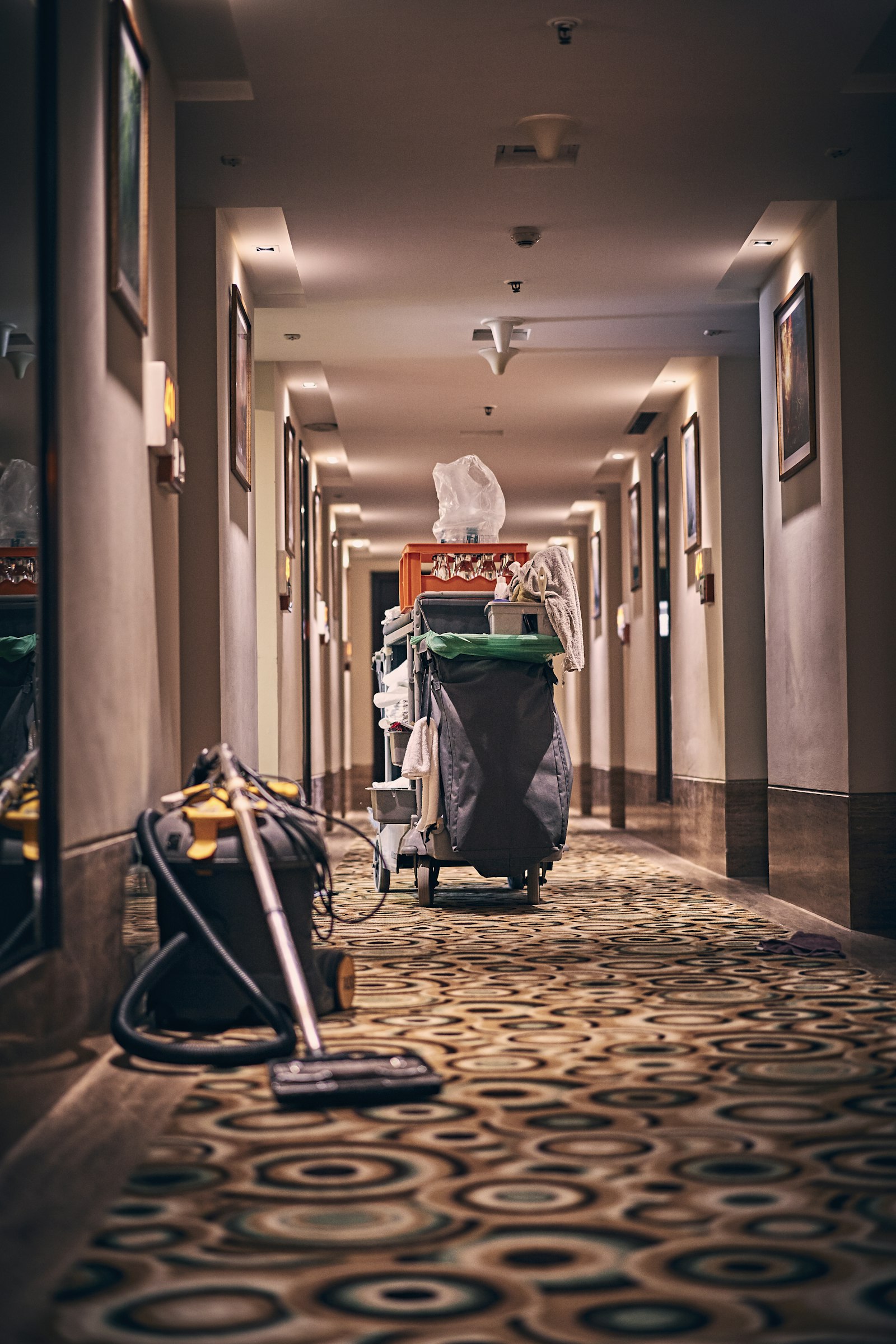
Hotel housekeepers cramp because the heat is inside the room, not in the forecast, and because a room board is a string of short maximal efforts rather than steady work. A checkout room that has sat closed with the air off on a sun-facing wall can be well above the hallway when the door opens, and the housekeeper walks into it wearing a uniform, gloves, and a face full of hot bathroom steam twelve to sixteen times a shift. Between the cart pushing, the mattress lifting, and the wringing, the muscles that fail first are the hands, the forearms, and the low back, because those are the muscles doing the work. A 3 oz pickle brine shot delivers 570 mg of sodium and triggers a reflex in the mouth and throat that quiets a cramping muscle in roughly 85 seconds, which is why a shot clipped to the cart beats a bottle of water waiting in the break room.
Ask a room attendant where she cramps and the answer is almost never the calf that the heat-safety poster shows.
It is the hand. The web of the thumb closing on its own around a wrung-out rag. The forearm going hard partway through a board of sixteen. The low back seizing on a mattress lift somewhere around room eleven, on the day the property is at ninety-eight percent occupancy and half the board is checkouts.
That pattern is not mysterious and it is not a personal failing. It is what you get when you put repeated near-maximal effort inside a series of small hot rooms, on a clock, with a break structure that exists on paper and collapses the moment the board runs long. Every piece of it is addressable. None of it is addressed by the thing most properties try first, which is a water cooler at the end of the hall and a reminder to use it.
The Heat Is In The Room, Not In The Forecast
This is the part that gets skipped in every heat talk that opens with a weather app, because housekeeping is classified as indoor work and indoor work is assumed to be climate controlled.
A guest room is climate controlled while a guest is in it. After checkout it frequently is not. Energy management systems set back the unit when the room is unoccupied, guests leave the thermostat wherever they left it, and on a sun-facing wall with the curtains open a closed room bakes for hours before anyone opens the door. The housekeeper walks into that, and she walks into it again a dozen or more times a shift.
Then add the parts of the job that generate heat on their own:
- The bathroom. Hot water, steam, chemical work in a small enclosed space with an exhaust fan and no real airflow. It is the hottest and most humid five minutes of every room, and it is the part that involves the most scrubbing and gripping.
- Linen and laundry. Anyone who runs linen into the laundry, or works a shift there, is in a room full of dryers, washers, and flatwork ironers. OSHA's own heat-stress guidance for institutional laundries is blunt about it: excessive heat in laundry areas leads to heat exhaustion, which shows up as dizziness, blurred vision, and nausea, and can progress to collapse.
- Stairwells and service corridors. Back-of-house is rarely conditioned to the same standard as the guest floors, and it is where the cart gets pushed.
- The uniform. Polyester blends, an apron, nitrile gloves on both hands for most of the shift. Gloves in particular shut down evaporative cooling on the exact surface that is about to cramp.
California recognized this in regulation. The Cal/OSHA indoor heat illness prevention standard took effect on July 23, 2024, and applies to indoor workplaces once the temperature reaches 82°F with employees present, requiring cool-down areas kept below 82°F. At 87°F, or at 82°F in areas with high radiant heat or where heat-retentive clothing is worn, employers have to add engineering or administrative controls. The standard also requires close observation of employees for their first 14 days while they acclimate.
That rule exists because indoor heat is real heat. Housekeeping is one of the clearest cases of it.
Why A 16-Room Board Is Anaerobic, Not Aerobic
Here is what separates housekeeping from most of the trades in this series.
Standard full-service assignments land around 12 to 16 rooms per eight-hour shift, and limited-service properties often target 16 to 20. Those numbers assume a mix, which matters, because a time-motion study in an all-suite hotel found checkout rooms took roughly 85% longer to clean than stayovers. A board that comes back heavy on checkouts is not a slightly harder day. It is a different day.
Across that board, a housekeeper covers something on the order of 8 to 12 kilometers, five to seven and a half miles, largely indoors and largely pushing something. A study of cardiovascular load in hotel room cleaners found heart rate, heart rate reserve, metabolic equivalents, and energy expenditure all significantly elevated on work days compared with off days, with some workers showing heart rate and blood pressure climbing across the shift in a pattern the authors read as physiologic fatigue.
But the walking is not what produces the cramp. The bursts are:
- Lifting and flipping a mattress to strip and remake a bed, often solo, often against a headboard with no clearance.
- Pushing a loaded cart down carpet, which is a far higher rolling resistance than anyone outside the job assumes, and then over a threshold or into an elevator.
- Wringing. Scrubbing a tub. Working a tile line at the grout. All grip, all repeated, all near-maximal for the small muscles involved.
- Reaching overhead for a shower rod or a vent, then down to a baseboard, dozens of times per room.
Exercise-associated muscle cramps overwhelmingly show up in the muscle that is working and fatigued. That is the most consistent finding in the modern cramp literature: as a muscle fatigues, the balance between excitatory input from the muscle spindles and inhibitory input from the Golgi tendon organs shifts, the motor neuron gets hyperexcitable, and the muscle locks.
Which is exactly where the injury data points. A systematic review and meta-analysis of work-related conditions in hotel housekeepers found 12-month prevalence highest for low back pain at 73.0%, followed by wrist and hand at 54.7%, shoulder at 48.2%, and neck at 40.1%. The same four regions that cramp are the four regions that get hurt, and the review tied them to biomechanical load, repetitive movement, and specifically to the number of beds made per shift.
So when a housekeeper says her legs feel fine and it cannot be a hydration thing, she is half right. Her legs feel fine because her legs are not the ones being asked for the hard effort.
The Sweat Math On A Full Board
Sweat is not just water. It carries sodium, and how much varies enormously between people.
Sweat sodium concentration in working adults commonly lands between roughly 400 and 1,800 mg per liter. The people at the top of that range are the ones who finish a shift with white salt rings dried into a navy uniform shirt. Sweat rate under sustained moderate-to-heavy work in warm conditions commonly runs somewhere between 0.5 and 1.5 liters per hour.
Run that against a real board:
- A moderate sweater at 0.8 L/hr loses roughly 500 to 900 mg of sodium per hour.
- A heavy, salty sweater working a hot property at 1.2 L/hr can clear 1,500 to 2,000 mg per hour.
- Over an eight-hour board, that is several thousand milligrams gone.
Now look at what goes back in. Housekeeping has the worst replacement structure of almost any job on this list, and not because anyone is careless. Water is at the end of the hall or on the cart. Drinking means a bathroom break, and a bathroom break means falling behind the board. Guest-facing rules in many properties restrict eating and drinking on the floor. So the pattern becomes almost nothing for four hours, then a large volume of plain water at lunch.
Plain water replaces the volume. It replaces none of the sodium. Drinking a lot of it on top of a significant sodium deficit dilutes what is left.
That is the shape of the week-three cramp, or in a heat wave, the Thursday cramp. It is not one bad day. It is a running deficit that finally gets called, usually at the worst moment, usually with both hands full.
What Pickle Brine Actually Does
There are two separate things happening here, and conflating them is how this topic gets oversold.
The fast one is a reflex. In 2010, Kevin Miller and colleagues published a study in Medicine & Science in Sports & Exercise in which cramps were induced electrically in dehydrated subjects. Subjects who swallowed roughly 2.5 oz of pickle juice got relief about 37% faster than those who drank water, with cramps resolving in around 85 seconds.
The timing is the important part. Eighty-five seconds is far too fast for anything to have been digested, absorbed, and delivered to a muscle. The researchers measured blood electrolytes five minutes after ingestion and found them essentially unchanged. Whatever stopped the cramp did not travel through the bloodstream to get there.
The leading explanation is an oropharyngeal reflex. Receptors in the mouth and throat respond to the sharp acetic acid stimulus, that signal reaches the brainstem, and it damps down the runaway firing of the alpha motor neurons driving the cramp. A strong sensory input in the throat interrupts a bad motor loop in the hand.
The slow one is sodium. Separately, and far less dramatically, a 3 oz Fast Pickle shot carries 570 mg of sodium. That is real replacement for a real loss, and it matters across a week of full boards, but it works on the timescale of hours, not seconds.
Keeping those two straight is the whole point. The shot is an off switch for a cramp that is happening right now. It is not a hydration plan, and it does not replace water, air conditioning, and a break that actually happens.
Why Not Just Keep Sports Drinks In The Break Room
Plenty of properties do, and nobody should throw them out. But there are three reasons they underperform for this specific job.
Sodium density. A standard 20 oz sports drink carries somewhere in the range of 250 to 270 mg of sodium. A 3 oz pickle shot carries 570 mg. Matching one shot from a bottle means drinking well over a quart, which is a lot of volume for someone who is already rationing bathroom breaks against a room board.
Sugar. Those same 20 oz typically bring 30 to 35 grams of sugar. Across three or four bottles on a hot shift that is a real load, and the afternoon crash is real too. The Fast Pickle shot has zero added sugar and under 1 gram of carbs.
Speed and footprint. A sports drink works by absorption, so it runs on the body's clock. The brine reflex runs on a different clock entirely. And a 3 oz shot fits in an apron pocket or clips into the cart caddy, which means it is in the room with you. A bottle in the break room is not in the room with you, and the room is where the cramp happens.
The Room Board Protocol
This is what a practical version looks like on a housekeeping floor. It is deliberately boring, because the people who stay out of trouble are boring about it.
Before the first room
Start the shift already topped off. Salt the first meal on purpose. Fill the bottle before you take the board, not after the first room. A deficit that starts before the first door opens does not get fixed at two in the afternoon.
Prop the door and let the room turn over
On a checkout that has been closed and hot, open the door and the drapes, and set the unit to cool before you start stripping. It costs thirty seconds and it changes the temperature you work the bathroom in. If the property has a heat policy, this is the part of it that actually helps you.
Drink on the cart, not on break
The break is not the reliable part of the day. The cart is. Keep the bottle where you reach it between rooms and take some every room, rather than saving the whole thing for a lunch that may or may not happen on time.
The moment a cramp starts
Take the shot at the first twitch, not after the hand has locked. Then stop for 60 to 90 seconds and let it work. Trying to finish a tub with a cramping forearm is how a bad minute turns into a wrist injury, and the wrist and hand are already the second most injured region in this job.
Heavy boards and doubles
On a board that runs long, a heavy checkout day, or a back-to-back double, a second shot late in the shift is reasonable. Sodium out has been high all day and the end of the shift is when most people are furthest behind.
End of shift
Salt the evening meal. Drink through the evening rather than all at once. Most of the overnight leg cramps that housekeepers report follow a day exactly like the one just described.
What Not To Do
- Do not push through a locked cramp with a mattress in your hands. Set it down first. A cramp that makes you lose control of something heavy is how a small problem becomes a back injury.
- Do not chug a large volume of plain water to fix a cramp. Volume without sodium is the condition that produced the problem, not the answer to it.
- Do not skip water to avoid falling behind the board. This is the single most common pattern in this job, and it is the one that reliably ends a shift early. Falling ten minutes behind is cheaper than a heat-illness call.
- Do not treat salt tablets as interchangeable with a brine shot. A dry tablet on a mostly empty stomach in the heat is a common route to nausea, and nausea on a guest floor ends the day.
- Do not assume an indoor job means a cool job. Hallway temperature is not room temperature, and room temperature is not bathroom temperature during a scrub.
When It Is Not Just A Cramp
A muscle cramp is a muscle cramp. Heat illness is a medical emergency, and both can happen on the same afternoon.
Stop work and get help if you or a coworker has any of the following:
- Confusion, slurred speech, stumbling, or behavior that is clearly off.
- Skin that has gone hot and dry, or someone who has stopped sweating in conditions where they obviously should be.
- Fainting, or a headache with nausea and vomiting that will not settle.
- Cramping that is severe, widespread, or will not let go with rest.
- Dark or cola-colored urine, or deep muscle pain and weakness out of proportion to the work. That combination can point to rhabdomyolysis and needs to be looked at the same day.
Heat stroke is life-threatening. Call 911, move the person to a cool area, and start active cooling while you wait. Nothing in this article replaces medical care, and a pickle shot is a tool for an ordinary working cramp, not a treatment for heat illness.
Common Questions
How fast does it actually work?
In the controlled study, electrically induced cramps resolved in roughly 85 seconds with pickle juice, about 37% faster than with water. In the field, most people describe the grip letting go within the first minute or two. Taking it at the first twitch works better than taking it after the muscle has been locked for five minutes.
Can I keep it on the cart, or does it need to stay cold?
It travels fine at room temperature, which is most of why it fits this job. It is a sealed 3 oz shot, not a bottle that sweats through an apron pocket, and it does not need ice or a break-room fridge to be usable at the moment you need it.
Why do my hands cramp instead of my legs?
Because your hands and forearms are doing the repeated near-maximal work. Wringing, scrubbing, and gripping fatigue those muscles specifically, and cramps land in fatigued muscle. It is not a sign that the cause is different. It is a sign of which tissue is working hardest.
My back is what goes, not my hands. Is this the same thing?
Partly. Low back pain in this job is largely mechanical, and it comes from bed-making and lifting rather than from sodium loss, so the fix for it is ergonomic and not nutritional. But a low back muscle can cramp for the same fatigue reasons as any other muscle, especially late in a heavy checkout board, and that part responds like a cramp anywhere else.
Can I just drink juice out of a pickle jar?
You can, and people have for decades. The problem is consistency. Jar brine varies widely in sodium and acidity between brands and batches, it is built for flavor rather than for this, and a 32 oz glass jar has no business on a housekeeping cart. A 3 oz shot with a known 570 mg of sodium is the same dose every time and survives a full shift in an apron pocket.
Will it help with cramps that wake me up at night?
A lot of workers in physically heavy jobs report that it does, and the same reflex mechanism is the likely reason. Nighttime cramps after a hot working day are extremely common. Keeping a shot on the nightstand is a normal use of it.
Is the sodium a problem?
570 mg is roughly a quarter of general daily guidance, taken by someone who just sweated out several times that. For a healthy person doing heavy work in heat, that is replacement. If you are on a sodium-restricted diet, or managing blood pressure, kidney issues, or heart failure, check with your doctor first. That is a real conversation, not a disclaimer.
6-pack or 12-pack for a housekeeping department?
For a single room attendant working regular boards, the 12-pack is the practical unit. The failure mode is always being out on the day the board ran long and the property hit ninety-eight percent. For a department, most supervisors keep a case in the linen room and a few in each caddy.
The Short Version
Hotel housekeepers cramp in their hands, forearms, and low back because those are the muscles doing repeated near-maximal work, inside rooms that are hotter than the hallway and bathrooms that are hotter than the rooms. Across a 12 to 16 room board, sodium leaves at several hundred to two thousand milligrams an hour and comes back as plain water at lunch, which fixes the volume and not the salt.
Water, a cool-down area, and a break that actually happens are still the base, and the Cal/OSHA indoor heat rule exists because those things are not optional. But when a cramp is already happening in the middle of a checkout, absorption is too slow to matter, and the fastest lever available is a neural one. A 3 oz shot with 570 mg of sodium hits the reflex in the throat and quiets the muscle in about 85 seconds, then leaves real sodium behind for the rest of the board.
Keep it on the cart, not in the break room.