
McDonald's NZ × Auckland FC: What Actually Happened.
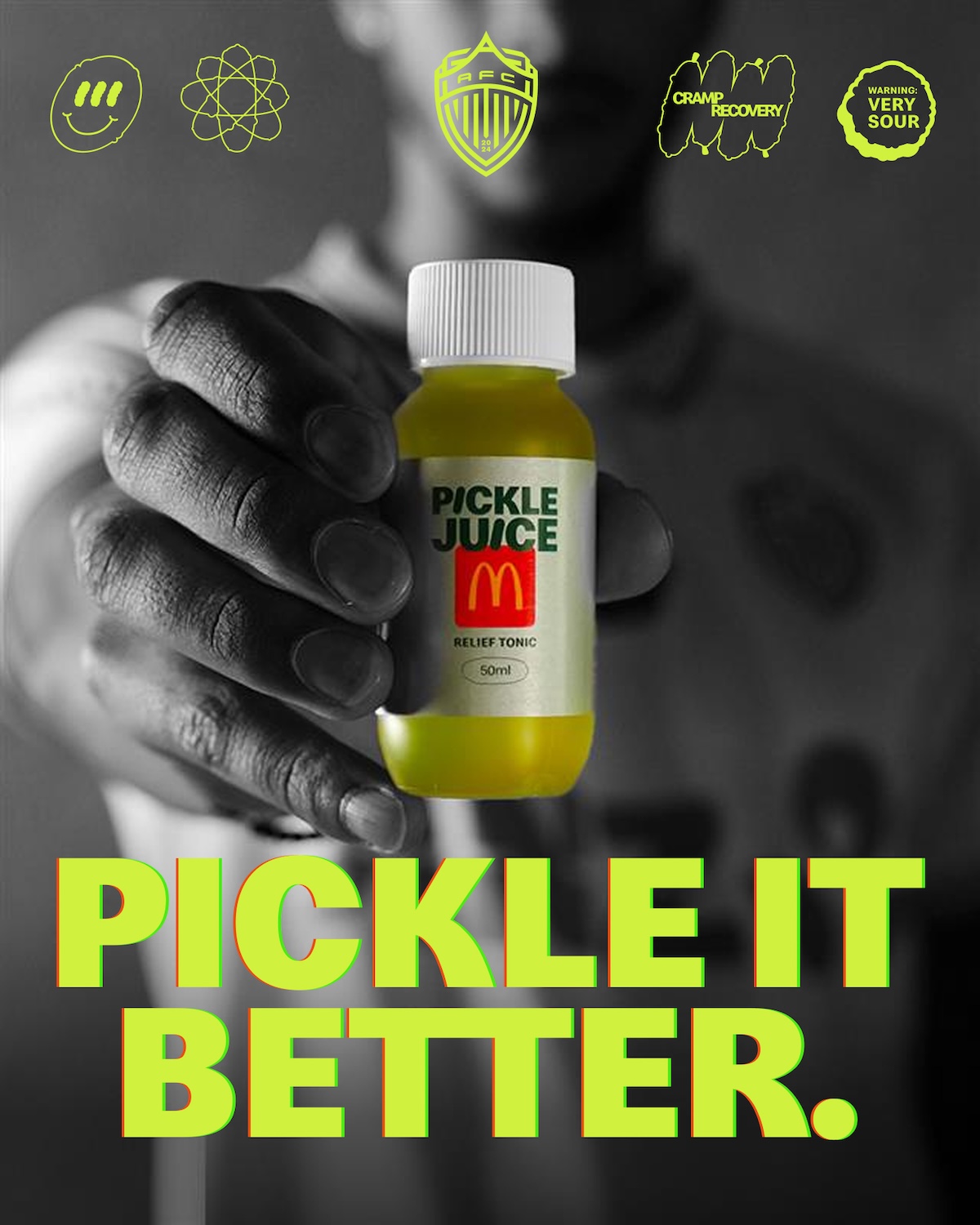
Yes — McDonald's New Zealand really did bottle pickle juice for athletes. In May 2026, McDonald's NZ partnered with professional soccer club Auckland FC on a campaign called the "Pickle Juice Relief Tonic." The 50ml shots are filled with leftover pickle brine harvested from McDonald's NZ kitchens (the same brine that comes off the pickles destined for cheeseburgers), labeled in McDonald's brand colors, and supplied to Auckland FC players during matches. The campaign was created by McCann and promoted by FleishmanHillard Aotearoa, and rolled out through in-stadium activations, creator partnerships, social content, and earned media.
If you saw the headline and thought "wait, that actually works?" — yes. Pickle juice for muscle cramps isn't a stunt. Endurance athletes have been pouring it back since at least the 1980s. The McDonald's NZ campaign is the mainstream version of a story Fast Pickle has been telling US customers since day one.
Below: what the campaign actually delivers, why pickle juice helps athletes, how the McDonald's NZ shot compares to a US-available Fast Pickle shot, and the honest answer to "can I get this in America?"
What McDonald's New Zealand actually did
Per AdAge's May 2026 coverage, McDonald's NZ is repurposing leftover pickle brine from its kitchens and supplying it to Auckland FC players as fast-acting hydration. The agency-supplied framing notes that pickle brine "has become a familiar sight in athletics, particularly in endurance sports." The actual product is the brine that would otherwise be a waste stream — bottled in 50ml shot-style containers, labeled with the McDonald's identity, and handed to the team.
This isn't a retail SKU. The McDonald's NZ Relief Tonic is a closed-loop sustainability play wrapped in a sports-performance story. The supporting media (in-stadium activations, creator partnerships, social content) drives the broader awareness, but the actual product exists for one professional soccer team. You cannot buy it.
The signal matters more than the SKU. A QSR brand the size of McDonald's putting its logo on a pickle-juice cramp tonic moves this concept from "weird thing endurance athletes do" to "thing your kid's soccer coach will mention at the next match."
Why pickle juice helps athletes (the sodium math)
The reason athletes reach for pickle brine has nothing to do with magic. It's sodium density.
When you sweat through a long match, a long shift, or a long pickleball tournament, you lose two things at once: fluid and electrolytes — primarily sodium. Water alone replaces fluid volume but dilutes the sodium concentration that's left, which can make cramps and fatigue worse, not better. That's why athletic trainers reach for sodium-loaded drinks, salt tabs, or brine when the heat is on.
Pickle brine is, by weight, one of the most sodium-dense liquids you'll find on a normal kitchen shelf. The brine McDonald's NZ is bottling, the brine you'd pour off a jar of full-sour Vlasics, and the brine Fast Pickle bottles in 3oz shots are all in the same family: high-sodium, no-sugar-added, fast-acting hydration support.*
Here's the rough sodium-per-ounce comparison across the most-common formats:
| Drink | Sodium / oz | Sugar / oz |
|---|---|---|
| Fast Pickle 3oz shot | ~190 mg | 0 g |
| McDonald's NZ Relief Tonic (50ml ≈ 1.7oz)* | est. 140–190 mg | 0 g |
| LMNT (16oz mixed) | ~62.5 mg | 0 g |
| Liquid IV (16oz mixed) | ~31.3 mg | ~0.7 g |
| Gatorade Thirst Quencher | ~9.4 mg | ~1.3 g |
| Plain water | 0 mg | 0 g |
*McDonald's NZ has not published the exact sodium content of the Relief Tonic. The estimate is based on standard commercial dill brine, which typically ranges 80–110mg sodium per ml.
Notice the gap. A 3oz Fast Pickle shot delivers about as much sodium as nine 16oz Gatorades, with none of the sugar. That's the math that won soccer trainers, marathon coaches, pickleball pros — and now McDonald's NZ — over.
How a pickle juice shot actually works (vs. drinking brine from a jar)
The reason endurance athletes first started reaching for the bottle in the kitchen — and the reason a packaged shot is now a real category — comes down to format.
Drinking brine straight from a jar at home: free, but messy, hard to dose, and impossible to carry to a match or job site. A pre-measured 50ml or 3oz shot: portable, dose-controlled, shelf-stable, and packaged so you can drop five into a gym bag. That's the format McDonald's NZ landed on for the Auckland FC Relief Tonic, and it's the format Fast Pickle has been shipping in the US for years.
The active mechanic in both cases is the same: 100–200mg of sodium per ounce, acetic acid from the brine, and zero added sugar. A 2010 study published in Medicine and Science in Sports and Exercise by Miller et al. ("Reflex inhibition of electrically induced muscle cramps in hypohydrated humans") also suggested a possible reflex mechanism in the throat that shortens cramp response, independent of fluid volume.* The combination is why pickle brine sometimes feels faster than plain salty water.
Endurance athletes have been doing this for 40 years
Here's the part the McDonald's NZ news misses: pickle juice as a cramp aid is not new.
The earliest widely-cited use is the late-1990s University of Florida football staff (the same staff that developed Gatorade) keeping pickle brine on the sideline for late-game cramping. By the early 2000s, the Philadelphia Eagles training staff was famously pouring pickle juice down players during a hot-weather game against the Dallas Cowboys — a story that hit ESPN and basically launched the modern pickle-juice-for-cramps category.
In the 20 years since:
- Marathon and ultra-running culture adopted pickle brine as a standard mid-race aid.
- CrossFit and HIIT athletes started keeping shots in gym bags.
- Pickleball — the fastest-growing sport in the US — picked it up because court cramps in long tournaments are a real, common problem.
- Construction, roofing, paving, and other outdoor trades adopted it independently of sport, because the underlying problem (sweat × sodium loss × heat) is identical.
McDonald's New Zealand and Auckland FC are not pioneers here. They're the mainstream proof point. When a McDonald's marketing department signs off on this campaign, it's because the science and the user base are now beyond question.
How Fast Pickle compares to the McDonald's NZ shot
The McDonald's NZ Relief Tonic is a campaign asset, not a retail product. You cannot order it. It is not sold. It exists for Auckland FC players and the campaign's PR run. For US athletes, workers, pickleball players — anyone who sweats — here's the equivalent.
| Spec | McDonald's NZ Relief Tonic | Fast Pickle 3oz Shot |
|---|---|---|
| Format | 50ml (≈1.7oz) bottle | 3oz bottle |
| Sodium | Not disclosed (est. 140–190mg/oz) | 190mg/oz, 570mg per shot |
| Sugar | 0g | 0g |
| Made from | McDonald's NZ kitchen pickle brine | Real US-made pickle brine |
| Availability | Auckland FC players only | Anywhere in the US, online + retail |
| Price | Not for sale | From $2.42 / shot (12-pack) |
| Shelf life | Limited (refrigerated brine) | Shelf-stable, no refrigeration |
If you want the closest US-available match to what the Auckland FC players are getting — a real-brine, sodium-loaded, no-sugar single shot — Fast Pickle's 3oz Tournament Day 12-pack is the direct equivalent.
Can you buy McDonald's pickle juice in the US?
Honest answer: no. The McDonald's NZ Relief Tonic is a campaign asset for Auckland FC players, not a retail product. It is not sold at McDonald's locations in New Zealand and there is no plan (as of the May 2026 launch) to ship it to other markets.
A separate question often gets bundled in: "Can I get pickle juice at McDonald's in the US?" — also no. McDonald's US does not sell pickle juice, has never sold it, and has not announced any plan to. If the New Zealand campaign caught your eye, the practical move is to skip the McDonald's branding and go straight to what the athletes actually drink. Fast Pickle's 3oz Tournament Day 12-pack ships free in the US, no subscription, and lands within days.
What to look for in a pickle juice shot
If you're shopping the category for the first time, three things matter:
- Sodium density per ounce. The whole point is sodium. Anything under 100mg/oz isn't a "pickle juice shot" — it's a flavored sports drink with brine in the name. Fast Pickle is 190mg/oz.
- Real brine, not flavoring. Read the label. "Pickle flavor," "natural flavor," and "pickle extract" are not the same as real cucumber brine. Real brine will list cucumbers, vinegar, salt, and dill or garlic — and usually nothing else.
- Zero added sugar. The whole reason athletes reach for brine over Gatorade is to skip the sugar. If your "pickle shot" has 8g of sugar in it, it's a sports drink dressed up. Fast Pickle has 0g added.
The McDonald's NZ Relief Tonic, based on the campaign reporting, hits all three. So does Fast Pickle. If you want to test the format the Auckland FC players use, the cleanest way in is the 3oz Tournament Day 12-pack — free US shipping.
*Fast Pickle does not claim to cure, treat, or prevent muscle cramps or any other condition. We describe the sodium-replacement and acetic-acid mechanics every athletic trainer's manual describes. See the FDA disclaimer at the bottom of this page. Always consult a healthcare professional for chronic or severe muscle cramps.