
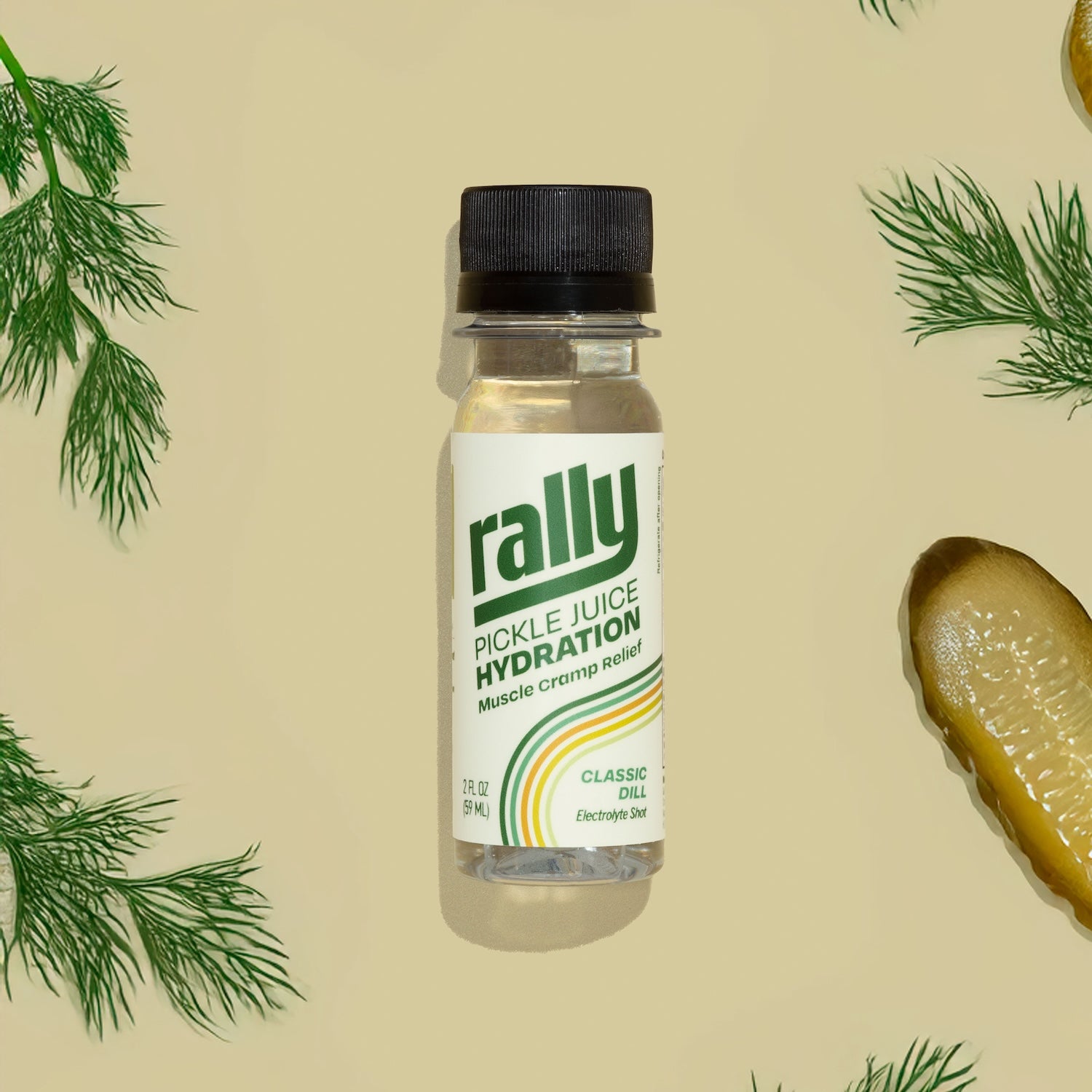
Fast Pickle is no sugar added. Rally adds sugar. That is the comparison straight off the label. Fast Pickle is a 3 oz remnant pickle brine shot — the actual liquid that pickled cucumbers — with 570 mg sodium and zero grams of added sugar, priced at $2.42 per bottle in the 12-pack. Rally is a 2 oz vinegar + electrolyte mix (no cucumbers ever touched it) with 400 mg sodium, B vitamins, zinc, and 1 g of added sugar, priced at $3.00 per bottle. Both shots are technically hypertonic (sodium delivery, not hydration). On the spec sheet, Fast Pickle delivers more sodium, no added sugar, actual pickle brine, and a lower price per ounce.
On April 21, 2026, Rally Labs launched its debut product: a 2 oz pickle juice shot positioned as a clean-label entry into the sports hydration category. Founder Brett Weisberg pitched it as "a quiet performance secret in pro sports for decades" brought to a wider audience, with the launch covered by both BevNET and Fitt Insider.
That "quiet secret" framing is fair. Athletes have reached for pickle juice for cramps since the 1990s, and the practice moved from locker-room folklore to peer-reviewed research over the last decade. Fast Pickle has been making the original 3 oz brine shot in that same lineage. With Rally now in market, athletes have a real choice between two pickle-juice shots. Here is how they actually compare.
What Rally Just Launched
Rally is a 2 oz functional shot built around vinegar, with sea salt, potassium, magnesium, B vitamins, and zinc layered on top. The brand positions it as "clean hydration": no artificial flavors, colors, sweeteners, or preservatives, and a vitamin pack designed to do double duty as a daily recovery shot.
Per the brand's spec sheet, each 2 oz Rally shot delivers 400 mg sodium, 250 mg potassium, 47 mg magnesium, plus B vitamins and zinc. A 12-pack runs $36.00, or $3.00 per bottle.
The 2 oz format is closer to a wellness shot than a brine shot, and the added micronutrients move it into a slightly different category than straight pickle juice. Worth knowing, though: each Rally shot also includes 1 gram of added sugar, which is unusual for a product positioned as "clean hydration."
Fast Pickle Is No Sugar Added. Rally Adds Sugar.
That is the line. Fast Pickle is no sugar added — zero grams per 3 oz shot. Each 2 oz Rally shot contains 1 gram of added sugar (2% DV). Both numbers come straight off the label. Rally's homepage frames the product as "clean hydration" with "no artificial flavors, colors, sweeteners, or preservatives," which is technically accurate on the artificial-sweeteners point — the sweetener on the label is not artificial. It is real sugar. Worth flagging too: "clean label" has no FDA or USDA definition. It is a marketing term, not a regulatory category, so what gets called "clean" varies brand to brand. The label numbers do not vary. If you are reaching for a pickle juice shot specifically because you want concentrated sodium without a sugar load, the comparison is exactly that simple: Fast Pickle does not add sugar. Rally does.
About That Tagline
Rally's homepage hero also reads "Cramps crushed. Hydration handled." That phrasing has been Fast Pickle's positioning since launch, so it is nice to see the framing catching on across the category. One small correction worth making, though: a hypertonic pickle juice shot does not actually handle hydration. It handles concentrated sodium delivery, with a vinegar-driven cramp interrupt as the headline mechanism. Hydration is what the water you chase the shot with does. The slogan is sticky; the physiology is just a little more honest than that — which is why we have always called Fast Pickle a hypertonic shot, not a hydration drink. More on that distinction below.
Rally vs Fast Pickle: The Side-By-Side
Here is the head-to-head spec comparison, pulled from each brand's own labeling:
| Spec | Rally | Fast Pickle |
|---|---|---|
| Shot size | 2 oz | 3 oz |
| Sodium per shot | 400 mg | 570 mg |
| Sodium per ounce | 200 mg | 190 mg |
| Potassium | 250 mg | Naturally occurring in brine |
| Magnesium | 47 mg | Naturally occurring in brine |
| Added micronutrients | B vitamins, zinc | None — brine only |
| Base ingredient | Vinegar + electrolyte powders (no cucumbers) | Remnant pickle brine (cucumbers touched it) |
| Added sugar | 1 g per shot | 0 g — none |
| Artificial colors / flavors | None | None |
| 12-pack price | $36.00 | $28.99 |
| Price per bottle | $3.00 | $2.42 |
| Price per ounce | $1.50 | $0.81 |
The two shots both lean on vinegar acidity and both put sodium in front. The differences are in format, base, added sugar, and price. Fast Pickle has zero added sugar; Rally adds 1 gram per shot. Fast Pickle uses pickle brine; Rally builds the flavor from vinegar plus an electrolyte and B-vitamin stack.
Sodium Per Shot
Fast Pickle delivers 170 mg more sodium per shot than Rally. On a per-ounce basis the two are nearly identical (190 mg/oz vs 200 mg/oz), but because Fast Pickle is a 3 oz shot, you walk away with meaningfully more sodium in a single dose. For a heavy sweater losing 4 to 6+ grams of sodium in a long session, that 170 mg difference per shot adds up fast across a day of training.
Size And Price
The price gap is the most concrete difference between the two. A 12-pack of Rally costs $36.00. A 12-pack of Fast Pickle costs $28.99. That is roughly 19 percent less per bottle. Per ounce, Fast Pickle costs $0.81 vs $1.50 for Rally, a 46 percent gap.
That is not because Fast Pickle skips on quality. It is because the product is straightforward: real pickle brine in a 3 oz bottle, with no added micronutrient stack to fund.
Did Cucumbers Touch It?
This is the simplest, most useful test of whether a pickle juice shot is actually pickle juice or a vinegar drink dressed up to taste like one.
Rally: a formulated functional shot. Vinegar is the acidity base, then sea salt, potassium, magnesium, B vitamins, and zinc are added in. It is engineered to hit specific electrolyte and micronutrient targets. No cucumbers ever touched it. In plain language, Rally is a vinegar drink built to taste pickle-adjacent.
Fast Pickle: actual remnant pickle brine. It is the liquid that cucumbers were pickled in — the brine sitting in the jar after the pickles come out. Cucumbers touched it. That is what makes a brine an actual pickle brine instead of a vinegar drink that tastes like one. The sodium, the acidity, the trace electrolytes, and the flavor all come from the same source athletes have used in locker rooms for decades, bottled at a consistent 570 mg of sodium per 3 oz.
Why a Pickle Juice Shot Is Sodium Delivery, Not Hydration
Here is the technical distinction worth getting right, because it is the one most pickle-juice marketing skips: a 3 oz pickle brine shot is not, strictly speaking, a hydration product. It is a hypertonic shot. The dissolved-solid concentration is well above blood plasma osmolality, which means drinking it does not deliver water into your bloodstream the way a sports drink or plain water does. It delivers sodium, fast.
Sports nutrition research separates drinks by tonicity:
- Hypotonic: Lower solute concentration than plasma. Plain water and dilute electrolyte drinks. Absorbed quickly. True rehydration.
- Isotonic: Roughly matches plasma osmolality (around 280 to 310 mOsm/kg). Standard sports drinks like Gatorade, designed to balance carbs, electrolytes, and fluid delivery.
- Hypertonic: Higher solute concentration than plasma. A concentrated brine shot lands here. Designed for fast solute delivery, not water replacement — and pulls fluid into the gut briefly via osmosis before the sodium absorbs.
This is why Fast Pickle is positioned as a hypertonic shot rather than a sports drink. The 570 mg of sodium in 3 oz is well above plasma sodium concentration, so the shot is doing concentrated electrolyte work, not hydrating in the traditional sense. The Miller et al. 2010 study in Medicine & Science in Sports & Exercise reinforces the distinction: cramps resolved in roughly 85 seconds after drinking pickle juice — far faster than the sodium could even reach the bloodstream. The mechanism appears to be an oropharyngeal reflex triggered by vinegar acidity, not electrolyte replacement.
Practical takeaway: a 3 oz Fast Pickle shot is the right tool when you need to deliver concentrated sodium quickly — mid-cramp, after a heavy salty-sweat session, or partway through a hot work shift. Follow it with plain water for actual fluid replacement. The shot is the sodium hit and the cramp interrupt. The water is what actually rehydrates you. Sports drinks try to combine both jobs into one bottle and end up underdosing sodium for anyone who sweats above average.
Rally is also a hypertonic shot — you cannot pack 400 mg of sodium plus B vitamins and zinc into 2 oz and end up below plasma osmolality. Both products belong in the "sodium delivery" category, not the "hydration drink" category. The marketing language conflates the two; the physiology does not.
Why Sodium Concentration Matters
Both Rally and Fast Pickle exist for the same reason: sports drinks designed for the average athlete deliver too little sodium for anyone who actually sweats hard. A typical 16 oz sports drink contains 100 to 270 mg of sodium. To replace the 4,500 mg a heavy sweater can lose in a two-hour session, that athlete would need to drink 16 to 45 bottles — impractical and a fluid-overload risk.
The fix is concentration: deliver real sodium in a small, fast hypertonic format, then chase it with water. That is the entire premise of the pickle juice shot category. Rally hits 400 mg in 2 oz. Fast Pickle hits 570 mg in 3 oz. Both work. The question is which dose size and price point fits your use case.
Real Pickle Brine vs Formulated Electrolyte Stack
Research on pickle juice for cramps points to a specific mechanism: the acidity in the back of the throat appears to interrupt the nerve signaling that drives a cramp, often before the sodium has time to even be absorbed. A 2010 study in Medicine & Science in Sports & Exercise found cramps resolved in roughly 85 seconds after drinking pickle juice, far faster than electrolytes alone could explain.
Both Rally and Fast Pickle deliver vinegar acidity, so both should hit that same reflex in principle. The open question is whether real pickle brine carries something a vinegar-plus-electrolyte stack does not. Athletes who reach for pickle juice in the locker room are reaching for the brine, not for a reformulated vinegar drink with a vitamin pack on top. Whether that distinction matters in practice is a personal call.
Fast Pickle's position is straightforward: if athletes have spent 30 years drinking pickle brine for cramps, the product should be pickle brine. Rally's position is that you can take the underlying mechanism and dress it up with a fuller electrolyte and B-vitamin stack.
Who Should Pick Each One
Who Rally Is Best For
Rally makes sense if you want a 2 oz functional shot with added B vitamins and zinc, and you want to use it as much for daily recovery and hydration as for cramps. The smaller format is easier to throw in a jacket pocket, and the added micronutrients are real if you are not getting them elsewhere. The trade-off is the price: $3.00 per bottle and $1.50 per ounce.
Who Fast Pickle Is Best For
Fast Pickle makes sense if you want more sodium per shot, real pickle brine, and the lowest per-ounce price in the category. If you are a heavy sweater stacking shots across a long session, a hot-shift work day, or back-to-back training, the 3 oz format and the $0.81-per-ounce price hold up better at volume. The 12-pack is a good starting point for anyone training multiple days per week, and the 24-pack makes sense for a household with more than one heavy sweater in it.
Frequently Asked Questions
What is the difference between Rally and Fast Pickle?
Rally is a 2 oz vinegar-and-electrolyte shot launched in April 2026 with 400 mg sodium, 250 mg potassium, 47 mg magnesium, plus B vitamins and zinc, priced at $3.00 per bottle. Fast Pickle is a 3 oz real pickle brine shot with 570 mg sodium and zero added sugar, priced at $2.42 per bottle in the 12-pack.
Which has more sodium, Rally or Fast Pickle?
Fast Pickle delivers 170 mg more sodium per shot. Each 3 oz Fast Pickle shot contains 570 mg of sodium. Each 2 oz Rally shot contains 400 mg. Per ounce, the two are nearly equal at 190 mg/oz and 200 mg/oz respectively — the difference is in total dose per bottle.
Which is cheaper?
Fast Pickle is cheaper on every metric. A 12-pack is $28.99 vs $36.00 for Rally, which works out to $2.42 vs $3.00 per bottle and roughly $0.81 vs $1.50 per ounce.
Does Rally have added sugar?
Yes. Per its own nutrition label, each 2 oz Rally shot contains 1 gram of added sugar (2% DV). Fast Pickle contains zero added sugar — the only carbohydrate in a Fast Pickle shot is what naturally occurs in pickle brine.
What is Rally made of?
Rally is built around vinegar with added sea salt, potassium, magnesium, B vitamins, zinc, and 1 g of added sugar. No cucumbers ever touched it — it is formulated to taste like a pickle juice shot, but it is, in plain terms, a vinegar-based functional shot. Fast Pickle is actual remnant pickle brine: the liquid cucumbers were pickled in, with no added sugar and no synthetic micronutrient stack.
Can I drink either one daily?
Both products are formulated for active adults. If you are stacking multiple shots a day around training or work, the price difference becomes meaningful. If you are using one shot a day mostly for recovery and the added B vitamins and zinc are useful for you, Rally is built for that use case. As with any new electrolyte product, anyone with high blood pressure or kidney issues should check with a doctor before adding concentrated sodium daily.
The Bottom Line
The pickle juice shot category just got more competitive, which is good for athletes. Rally is a thoughtful entry: smart electrolyte and B-vitamin stack, smaller 2 oz format, with 1 g of added sugar per shot. Fast Pickle is the original 3 oz brine shot: more sodium per bottle, real remnant pickle brine, zero added sugar, and a lower price per ounce. If you want a vinegar-based functional shot with added micronutrients and don't mind a gram of sugar, Rally fits. If you want concentrated sodium from the actual liquid that pickled the cucumbers — with no added sugar, at the lowest per-ounce price in the category — Fast Pickle is built for exactly that.
The simplest test, if it helps: did cucumbers touch it?
See all comparisons: Fast Pickle vs. Other Electrolytes — Full Comparison Hub →