
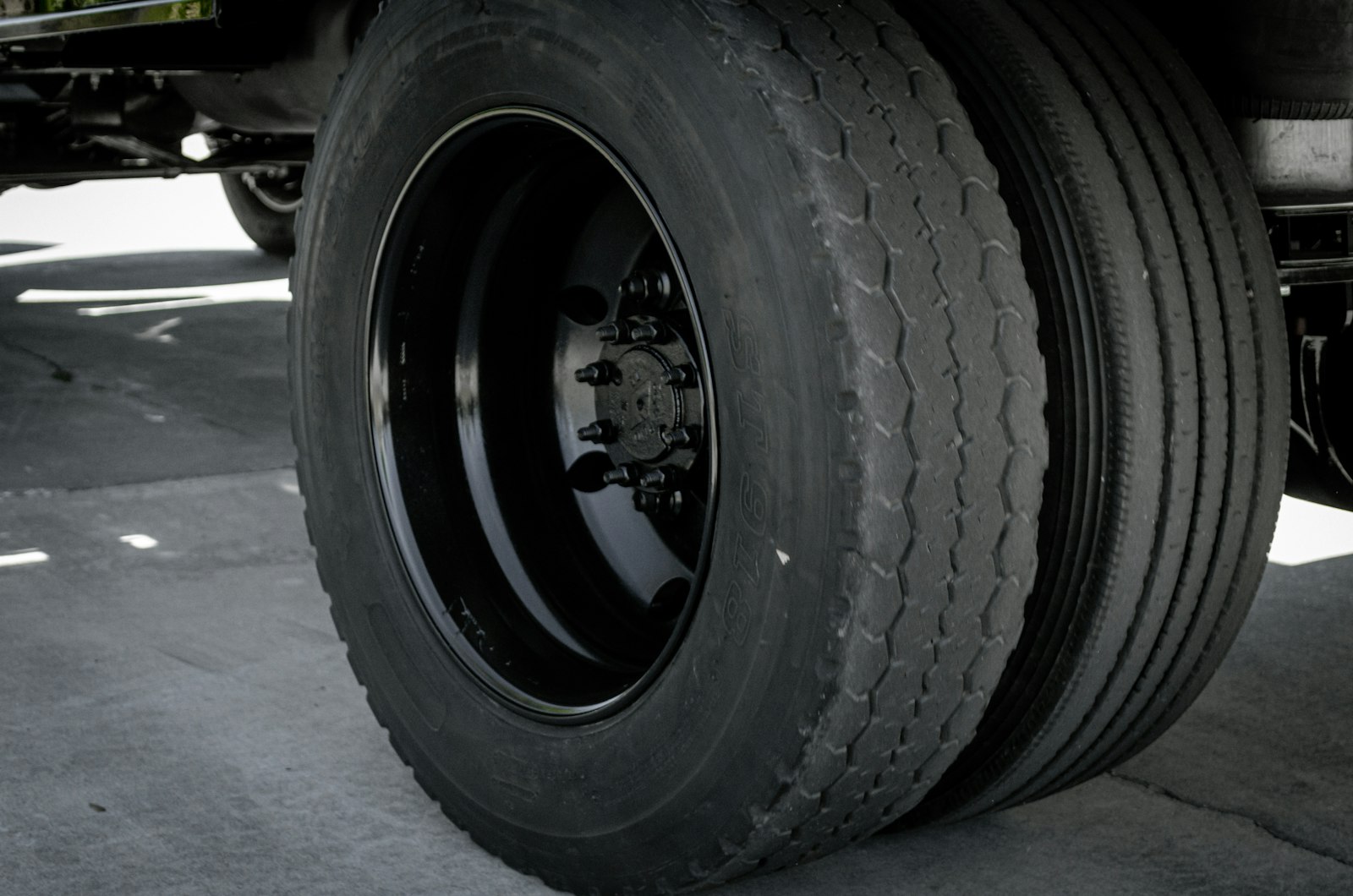
Tire technicians cramp because the heat comes off the pavement and the rim, not off the forecast, and because the work is short bursts of maximal effort instead of steady exertion. Asphalt in direct sun runs 40° to 50°F hotter than the air above it, and a wheel that just came off a loaded trailer is hotter still, so a tech kneeling at a road call is working inside a heat pocket the weather app never sees. Break the bead, torque ten nuts to 450 ft-lb, wrestle a 150 pound assembly, and the muscles that fail first are the forearms and hands, because those are the muscles doing the work. A 3 oz pickle brine shot delivers 570 mg of sodium and triggers a reflex in the mouth and throat that quiets a cramping muscle in roughly 85 seconds, which is why service trucks keep a case behind the seat instead of trying to drink their way out of a cramp mid-call.
Ask a commercial tire tech where he cramps and you will not hear what you expect. The heat-illness posters all show a calf. The tech will hold up a hand.
It is the thumb web, the forearm flexors, the grip closing on its own around nothing. It happens on the third or fourth road call of a July afternoon, usually while he is holding a wrench, and it happens because tire service loads a very specific set of muscles in a very specific way that almost nothing else on a jobsite does.
That pattern is not a mystery. It is what you get when you combine a radiant heat source at ground level, a shift with no predictable break structure, and work that is anaerobic in short violent bursts rather than aerobic and steady. Every one of those is fixable. None of them is fixed by the thing most shops try first, which is telling people to drink more water.
The Heat Comes Off the Pavement, Not the Forecast
This is the part that gets skipped on every heat safety talk that opens with a weather app.
Asphalt is a dark, dense, low-reflectivity surface. It absorbs solar radiation all day and re-emits it as heat. Pavement surface temperature studies and burn-prevention research consistently find blacktop running roughly 40° to 60°F above ambient air in direct summer sun. A 95°F afternoon is a 140°F shoulder. A 100°F afternoon can put the surface near 150°F.
A tire tech does not work standing in that air. He works kneeling on that surface, with his face two feet off it, for the duration of the call.
Then add the wheel. A tire and rim that just came off a loaded trailer running the interstate has been absorbing brake and flex heat for hours. Brake drums and the wheel ends next to them get genuinely hot, and a tire that has been run low or flat is hotter still, because a underinflated tire flexes more and every flex cycle turns into heat inside the sidewall. The tech is not next to one heat source. He is between two.
Now put on what the job requires:
- Long sleeves and gloves. Steel cord, hot rims, and the ever-present risk of a cut mean covered arms and heavy gloves are standard. Both cut evaporative cooling exactly where you have the most skin surface to cool with.
- Face and eye protection. Standard for bead work and inflation, and one more barrier between sweat and moving air.
- Cage and standoff discipline. OSHA's rim wheel standard (1910.177) requires a restraining device for inflation and trained personnel, with the tech staying out of the trajectory. That is a good rule. It also means the work has stop-and-start choreography that is hard to pause for a drink.
None of that is bad practice. All of it is necessary. But collectively it builds a job where a person is losing fluid and salt faster than a weather forecast would predict, in gear that slows cooling, on a surface that is radiating heat up at him the entire time.
Why the Cramp Lands in Your Hands First
Here is the piece that separates tire service from nearly every other trade in this series.
Most heat-cramp guidance is written for steady aerobic work. Walking a roof. Pushing a mower. Hanging drywall. The classic cramp shows up in the calf or the hamstring because those are the muscles under sustained load.
Tire work is not steady. It is a sequence of short maximal efforts separated by dead time:
- Breaking a bead that has been seated for 80,000 miles.
- Running ten wheel nuts off, then torquing them back to spec. Hub-piloted disc wheels on a Class 8 truck typically call for somewhere around 450 to 500 ft-lb, and getting there by hand on a torque wrench is a whole-body pull that terminates in your grip.
- Manhandling the assembly. A mounted 22.5 tire on a steel wheel commonly lands somewhere between 150 and 200 pounds. Aluminum drops that, but not to something you carry casually.
- Prying, seating, levering. All grip.
Exercise-associated muscle cramps overwhelmingly appear in the muscle that is working and fatigued. That is the most consistent finding in the modern cramp literature: as a muscle fatigues, the balance between excitatory input from muscle spindles and inhibitory input from Golgi tendon organs shifts, the motor neuron gets hyperexcitable, and the muscle locks.
So for a tire tech, the fatigued muscle is the forearm flexor group and the small muscles of the hand. That is where the cramp lands. Not because his hands are dehydrated differently than the rest of him, but because that is the tissue doing the repeated near-maximal work.
Which is why a tech will sometimes swear the cramp cannot be a hydration thing, because his legs feel fine. The legs feel fine because the legs are not the ones being asked for 450 ft-lb.
The Sweat Math on a Road Call Day
Sweat is not just water. It carries sodium, and the amount varies a lot from person to person.
Sweat sodium concentration in working adults commonly lands between roughly 400 and 1,800 mg per liter, with a real minority of people sitting at the high end. Those are the ones who finish a shift with white rings on a navy shirt. Sweat rate under heavy work in heat commonly runs 1 to 2 liters per hour.
Run that against a normal summer service day:
- A moderate sweater at 1 L/hr loses roughly 800 to 1,000 mg of sodium per hour.
- A heavy, salty sweater at 1.5 L/hr can clear 2,000 mg per hour.
- Over a 10 hour shift with five or six calls, that is several thousand milligrams out the door.
Now look at what goes back in. On a road call day the tech is eating out of a cooler and a gas station. He is drinking water, because that is what he was told to do and what is available. Water replaces the volume. It replaces none of the sodium. If anything, a large volume of plain water on top of a big sodium deficit dilutes what is left.
That is the shape of the week-three cramp, or in a bad heat wave, the Thursday cramp. It is not a single bad day. It is a running deficit that finally gets called.
What Pickle Brine Actually Does
There are two separate things going on, and conflating them is how this topic gets oversold.
The fast one is a reflex. In 2010, Kevin Miller and colleagues published a study in Medicine & Science in Sports & Exercise in which cramps were induced electrically in dehydrated subjects. Subjects who swallowed roughly 2.5 oz of pickle juice got relief about 37% faster than those who drank water, with cramps resolving in around 85 seconds.
The important detail is the timing. Eighty-five seconds is far too fast for anything to have been digested, absorbed, and delivered to a muscle. The researchers measured blood electrolytes five minutes after ingestion and found them essentially unchanged. Whatever stopped the cramp did not travel through the bloodstream.
The leading explanation is an oropharyngeal reflex. Receptors in the mouth and throat respond to the sharp acetic acid stimulus, and that signal reaches the brainstem and damps down the runaway firing of the alpha motor neurons driving the cramp. Effectively, a strong sensory input in the throat interrupts a bad motor loop in the arm.
The slow one is sodium. Separately and much less dramatically, a 3 oz Fast Pickle shot carries 570 mg of sodium. That is real replacement for a real loss, and it matters across a week of heat, but it works on the timescale of hours, not seconds.
Keeping those two straight is the whole point. The shot is an off switch for a cramp that is happening right now. It is not a hydration plan, and it is not a substitute for water, shade, and rest.
Why Not Just Keep Sports Drinks in the Service Truck
Plenty of shops do, and nobody should throw them out. But there are three reasons they underperform for this specific job.
Sodium density. A standard 20 oz sports drink carries somewhere in the range of 250 to 270 mg of sodium. A 3 oz pickle shot carries 570 mg. To match one shot from a bottle you are drinking well over a quart, which is a lot of volume to put in a body that is about to lie down under a trailer.
Sugar. Those same 20 oz typically bring around 30 to 35 grams of sugar. Over five or six bottles on a hot day that is a meaningful load, and the crash is real. The Fast Pickle shot has zero added sugar and under 1 gram of carbs.
Speed. This is the one that actually matters at a road call. A sports drink works by absorption, so it is on the body's clock, not yours. The brine reflex is on a different clock entirely. When a tech's hand locks up while he is holding a 3/4 drive wrench next to a live shoulder, the relevant question is how fast he can get his grip back, not what his plasma sodium will look like in 40 minutes.
The Road Call Protocol
This is what a practical version looks like for a mobile tire operation. It is deliberately boring, because the crews that stay out of trouble are boring about it.
Before the first call
Start the day already topped off. Salt the first meal on purpose. Fill the jug and put it in the cab where you can reach it without getting out. Dehydration that starts before 7 a.m. does not get fixed at 2 p.m.
Between calls
The drive between calls is the only reliable break the day gives you. Use it. Drink on the road, in the seat, with the air on. Do not save it for when you are done, because the next dispatch will land before you are done.
The moment a cramp starts
Take the shot at the first twitch, not after the muscle has locked. Then stop working for 60 to 90 seconds and let it act. Trying to torque through a cramping forearm next to an inflated commercial tire is how a small problem becomes an injury.
Hot, long, or multi-call days
On the days that run past 10 hours in real heat, a second shot late in the shift is reasonable. Sodium out has been high all day, and the end of shift is when most techs are furthest behind.
End of shift
Salt the evening meal. Drink through the evening rather than all at once. Most overnight leg cramps in trade workers show up after a day exactly like this one.
What Not to Do
- Do not stretch through a locked cramp with a wrench in your hand. Set the tool down first. Every year people get hurt because a cramp made them lose control of something heavy or pressurized.
- Do not chug a gallon of plain water to fix a cramp. Volume without sodium is the condition that produced the problem, not the answer to it.
- Do not treat salt tablets as interchangeable with a brine shot. A dry tablet on an empty stomach in the heat is a common route to nausea, and nausea on a road call ends the call.
- Do not stand in the trajectory to save time, ever, for any reason. Cage the assembly, use the remote inflation line, stand clear. Zipper ruptures on steel-cord truck tires are sudden, and they are especially a risk on any tire that has been run low or flat, which is most of what you are called out for.
- Do not assume the cool morning means a cool surface. The pavement was collecting heat before you got there and will keep radiating it long after the air temperature drops.
When It Is Not Just a Cramp
A muscle cramp is a muscle cramp. Heat illness is a medical emergency, and the two can show up on the same afternoon.
Stop work and get help if you or a coworker has any of the following:
- Confusion, slurred speech, stumbling, or behavior that is off.
- Skin that has gone hot and dry, or a person who has stopped sweating in conditions where they obviously should be.
- Fainting, or a headache with nausea and vomiting that will not settle.
- Cramping that is severe, widespread, or does not let go with rest.
- Dark or cola-colored urine, or deep muscle pain and weakness that is out of proportion to the work. That combination can point to rhabdomyolysis and needs to be looked at the same day.
Heat stroke is life-threatening. Call 911, move the person to shade or air conditioning, and start active cooling while you wait. Nothing in this article replaces medical care, and a pickle shot is a tool for a garden-variety working cramp, not a treatment for heat illness.
Common Questions
How fast does it actually work?
In the controlled study, electrically induced cramps resolved in roughly 85 seconds with pickle juice, about 37% faster than with water. In the field, most people describe the grip letting go somewhere in the first minute or two. Take it at the first twitch and it works better than taking it after the muscle has been locked for five minutes.
Do I have to drink the whole thing?
Yes, drink the shot. The reflex is triggered in the mouth and throat, so the point is getting the brine across those receptors, but the sodium in the shot is doing the slower replacement job and you want that too.
Can I just drink juice out of a pickle jar?
You can, and people have for decades. The problem is consistency. Jar brine varies enormously in sodium and acidity between brands and between batches, it is usually built for flavor rather than for this, and a 32 oz glass jar rolling around a service truck is a bad idea. A 3 oz shot with a known 570 mg of sodium is the same dose every time and survives the toolbox.
Why do my hands cramp instead of my legs?
Because your hands and forearms are doing the near-maximal repeated work. Cramps land in fatigued muscle. Change the muscle doing the work and you change where the cramp shows up. It is not a sign that the cause is different.
Will it help with cramps that wake me up at night?
A lot of trade workers report it helps, and the same reflex mechanism is the likely reason. Nighttime cramps after a hot working day are common. Keeping a shot on the nightstand is a normal use of it.
Is the sodium a problem?
570 mg is roughly a quarter of the general daily guidance, and it is being taken by someone who just sweated out several times that. For a healthy person doing heavy work in heat, that is replacement. If you are on a sodium-restricted diet, or you are managing blood pressure, kidney issues, or heart failure, check with your doctor first. That is a real conversation, not a disclaimer.
6-pack or 12-pack for a service truck?
For a single tech running his own truck, the 12-pack is the practical unit. Road call work is high-volume and unpredictable, and the failure mode is always being out on the day you needed one. For a shop with several trucks, most keep a case in the shop and a handful in each cab.
The Short Version
Tire technicians cramp in their hands and forearms because those are the muscles doing repeated near-maximal work, in a heat pocket built by pavement that runs 40° to 50°F above the air and wheels that arrive hot off the road. Across a shift, sodium leaves at 800 to 2,000 mg an hour and comes back as plain water, which fixes the volume and not the salt.
Water and shade are still the base. But when a cramp is already happening, absorption is too slow to matter, and the fastest lever available is a neural one. A 3 oz shot with 570 mg of sodium hits the reflex in the throat and quiets the muscle in about 85 seconds, then leaves real sodium behind for the rest of the day.
Keep it in the truck, not in the shop.