
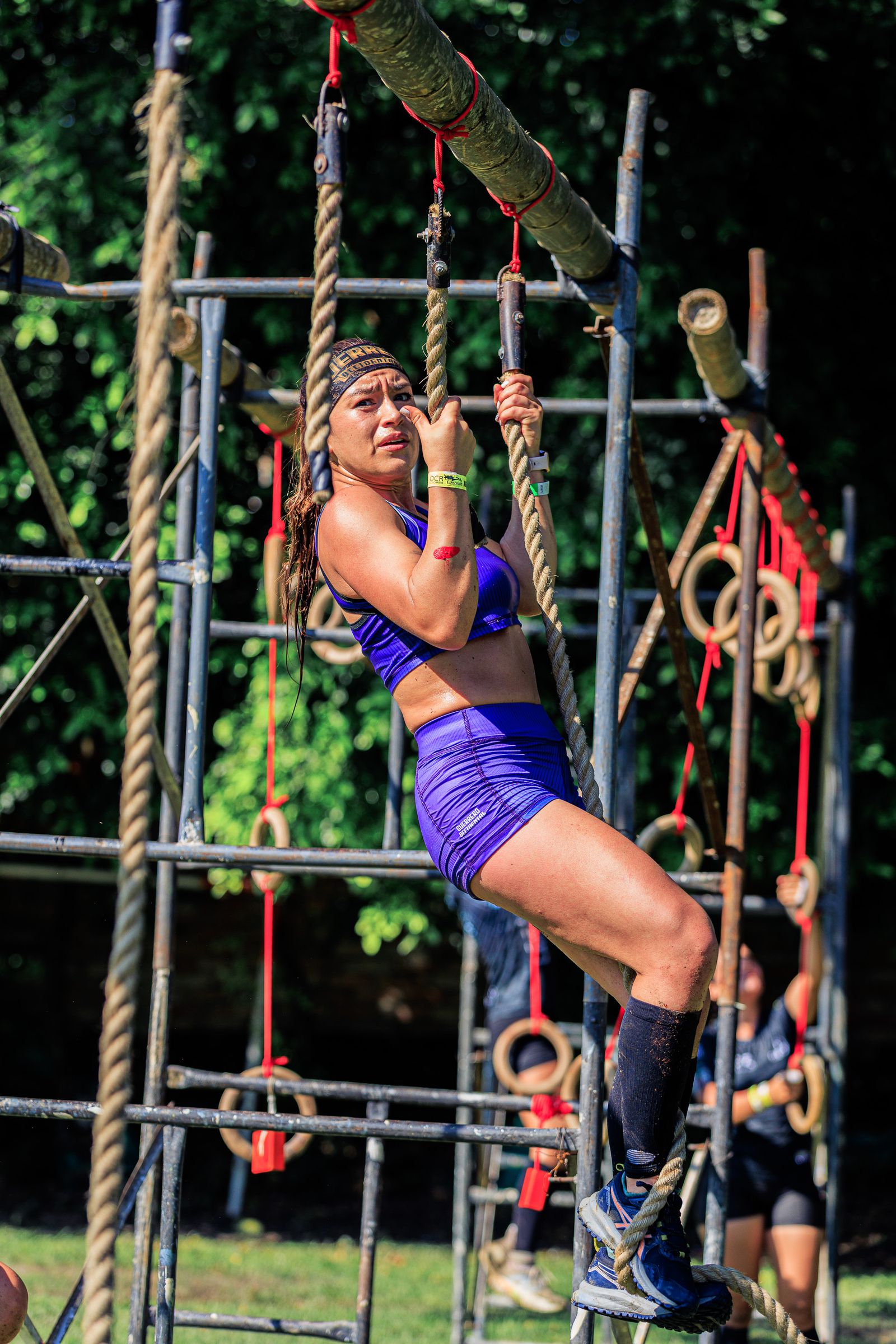
Does pickle juice work for Spartan Race and OCR athletes? Yes — registered dietitians who fuel Spartan pros target 700 to 1,000 mg of sodium per hour during the race. A 3 oz Fast Pickle shot delivers 570mg of fast-acting sodium in seconds, fits in any hydration vest pocket, and survives mud, water crossings, and barbed-wire crawls without leaking or breaking.
Spartan Race, Tough Mudder, Savage Race, and the rest of the obstacle-course-racing world demand a strange combination of qualities from your hydration: enough sodium for a four-hour effort, a format small enough to ride in a vest pocket, and packaging that doesn't get destroyed by mud crawls or barbed-wire low-crawl obstacles. Most electrolyte products are designed for a fueling-belt jog around a flat 10K. They don't survive a Beast course.
This guide breaks down exactly how much sodium you lose during a Spartan event, where the cramps actually hit (it's not random), and how to time the Tournament Day 12-pack across the three distances — Sprint, Super, and Beast — without conflicting with your gel and carb strategy.
Why OCR is uniquely brutal on sodium
A flat 10K loses sodium at a predictable rate. An OCR course doesn't. The combination of running, heavy-carry obstacles, full-body grip work, and unpredictable terrain creates a sweat-rate profile that swings up and down — and the cramps cluster at the high-output moments, not the steady-state ones.
Three OCR-specific factors raise sodium demand above a comparable road race:
- Heavy-carry obstacles (Atlas Stone, sandbag, bucket carry). These spike heart rate and sweat rate without giving you the steady stride that allows efficient thermoregulation. Most racers underestimate the sweat coming off these stations because they're stationary or near-stationary.
- Mud and water crossings. Cool water immersion masks sweat loss — you feel cooler so you drink less, but your sweat sodium loss continues during exertion. Tough Mudder athletes in particular drink less than they should because they keep feeling wet.
- Grip and forearm fatigue from rigs. The Multi-Rig, Twister, Olympus, and Spear Throw all demand sustained forearm contraction. Forearm and calf cramps hit racers near the end of the course at a much higher rate than they hit in pure-running events.
How much sodium do you actually lose in a Spartan race?
Working dietitians who fuel Spartan and OCR pros recommend 700 to 1,000 mg of sodium per hour during the race. That's higher than the 300 to 1,000 mg/hr range cited for general endurance events — and it reflects the heavy-carry sodium spike.
Translating that to the three Spartan distances:
| Race | Distance | Obstacles | Typical Time | Sodium Target |
|---|---|---|---|---|
| Sprint | 5K | 20 | 35–90 min | 600–1,000 mg |
| Super | 10K | 25 | 1.5–3 hrs | 1,500–2,500 mg |
| Beast | 21K | 30 | 3–6 hrs | 3,000–5,500 mg |
| Ultra | 50K+ | 60+ | 6–14 hrs | 6,000–12,000 mg |
A Beast or Ultra athlete in a warm venue is looking at sodium losses bigger than most non-OCR athletes will ever encounter. A reservoir of dilute sports drink alone won't cover it — you need concentrated sodium delivery between obstacles.
What Spartan water stations actually give you (and don't)
Spartan provides water and a branded electrolyte drink at every aid station. Sprint courses (5K) typically have one aid station halfway through. Super (10K) has two to three. Beast (21K) has three to four. Ultra (50K+) has four to six plus a special-needs drop bag if you set one up.
What Spartan does NOT provide at the aid stations: food, gels, or any pickle juice or sodium concentrate. The aid-station electrolyte drink delivers roughly 200 to 300 mg of sodium per 12 oz cup. If you only drink one cup per aid station — which is what most racers do because the cups are small and you're moving — you're getting 200 to 300 mg per aid station total. That covers maybe 20 to 30% of what your sodium math actually demands.
The gap gets filled by what you carry yourself. Most Beast and Ultra racers run a hydration vest (Salomon, Nathan, or Ultimate Direction) with a 1.5L reservoir mixed with an electrolyte powder, and front-mount soft flasks for additional concentrated sodium. The 3 oz Fast Pickle shot fits perfectly in the front-mount stash pocket where racers normally stuff gels.
Pickle juice vs the usual OCR electrolyte options
Here's how a 3 oz Fast Pickle shot stacks up against the products most racers actually carry, normalized to sodium per ounce so the comparison is fair across very different formats:
| Product | Format | Sodium | Sodium / oz | Sugar |
|---|---|---|---|---|
| Fast Pickle | 3 oz shot | 570 mg | 190 mg/oz | 0 g |
| LMNT | 16 oz mixed | 1,000 mg | 62 mg/oz | 0 g |
| Skratch Labs Sport | 16 oz mixed | 380 mg | 24 mg/oz | 21 g |
| Liquid I.V. | 16 oz mixed | 500 mg | 31 mg/oz | 11 g |
| GU Hydration Tabs | 16 oz mixed | 320 mg | 20 mg/oz | 0 g |
| Gatorade Endurance | 20 oz | 620 mg | 31 mg/oz | 22 g |
The Fast Pickle row wins on two metrics that matter on a Spartan course: sodium density (no extra fluid weight) and format size (the bottle survives mud and barbed-wire crawls while soft flasks of mixed powder don't always cooperate).
Related read: The 8 Best Electrolyte Drinks for Heavy Sweaters, Ranked by Sodium Density.
Why a 3 oz shot beats a vest reservoir for sodium delivery
The hydration vest reservoir is fantastic for one thing: maintaining fluid volume. It's slow, steady sipping while you run, and that keeps your blood volume up. What it's NOT good at is delivering a concentrated sodium dose at the exact moment your forearm or calf is starting to seize.
For that, you want a 3 oz shot. One twist, one sip, two seconds, done. The hypertonic concentration of pickle brine (higher salt than blood) delivers sodium quickly without the fluid bloat of drinking 12 to 16 ounces of dilute powder between obstacles.
The format also handles abuse. Most OCR courses include barbed-wire low-crawls, mud pits, and water submersions. A bottle survives all of these. A soft flask of mixed powder gets dirt in the bite valve and starts leaking sticky liquid into your vest. A bottle in a sealed plastic pouch doesn't.
The OCR obstacles where cramps strike
Cramps cluster at specific Spartan obstacles. Knowing where they hit tells you when to time your sodium intake:
- Atlas Stone Carry (50–100 ft, 80–120 lb stone). The grandfather of OCR cramp triggers. Forearms, traps, and lower back all lock up if you're sodium-depleted.
- Sandbag Carry (200–300 ft, 40–60 lb bag). Hamstrings and glutes. Late-race sandbag carries are where a lot of finishes fall apart.
- Bucket Carry (200–400 ft, 30–60 lb bucket). Forearms and biceps. The bucket position forces an awkward grip that locks up before most other muscles.
- Hercules Hoist (sandbag pulled up via pulley). Lats, biceps, and grip. Heart rate spike that sets up cramps two obstacles later.
- Spear Throw (1 attempt, 30 burpees on failure). The burpees on a missed spear are a brutal cramp accelerator — chest, shoulders, hip flexors all under load.
- Multi-Rig / Olympus / Twister (grip-strength rigs). Forearm cramps drop racers off these rigs more than actual grip failure does.
- Rope Climb (20 ft rope, often with knots). Forearms, biceps, calves. Late-race rope climbs are where racers post their worst attempts.
- Final Slip Wall + Fire Jump. Hamstring or calf cramp at the slip wall ends races in sight of the finish more often than racers admit.
When to drink Fast Pickle on race day
Sodium timing differs by distance. Here's a starting protocol — test it in training first, never on race day.
Sprint (5K, 35–90 min)
Two shots total. One 20 to 30 minutes pre-race to preload sodium. One within 10 minutes of crossing the finish line to start recovery. The single mid-race aid station handles your in-race needs for this distance.
Super (10K, 1.5–3 hrs)
Three shots. One pre-race. One mid-race, taken at the second aid station or right after the first heavy-carry obstacle (whichever comes first). One post-finish for recovery.
Beast (21K, 3–6 hrs)
Four shots minimum. One pre-race. One around the one-hour mark, before the major-carry obstacles start clustering. One around the three-hour mark, right when most racers' second-half cramps begin to threaten. One post-finish.
Ultra (50K+, 6–14 hrs)
Six to eight shots. One pre-race. One every 90 minutes throughout. Two for the back half (the 30K–50K window where Ultra athletes most often drop). One post-finish.
What about Tough Mudder, Savage Race, and Conquer the Gauntlet?
The same sodium math applies — the differences are stylistic. Tough Mudder runs more water crossings and mud pits, which cool you down and can mask sweat loss. Savage Race and Conquer the Gauntlet pack more heavy-carry obstacles into shorter courses, which raises sodium demand per mile. The 3 oz shot format works across all of them because it fits any vest, survives any condition, and doesn't need a clean water source to mix.
For team OCR events (Spartan Team Series, Tough Mudder team races), the 12-pack covers a team of three for a single race day. Each racer carries two shots, the captain carries two shots for shared post-finish recovery.
Frequently asked questions
Can I bring Fast Pickle on a Spartan Race course?
Yes. The 3 oz format fits inside any hydration vest pocket, running belt, or fanny pack. It also fits inside the small front-mount pockets on Salomon, Nathan, and Ultimate Direction vests that most Beast and Ultra athletes wear. The bottle is sealed until you twist the cap, so it survives mud, water crossings, and barbed-wire crawls.
Does Spartan provide electrolytes at water stations?
Spartan provides water and an electrolyte drink at aid stations — typically one for a Sprint, two to four for a Super or Beast. They do not provide food, gels, or pickle juice. If you want sodium between aid stations or want a specific format, you need to carry it yourself.
How much sodium does a Spartan racer actually lose?
Working dietitians who advise OCR athletes recommend 700 to 1,000 mg of sodium per hour during the race. A 90-minute Sprint athlete loses roughly the same amount as a 5K runner. A four-hour Beast finisher in a hot venue can plausibly lose 4 to 6 grams of sodium across the race.
Will pickle juice mess up my gel strategy?
No. Fast Pickle is 0 grams of sugar, so it doesn't add carbs to your in-race fueling plan. You can still hit your 30 to 60 grams of carbs per hour through gels and chews — the pickle shot just covers the sodium side.
When should I drink Fast Pickle during a Spartan race?
Most racers do well with one shot 20 to 30 minutes pre-race to preload sodium, one mid-race after the first set of heavy carries (Atlas, sandbag, bucket), and one post-finish for recovery. Beast and Ultra athletes can carry an extra shot for hour three or four.
Is Fast Pickle better than Liquid IV for OCR?
Different jobs. Liquid IV mixes into 16 ounces of water for general hydration. Fast Pickle delivers 570mg of fast-acting sodium in 3 ounces without a mixing step or extra volume — better for the moment a cramp is forming during a carry station. Many racers use both: Liquid IV in the pack reservoir, Fast Pickle in a vest pocket.
What about Tough Mudder, Savage Race, or other OCR brands?
The same sodium math applies. Tough Mudder courses tend to be muddier with more water crossings, which can mask sweat loss and lead to more cramping. Savage Race and Conquer the Gauntlet have heavier carry obstacles per mile than Spartan, which raises sodium demand. The 3 oz shot format works across all of them.
Will Fast Pickle help with the day-after recovery soreness?
The 570mg of sodium and the electrolytes in real pickle brine help replenish what you sweated out during the race. Drinking one within 30 minutes of crossing the finish line, paired with water and a real meal, supports rehydration and muscle function in the 24 to 48 hours that follow.