
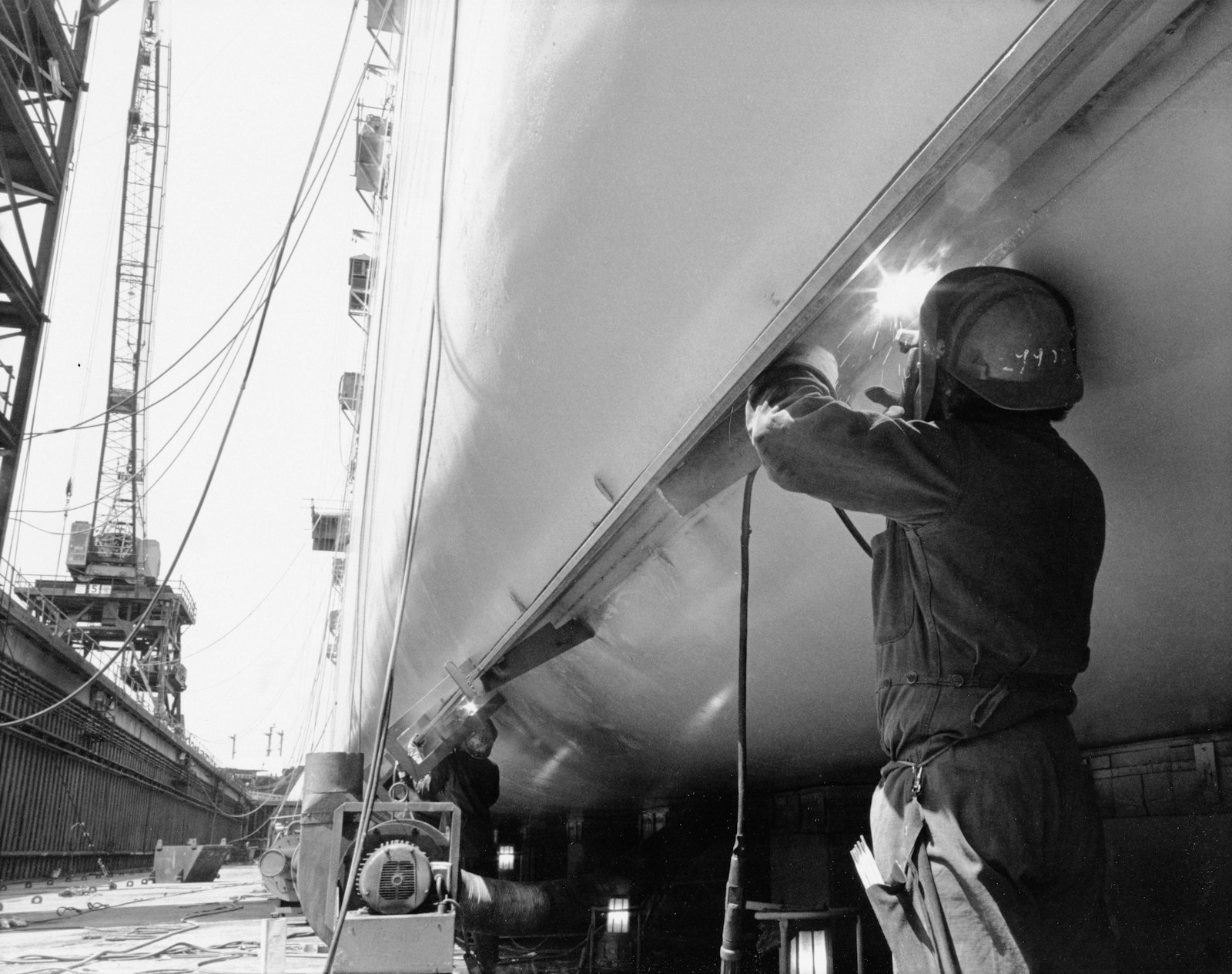
Shipyard workers cramp because the job stacks three heat multipliers that the weather forecast never sees: steel plate that radiates absorbed sun long after dark, confined tank and void spaces where OSHA notes the temperature runs higher than outside air with almost no airflow, and full PPE that blocks the evaporation your sweat depends on. A 3 oz Fast Pickle shot carries 570 mg of sodium and triggers a nerve reflex that quiets cramp signaling in roughly 85 seconds, which is faster than any sports drink can absorb and small enough to take through a manhole in a coverall pocket.
Ask a fitter, a welder, or a tacker what makes summer hard in the yard and nobody says the temperature outside. They say the double bottom. They say the third hour inside a ballast tank with a blower pointed at a hole twenty feet away. They say the deck plate you can feel through your boots at seven in the evening.
This article covers why the cramp pattern in shipyard work behaves differently from ordinary outdoor construction, what the sodium math actually looks like across a ten-hour shift, and why a 3 oz brine shot fits a trade where a cooler cannot follow you into the space.
A Shipyard Is Three Heat Environments at Once
Most heat guidance assumes a single environment. A shipyard is not one environment, it is three, and a single worker can move through all of them before lunch.
On the ways and the dock. Open ground, no shade, and a hull that behaves like a radiator. Steel absorbs solar load all day and re-emits it, so a staging platform against a black-primed hull is measurably hotter than the same spot in an open lot. That radiant component does not switch off when the sun goes down, which is why the second shift often takes the worst of it.
Inside the vessel. Tanks, voids, cofferdams, engine rooms, and double bottoms. OSHA's shipyard-specific guidance on heat illness in confined spaces is blunt about the mechanics: the temperature inside is often higher than the outside air, airflow is usually low, and PPE causes body overheating. Add hot work to that and you are generating heat in a box that has no way to shed it.
Under the hood. Welding hoods, respirators, leathers, hard hat, harness, and in some yards a supplied-air setup on top. Every layer is another barrier between your sweat and the air it needs to evaporate into.
The practical result is that a hydration plan built around the shipyard's weather station will systematically under-deliver, because none of the three environments that matter are what the weather station is measuring.
Why Confined Space Work Drives the Cramp Curve
Sweat only cools you when it evaporates. Evaporation requires air movement and air that is not already saturated. A double bottom, a ballast tank, or a void with a single blower gives you neither. Humidity inside the space climbs as the crew sweats into it, and once the air is near saturation your sweat stops working as a cooling mechanism entirely. You keep paying the full cost of sweating, including the sodium, and you collect none of the benefit.
OSHA's shipyard heat publication recommends ventilating the space to bring in cooler air, checking the temperature before entry, running a buddy system, and providing cool drinking water with the guidance that workers drink about one cup every 20 minutes. That is sound volume advice and it is also incomplete, because one cup of water every 20 minutes across a ten-hour shift is roughly 3.7 liters of plain water going in against a sodium loss the water does nothing about.
Acclimatization is the other half of it. OSHA's 20% rule holds that a new or returning worker should spend no more than 20% of the shift at full intensity in the heat on day one, increasing by no more than 20% per day. Yards running heavy hiring or bringing travelers in for an availability are constantly cycling unacclimated people into the hottest spaces on the job. An unacclimated worker sweats later and wastes more sodium doing it, which is exactly why cramp incidents cluster in a new hire's first week rather than their tenth.
The Sodium Math on a Ten-Hour Shift
Sweat sodium concentration varies a lot between individuals. Average sweaters lose roughly 500 to 1,000 mg of sodium per liter of sweat. Heavy salty sweaters, the ones with white rings dried into a navy coverall by second break, run 1,500 to 2,500 mg per liter. Sweat rates in hot work commonly land between 0.5 and 1.5 liters per hour, and confined space work with full PPE pushes toward the top of that band.
Take a conservative case. A tank welder sweating 1 liter per hour at 900 mg of sodium per liter is losing about 900 mg per hour. Across nine working hours that is roughly 8,100 mg of sodium out the door. The water station on the pier replaces none of it, and neither does the ice chest in the shop.
Here is how the common options compare on sodium density, which is the number that actually matters when your carrying capacity is a chest pocket rather than a cooler.
| Option | Serving | Sodium | Sodium per oz | Added sugar |
|---|---|---|---|---|
| Fast Pickle 3 oz shot | 3 oz | 570 mg | 190 mg | 0 g |
| LMNT (mixed) | 16 oz | 1,000 mg | 63 mg | 0 g |
| Liquid I.V. (mixed) | 16 oz | 500 mg | 31 mg | 11 g |
| Gatorade Thirst Quencher | 20 oz | 270 mg | 14 mg | 34 g |
| Water | 16 oz | 0 mg | 0 mg | 0 mg |
A 3 oz shot carries more than twice the sodium of a 20 oz bottle of Gatorade in one-seventh the volume. When the only thing that fits through the manhole with you is what is already in your pockets, density is the entire argument.
The Neural Reflex Behind a 3 oz Shot
The reason a small volume of brine works faster than a large volume of sports drink has nothing to do with absorption. It is a nerve response, and it was measured directly.
In a 2010 study published in Medicine & Science in Sports & Exercise, Miller and colleagues induced cramps in hypohydrated subjects and compared pickle juice against deionized water. Cramp duration after pickle juice averaged 84.6 seconds, compared with 133.7 seconds after water, a difference of roughly 49 seconds. Critically, the researchers concluded the effect could not be explained by restoration of body fluids or electrolytes, because the timeline was far too short for the sodium to have been absorbed and distributed.
What they proposed instead was a reflex originating in the oropharyngeal region, the back of the mouth and throat, triggered by the acetic acid in the vinegar. That reflex reduces firing in the alpha motor neuron pool serving the affected muscle. In plain terms: the sour hit at the back of your throat tells the overfiring nerve to settle down. The sodium arriving behind it addresses the underlying deficit on a slower clock.
That two-stage behavior is why format matters more than volume. You do not need to drink a liter to get the reflex. You need the brine to reach the back of your throat. A 3 oz Fast Pickle shot is built for exactly that: small enough to ride in a coverall pocket through a manhole, quick enough to take without breaking out of the space, and carrying 570 mg of sodium behind the reflex.
What Doesn't Work in the Yard
Water alone. The default yard answer is a water station and a reminder to drink. Water addresses volume, not sodium. Drinking heavily from a water-only source while losing 900 mg of sodium per hour moves you toward dilution, not recovery, and dilution is its own problem on a long summer shift.
Sugary sports drinks. A 20 oz bottle with 34 g of added sugar and 270 mg of sodium is mostly sugar water for this application. It also has to clear your stomach before it does anything, which is the wrong timeline when a forearm is already locking up on a stinger.
Powder sticks. Powders need a clean bottle, clean water, and about a minute of free hands. Inside a tank in a harness with gloves on and a hole watch counting heads, you have none of those. A sealed single-serve shot does not require mixing, does not spill into the space, and does not need refrigeration.
Salt tablets. Tablets deliver sodium and nothing else, and they sit badly on an empty stomach late in a long shift. They also skip the reflex entirely, so there is no fast-acting component at all when you actually need one.
Quick Reference: Shipyard Shift Protocol
- Pre-shift: Eat sodium with breakfast. Start topped up rather than trying to catch up in hour eight, because you cannot catch up in hour eight.
- Before entry: Take water on a schedule, not on thirst. Thirst lags fluid deficit, and it lags further under a hood.
- Mid-shift: One 3 oz shot at the halfway mark as routine, not as a reaction. For most crews this is the single highest-leverage change.
- At first twitch: Take a shot immediately. The reflex works fastest before a full cramp establishes itself, and a cramp inside a tank is a rescue problem, not just a pain problem.
- Between spaces: Use the ventilation and cool-down breaks you are entitled to. Sodium replacement is a layer on top of rest, not a substitute for it.
- Crew stock: Keep a case in the tool crib, the shop gang box, or the safety trailer so a shot is a short walk instead of a trip to the gate.
Frequently Asked Questions
How fast does a pickle shot work on a cramp?
In the Miller 2010 trial, cramp duration after pickle juice averaged about 85 seconds versus roughly 134 seconds after water. The response is driven by a nerve reflex at the back of the throat rather than by digestion, which is why it registers well before the sodium could possibly be absorbed.
Why do I still cramp when I drink water all shift?
Because water replaces volume but not sodium. If you are losing roughly 900 mg of sodium per hour and replacing it with plain water, you are diluting the sodium you have left. That pattern is common in confined space work, where sweat output is high but evaporative cooling is blocked by saturated air and PPE.
Is tank work really hotter than working topside?
OSHA's shipyard guidance on confined spaces states plainly that the temperature is often higher than outside air, airflow is usually low, and PPE contributes to overheating. Add hot work inside the space and the heat you generate has nowhere to go, which is why crews check the space temperature and ventilate before entry.
How many shots does a ten-hour shift take?
Most crews use two: one at mid-shift as routine maintenance and one held in reserve for the first sign of a cramp. On a heavy tank day or for a known salty sweater, three is reasonable. The shots are the fast-acting layer on top of steady water and salted meals, not a replacement for either.
Does it need refrigeration or a cooler?
No. The shots are shelf-stable, which is the point for a trade where the cooler stays on the pier and you do not. A case lives fine in a gang box or a tool crib through a summer.
Can a yard or a contractor buy these for a whole gang?
Yes. Safety departments and superintendents typically stock the 12-pack where the work is, so it is available at the space rather than at the gate. No mixing, no refrigeration, no cleanup inside a tank.
The Science Behind the Bottle
Fast Pickle is a 3 oz shot of purpose-built brine: 570 mg of sodium, zero added sugar, under 1 g of carbohydrate, and the vinegar content that drives the oropharyngeal response documented in the cramp literature. It is not a daily hydration plan. It is the fast-acting piece that sits on top of one, sized for a trade where your carrying capacity is a chest pocket and the nearest cooler is on the other side of a manhole.
For the roughly 105,000 people working in U.S. shipbuilding and repair, the case is straightforward. The heat load is higher than the forecast suggests, confined spaces guarantee you will sweat more than you cool, and hiring cycles keep putting unacclimated workers into the hottest spaces on the job. A format that delivers 190 mg of sodium per ounce and works on a nerve-reflex timeline is built for exactly that problem.
*These statements have not been evaluated by the Food and Drug Administration. This product is not intended to diagnose, treat, cure, or prevent any disease. Individual results may vary. If you experience symptoms of heat exhaustion or heat stroke, leave the space, stop work, and seek medical attention.