
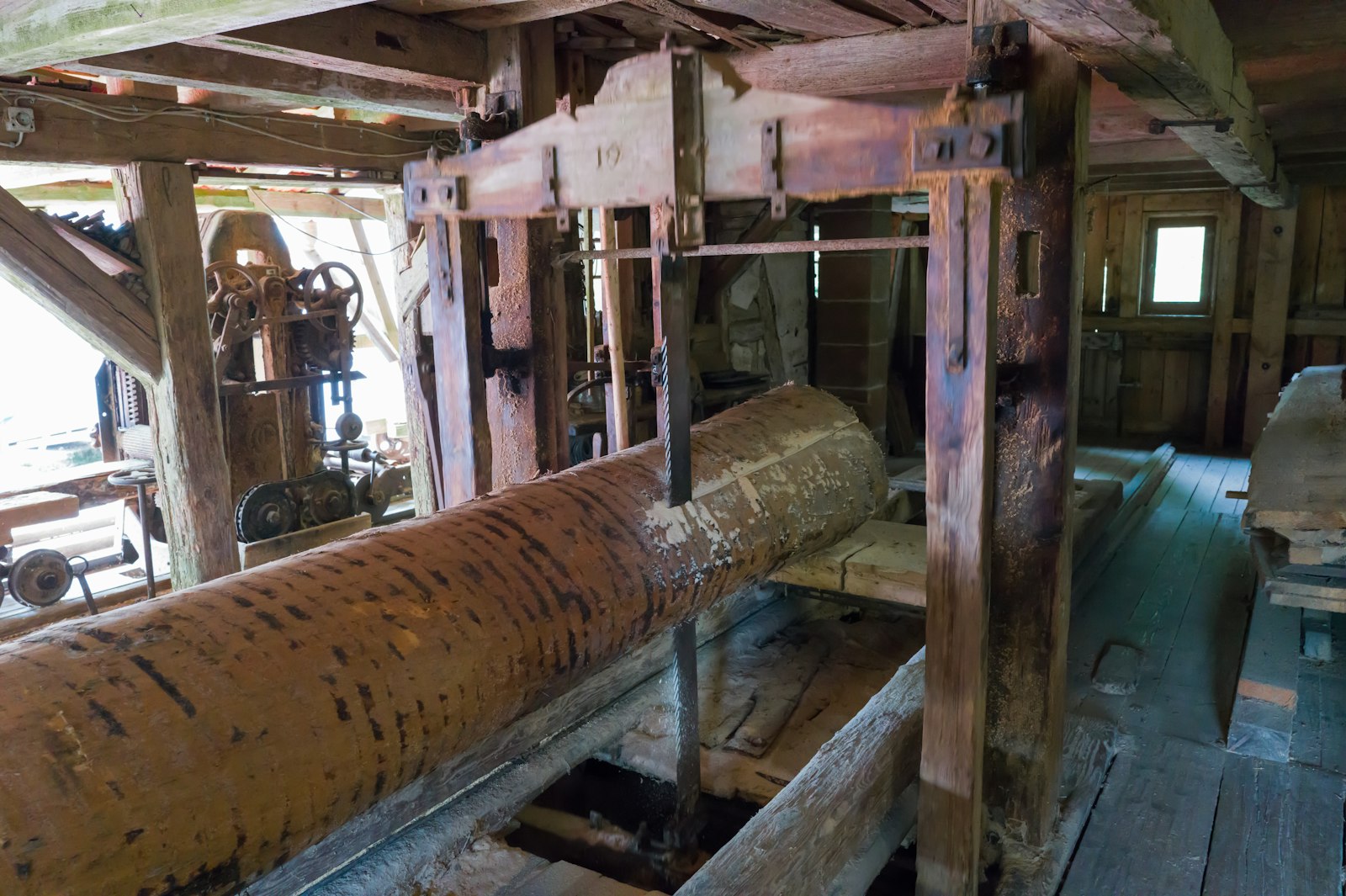
Sawmill workers cramp because the mill is filed under manufacturing while the work is done in heat that rivals any roof. Dry kiln schedules run 110°F to 180°F for conventional runs, 180°F to 212°F for elevated schedules, and above 212°F for high-temperature softwood drying, and OSHA's own sawmill standard assumes the kiln is hot enough that workers need a separate warm room on the way out in winter. Sweat carries roughly 460 to 1,840 mg of sodium per liter and the water cooler carries none, so a ten-hour turn on the green chain drains salt that volume alone never replaces. A 3 oz pickle brine shot puts 570 mg of sodium back and triggers a throat reflex that cut electrically induced cramp duration to about 85 seconds in the Miller 2010 study, roughly 37% faster than water.
The Mill Is Classified As Manufacturing. The Kiln Is Not.
Heat guidance in this country is built around a mental image of a guy on a roof. Outdoor, sun overhead, obvious. That image is why roofing crews, paving crews and farmworkers get the safety talks, and why a sawmill hand almost never does.
But a mill is not an air-conditioned factory. It is a metal building with open bays, a continuous run of machinery throwing off heat, and a dry kiln operating at temperatures that would cook anything left in it. The Bureau of Labor Statistics counts roughly 393,600 people in wood product manufacturing as of March 2026, with about 302,300 of those in production and nonsupervisory roles. Sawmills and wood preservation account for a large block of that, and almost none of it gets treated as a heat trade.
The heat is real anyway. And so is the sodium it takes out of you.
What OSHA's Own Sawmill Guidance Says, And What It Leaves Out
OSHA maintains a dedicated Sawmills eTool, and its plant-wide hazards section has a page on heat stress. It is worth reading, because it is unusually direct about the mechanism.
On heat cramps, OSHA writes that they usually follow prolonged heat exposure, that they affect people who sweat a lot during strenuous activity, and that the body is depleted of salt and moisture — the decreased salt being what causes the painful cramping in the abdomen, arms or legs. That is a plain statement that the cramp is a salt problem, published by the regulator, on a page about sawmills.
Then look at what the same page recommends doing about it:
- Acclimatize new workers gradually, over seven to 14 days.
- Schedule the bulk of the work early morning or late afternoon.
- Allow frequent breaks.
- Have workers drink cool — not ice cold — liquids, a small cup every 20 minutes.
- Avoid heavy caffeine and alcohol.
- Eat frequently, in small amounts.
- Wear layered cotton clothing.
- Work in pairs.
All of that is sound. But notice the shape of it. OSHA identifies the deficit as salt and moisture, and then the hydration instruction is a volume instruction: a small cup every 20 minutes. Nothing in the list says what should be in the cup.
Over a ten-hour turn, a small cup every 20 minutes is around thirty cups. If those thirty cups are plain water, you have addressed exactly one of the two things OSHA just told you were depleted. The "eat frequently, in small amounts" line is doing a lot of quiet work as the only sodium in the whole protocol.
The Kiln Is The Part Nobody Outside The Mill Understands
Drying schedules are not a vague "it gets warm in there." They are published temperature programs, and they are hot.
Kiln schedules sort into three bands: conventional-temperature schedules below 180°F, elevated-temperature schedules from 180°F to 212°F, and high-temperature schedules above 212°F. A typical hardwood schedule starts around 110°F to 120°F at 70 to 80 percent relative humidity while the lumber is still green, then climbs to 170°F or 180°F as moisture content drops into the 10 to 15 percent range. Softwood pine is commonly run at 180°F to 210°F and held there for the length of the charge.
Two things follow from that, and both matter for cramping.
First, the humidity. Early in a hardwood schedule the kiln is deliberately held at 70 to 80 percent relative humidity. High heat plus high humidity is the combination that shuts down evaporative cooling, which is the only cooling mechanism you have. You sweat, it does not evaporate, and your core temperature climbs anyway. Your body keeps spending sodium on a cooling process that is not working.
Second, OSHA's sawmill standard, 29 CFR 1910.265, takes the kiln seriously as a thermal environment in a way most break room posters do not. It requires kiln pits to be well ventilated, drained and lighted, and large enough to safely hold the operator along with the valves, dampers, damper rods and traps. It requires high-pressure steam mains in or next to an operating pit to be covered with heat-insulating material. And it requires that during cold weather, a warm room be provided for kiln employees after they leave a hot kiln, because the swing from kiln heat to cold air is itself a hazard.
Read that last one again. The regulation assumes the temperature drop on the way out is severe enough to need its own room. That is the building you are sweating in.
Where The Heat Actually Comes From On A Mill Floor
OSHA's heat guidance names four contributors: air temperature, humidity, radiant heat from sunlight or artificial sources such as furnaces, and air movement. A sawmill supplies all four, from several directions at once.
- The kiln and the boiler. Artificial radiant heat, running continuously through the charge. A kiln does not take the afternoon off because it hit 95°F outside.
- The building itself. Metal roof, metal siding, large open spans. On a clear summer day the roof deck is absorbing sun all afternoon and re-radiating it down onto the line well after the sun has moved.
- The machinery. Headrigs, edgers, planers, chippers and motors all dump waste heat into the same air you are breathing. A planer mill in August is not cooler than the yard, it is usually warmer and with less breeze.
- Your own metabolic load. Pulling on the green chain, stacking, stickering, banding and hand-feeding are heavy physical work. OSHA's heat stress framing lists physical activity as a direct contributor, and metabolic heat is the one source you carry with you into every room.
- PPE. Hard hat, eye and hearing protection, cut-resistant gloves, sometimes a respirator for dust. Every layer is a layer sweat has to get through before it can evaporate.
NIOSH's criteria call for heat-stress work practices once a one-hour time-weighted average WBGT runs above about 79°F for continuous work. Plenty of mill jobs clear that on an ordinary July afternoon without anybody logging it, because nobody is walking the planer mill with a WBGT meter.
Four Things Mill Crews Deal With That Outdoor Trades Do Not
1. The heat has no season and no weather
A roofing crew reads the forecast and adjusts. A kiln operator's environment is set by a drying schedule, not by the sky. Rain does not help you. An overcast day does not help you. October does not help you much either, because the kiln is running the same program it ran in July. That means the crew never fully gets the natural off-season that lets an outdoor trade recover, and it also means the crew is less likely to think of itself as working in heat at all.
2. You cycle between extremes in the same shift
Green chain to kiln to yard to planer. In winter that is a genuinely violent swing, which is exactly why OSHA wrote the warm-room requirement. Each move into heat restarts the sweat response, and cardiovascular strain shows up on the transitions, not just at the peaks. A shift spent moving between hot and cold zones produces more total sweat loss than the average temperature would suggest.
3. Acclimatization is fragile and mills have high turnover
OSHA's sawmill page puts acclimatization at seven to 14 days of gradual introduction. Mills run new hires, seasonal help, temp labor and people coming back from layoffs, shutdowns, hunting season and vacation. Every one of those is somebody functionally unacclimatized standing next to a kiln on day one. The single worst day in any hot trade is usually somebody's first day back, and a mill generates more of those days than most.
4. The dust makes the hydration worse
Sawdust means many crews wear a respirator or a dust mask through the turn. A mask is a barrier to evaporative cooling, and more practically, it is a reason not to drink. Every sip means breaking the seal, stepping back, pulling it down. Across ten hours that friction adds up to real missed fluid, and it is invisible on any safety checklist.
The Sodium Math On A Ten-Hour Turn
Reviews of sweat testing put sweat sodium concentration at roughly 460 to 1,840 mg per liter, with an average near 826 mg/L across a pooled sample of about 506 athletes. That spread is mostly genetic. The saltiest sweaters lose four to five times what the least salty lose at the same sweat rate, which is why two guys on the same chain can have completely different days.
Run it against plausible mill sweat rates for a hot turn:
- 2 liters of sweat — 920 to 3,680 mg of sodium out.
- 4 liters of sweat — 1,840 to 7,360 mg of sodium out.
- 6 liters of sweat — 2,760 to 11,040 mg of sodium out.
No 3 oz bottle covers the top of that column, and this page is not going to pretend one does. Closing a gap that size is a full-day job: salt on your food, sodium in what you drink through the turn, and an honest look at what you ate before the shift started. The shot is not the daily plan.
What the shot is for is the moment a calf or a forearm locks up with three hours left on the charge, when you need the fastest documented response available plus 570 mg heading back into the tank.
Sodium Per Ounce: What Is Actually In The Break Room Cooler
| What you drink | Typical serving | Sodium | Sodium per oz |
|---|---|---|---|
| Water | 20 oz | 0 mg | 0 mg |
| Coconut water | 11 oz | 60 mg | ~5 mg |
| Powerade | 20 oz | 250 mg | ~13 mg |
| Gatorade Thirst Quencher | 20 oz | 270 mg | ~14 mg |
| Pedialyte | 12 oz | 370 mg | ~31 mg |
| Liquid I.V. stick in water | 16 oz | 500 mg | ~31 mg |
| LMNT stick in water | 16 oz | 1,000 mg | ~63 mg |
| Fast Pickle 3 oz shot | 3 oz | 570 mg | 190 mg |
The per-ounce column is the argument for a mill. OSHA already told you to take a small cup every 20 minutes, so volume is not your constraint — you are drinking plenty. Density is the constraint. A 3 oz shot with 570 mg of sodium carries more sodium than two full 20 oz sports drinks, in three ounces instead of forty, and three times the sodium per ounce of the densest electrolyte stick on the shelf. It also does not require you to find a bathroom in a building where the nearest one is a long walk from the deck.
Why 3 oz Works On A Reflex, Not On Absorption
The obvious objection is arithmetic. If you just lost several thousand milligrams of sodium, 570 mg cannot possibly fix anything in a minute. That objection is correct, and it is aimed at the wrong mechanism.
In Miller et al. 2010, published in Medicine & Science in Sports & Exercise, researchers induced cramps electrically in dehydrated subjects and then gave them about 1 mL per kilogram of body weight of pickle juice — roughly 73 mL, close to a 3 oz shot. Cramps resolved in an average of 85 seconds, about 37% faster than with deionized water and 45% faster than with no fluid at all.
The important detail is what the blood work showed. Five minutes after ingestion, plasma electrolyte composition had barely moved. Nothing had absorbed yet. The relief arrived before the sodium could possibly have reached the muscle.
The explanation that fits is a reflex in the throat. Acetic acid from the vinegar hits receptors in the oropharynx, and the resulting nerve signal damps the runaway alpha motor neuron firing producing the cramp. Follow-up work found that mouth rinsing alone produced a comparable effect, which is difficult to explain any other way.
So there are two separate jobs happening, on two separate clocks. The vinegar is the fast signal. The 570 mg of sodium is the slow refill, moving on the ordinary digestive timeline like everything else you swallow.
The Mill Shift Protocol
- Salt dinner the night before, not just breakfast. You want to clock in already topped off. Trying to catch up in the parking lot at 5:50 a.m. does not work, and it is the most common version of this mistake.
- Put sodium in the cup OSHA told you to fill. A small cup every 20 minutes is roughly thirty cups across a ten-hour turn. That volume is a delivery vehicle you already have. Unsalted, it is working against you.
- Treat your first shift back like your first week. After a layoff, a shutdown, vacation, hunting season or a stretch of sick days, you are functionally unacclimatized. OSHA's own number is seven to 14 days to adapt. Slow the ramp and tell your lead.
- Respect the kiln-to-yard swing. In cold weather that transition has its own OSHA requirement for a reason. Do not treat coming out of the kiln as your break.
- Drink before you mask up, not after. If dust protection is making you skip sips, front-load fluid at every scheduled break instead of relying on grabbing one mid-run.
- Keep a shot in the lunchbox, not just the cooler. Cramps do not wait for you to cross a mill. It is shelf stable, so a bottle lives fine in a bag all week. Cold is nicer, warm still works.
- Weigh yourself across one turn. Losing more than about 1.5% of body weight in a shift is the standard risk flag, and it is the cheapest measurement in this entire article. A bathroom scale, twice.
When It Is Not Just A Cramp
OSHA's sawmill heat page separates the three conditions clearly, and the distinction is worth knowing on the floor.
Heat cramps are muscle pains or spasms in the abdomen, arms or legs, sometimes with a sick feeling in the stomach. Heat exhaustion looks like dizziness, weakness, heavy sweating, pale skin, nausea or vomiting, irritability, moist clammy skin, and fainting. Heat stroke is the emergency: red hot dry skin, a rapid strong pulse, body temperature at or above 105°F, confusion in talking or acting, throbbing headache, or loss of consciousness. OSHA notes body temperature can reach 106°F or higher within 10 to 15 minutes.
The line that matters most is sweating stopping. If somebody is hot, dry and confused, that is not a hydration decision, that is a 911 call. Fast Pickle is a beverage, not a treatment for heat illness, and nothing in a bottle substitutes for getting a worker in trouble to medical care.
Nationally, environmental heat produced an average of 38 workplace fatalities a year and about 2,700 cases with days away from work between 2011 and 2019. Those numbers are the reason the early signal is worth acting on.
Common Questions
Is a sawmill really a heat job? It is indoors.
Indoors is not the same as cool. The heat sources in a mill are artificial and continuous: kilns running published schedules from 110°F up past 212°F, boilers, motors, and a metal building re-radiating afternoon sun. OSHA maintains a heat stress page inside its Sawmills eTool specifically because the hazard is real in this industry.
I already drink water constantly. Why do I still cramp?
Because water addresses one half of the loss. OSHA's own description of heat cramps is that the body is depleted of salt and moisture, and that the decreased salt is what causes the cramping. Replacing moisture without salt leaves the actual driver untouched, and at very high volume it can push serum sodium lower.
How fast does it actually work?
In the Miller study, electrically induced cramps ended in roughly 85 seconds with pickle juice, about 37% faster than with water and 45% faster than with nothing. That speed comes from the throat reflex, not absorption. The sodium follows on the normal timeline.
Does it have to be cold?
No. It is shelf stable, which is the point in a building where the nearest cooler might be two hundred feet and a set of stairs away. Cold tastes better. Warm works the same.
Is 570 mg of sodium too much?
It is roughly a quarter of general daily sodium guidance, taken by somebody who may have sweated out several times that in a single turn. Context decides it. If you are on a sodium-restricted diet or managing blood pressure, talk to your doctor before adding any sodium product, same as you would with anything else.
What about the guys on night shift?
Night helps with solar load and does not help with the kiln, the boiler or the machinery, which run the same either way. A mill building also holds heat well past sundown. Night crews get a real break on radiant sun and very little break on everything else.
6-pack or 12-pack?
The 6-pack is the cheap way for one person to find out whether it does anything for them. The 12-pack is the one that makes sense for a mill, because rotating ten- and twelve-hour turns next to a kiln produce a real usage rate rather than an occasional bad day, and because the second guy on the chain who asks for one is never far behind the first.
The Short Version
A sawmill is a heat trade that does not get counted as one. Dry kilns run published schedules from 110°F through 212°F and above, early hardwood runs hold 70 to 80 percent relative humidity on purpose, the building re-radiates sun all afternoon, and OSHA's sawmill standard assumes the kiln is hot enough that leaving it in winter needs its own heated room.
OSHA names the deficit correctly — salt and moisture — and then hands you a hydration plan made entirely of volume. Sweat carries 460 to 1,840 mg of sodium per liter. The cup does not carry any. A 3 oz brine shot gives you 570 mg of sodium and a documented throat reflex that cut induced cramp duration to about 85 seconds in the Miller data. Salt the meals, salt the fluid, respect your first shift back, and keep a shot in the lunchbox for the moment your leg locks up with three hours left on the turn.
*These statements have not been evaluated by the Food and Drug Administration. This product is not intended to diagnose, treat, cure, or prevent any disease. Individual results may vary.