
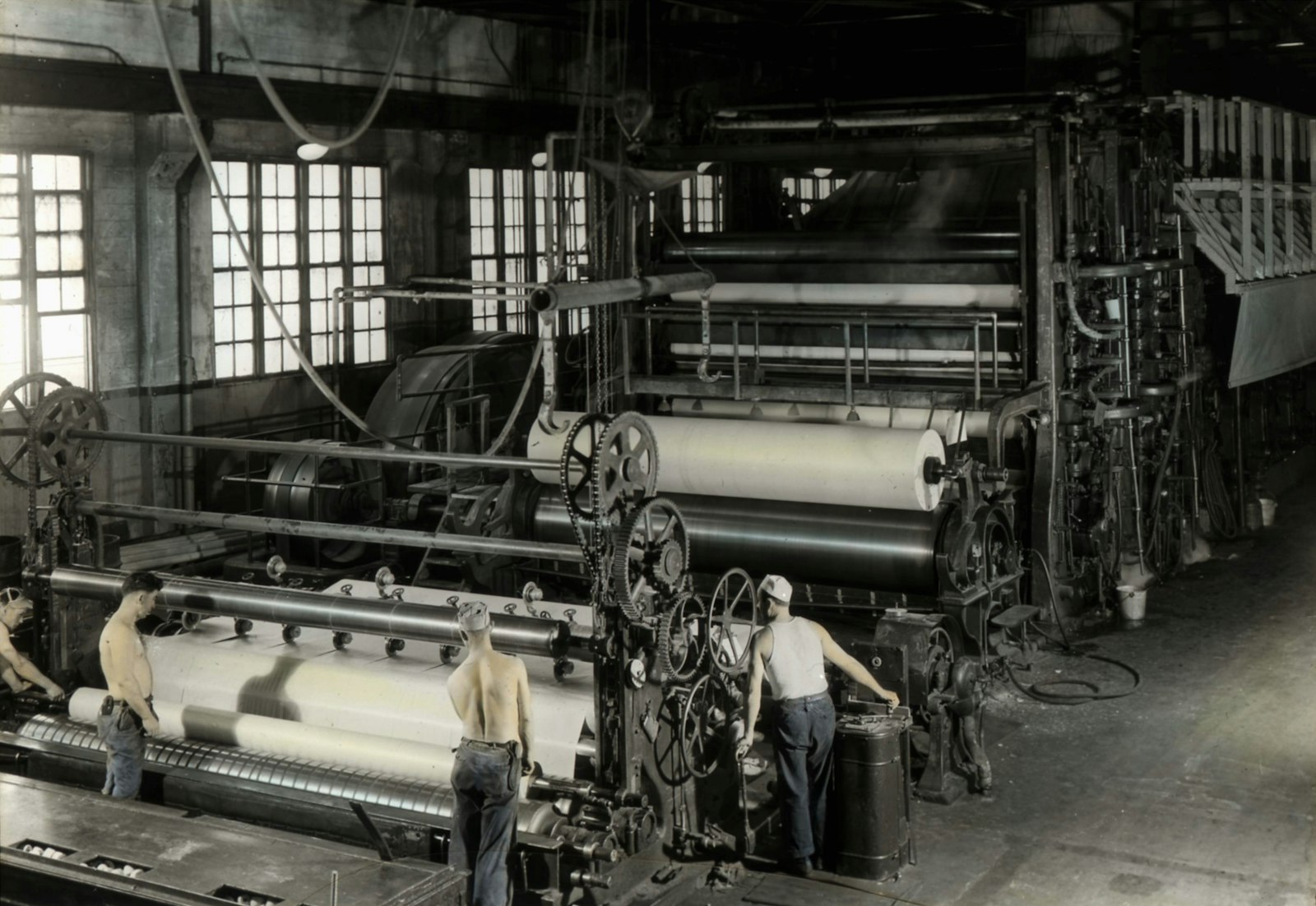
Paper mill workers cramp because the mill runs a heat load that never shuts off. Dryer cans hold shell temperatures in the range of 212°F to 284°F, the hood dumps evaporated water straight into the air you are breathing, and the schedule is twelve hours on a rotating shift rather than a summer afternoon. Sweat carries roughly 460 to 1,840 mg of sodium per liter, so a machine tender who loses three liters across a shift can be down 1,400 to 5,500 mg of sodium with nothing but water going back in. A 3 oz pickle brine shot puts 570 mg of sodium back and triggers a swallowing-reflex response that shortened electrically induced cramps to roughly 85 seconds in the Miller 2010 study, far faster than any drink can absorb.
The Mill Does Not Have A Hot Season
Almost every trade in this series has a calendar. Roofers get destroyed in July and coast in October. Landscapers work an outdoor season. Asphalt crews chase the paving window. The heat is real, but it arrives, it peaks, and it leaves.
A paper machine does not care what month it is. The dryer section is a row of steam-heated cylinders, anywhere from ten to seventy of them depending on the machine, and their outer shells typically sit somewhere between 212°F and 284°F. That heat is not weather. It is process. It is there in January at 2 a.m. and it is there in August at 2 p.m., and the only difference between the two is whether the outside air gives you any relief when you walk out to the yard.
That single fact changes the hydration problem completely. Seasonal trades can survive on a bad plan for a few months because the season ends before the deficit catches up with them. Mill workers cannot. A machine tender, a back tender, a fifth hand, a broke hustler, a recovery boiler operator, a lime kiln operator, a roll wrapper on the finishing end: these are people working a heat job 200-plus days a year, most of them on twelve-hour rotating shifts, which is a fundamentally different problem than surviving a hot week.
Where The Heat Actually Comes From
It helps to name the sources, because mill heat is layered and workers often blame the wrong one.
- The dryer section. Steam-heated cans running roughly 212°F to 284°F on the shell, in a row, radiating into the aisle you walk to do a sheet break or a felt check.
- The hood and the pocket ventilation. The dryer hood exists to pull evaporated water out of the machine. That water has to go somewhere, and the pathway runs through the air on the machine floor before it reaches the exhaust.
- The recovery boiler and the lime kiln. On the pulp side these are the hottest fixed positions in the building, and they run continuously.
- Steam lines and hot surfaces. OSHA's own pulp and paper hazard guidance calls out hot surfaces and high temperatures as a standing hazard in mills, driven by the steam and friction the papermaking process generates.
- The building itself. A machine hall is a large enclosed structure with a continuous heat source inside it. Once the mass of that building is warm, it stays warm.
Add those together and you get a workplace where the air temperature on the machine floor is only part of the story. The radiant load off the cans and the humidity off the hood are the other two parts, and those are the two that break your cooling system.
Four Reasons Mill Workers Cramp That Other Trades Do Not Have
1. Humid heat cancels the only cooling system you own
Sweating does not cool you. Sweat evaporating cools you. When the air around you is already loaded with moisture, evaporation slows down, and the sweat runs off your arms and into your boots without buying you anything. You pay the full sodium and fluid cost of sweating and collect almost none of the cooling benefit.
This is why NIOSH uses wet bulb globe temperature rather than a plain thermometer to judge heat stress. WBGT folds in humidity, radiant heat, and air movement, because those three are what actually determine whether your body can shed heat. A mill floor at 88°F with high humidity and a wall of radiant cans is a harder physiological job than a dry 100°F day outside with a breeze, and the thermometer on the wall will never tell you that.
2. Twelve-hour rotating shifts stack the deficit
An eight-hour trade gets sixteen hours to recover. A twelve-hour mill shift gets twelve, and on a rotating schedule some of those twelve are spent sleeping during daylight, poorly, in a body that is still short on fluid and sodium from the shift before.
The mill worker's cramp is rarely the product of one bad shift. It is the product of the fourth night in a row where the deficit never fully closed, which is why the cramp so often arrives at the end of a stretch rather than on day one of it.
3. The heavy work is bundled into the worst spots
Mill work is not uniformly heavy. It is long stretches of monitoring punctuated by short bursts of genuinely hard physical labor, and the hard bursts almost always happen in the hottest places. Clearing a sheet break at the dryer section. Changing a felt or a wire. Hustling broke. Pulling and wrapping rolls on the finishing end. Confined-space work in a tank or a chest during an outage.
Your body generates metabolic heat when you work hard, and that heat adds to the environmental heat rather than competing with it. NIOSH treats occupational heat stress as exactly that sum: metabolic heat plus environmental heat plus whatever your clothing and PPE trap against your skin. The bursts are where all three peak at once.
4. FR clothing and PPE are a third layer of insulation
Flame-resistant clothing, hearing protection, safety glasses that fog, gloves, and steel-toe boots are not optional in a mill. They are also, thermally speaking, a barrier between your skin and any air movement that might have helped. Whatever evaporation the humidity had not already killed, the clothing finishes off.
The Sodium Math On A Twelve-Hour Shift
Sweat is not water. It is water with minerals in it, and sodium is the one that matters most for cramping.
Published sweat sodium data puts the range at roughly 460 to 1,840 mg of sodium per liter of sweat, with an average around 950 mg/L across large athlete samples. That spread is genetic and it is wide: the saltiest sweaters lose four to five times what the least salty lose from the identical amount of sweat. If your hard hat liner and your FR shirt come out of a shift with white salt rings on them, you are near the top of that range, not the middle.
Run the arithmetic on a mill shift. A worker sweating two to three liters across twelve hours, which is conservative for a machine floor in summer, is losing somewhere between roughly 900 mg and 5,500 mg of sodium depending on where they sit in that range. Replace it with water alone and you have restored volume and replaced none of the mineral, which is the exact setup for a cramp in the calf, the hamstring, or the hand that has been gripping tools.
Sodium Per Ounce: What Is Actually In The Break Room Cooler
The number worth comparing is sodium per ounce, not sodium per bottle, because per-bottle numbers hide how much liquid you have to move to get the mineral.
- Pickle brine shot: roughly 190 mg of sodium per ounce. 570 mg in a 3 oz shot.
- Standard sports drink: roughly 5 to 9 mg of sodium per ounce. You would have to drink the better part of a gallon to reach what one shot carries, and you would take on a large sugar load doing it.
- Coconut water: roughly 3 to 6 mg per ounce. It is a potassium drink, not a sodium drink.
- Water: zero. Useful for volume, does nothing for the mineral deficit, and in large amounts with no sodium it dilutes what you have left.
This is not an argument that sports drinks are useless. It is an argument that they are built for a sixty-minute game, not a twelve-hour shift next to a dryer hood, and the sodium density reflects that.
Why 3 oz Works On A Reflex, Not On Absorption
Two separate things happen with a brine shot, and mixing them up is where most of the confusion about pickle juice comes from.
The fast one is neural. In the Miller 2010 study, researchers induced cramps in hypohydrated subjects and gave them either pickle juice or deionized water. The pickle juice group's cramps ended in roughly 85 seconds, around 45% faster than water. The key finding was that this could not be explained by fluid or electrolyte restoration, because nothing absorbs that fast. The researchers attributed it to a reflex originating in the oropharyngeal region, triggered by the acetic acid, that damps the firing of the alpha motor neurons driving the cramping muscle. Later work found that mouth rinsing produced a similar effect without swallowing, which supports the same mechanism.
The slow one is nutritional. The 570 mg of sodium in the shot is a real contribution toward the deficit you built across the shift. It absorbs on a normal digestive timeline, like any other sodium you eat.
So the shot is two tools in one bottle: an off-switch when a cramp has already started, and a sodium deposit that helps keep the next one from arriving. It is not a replacement for drinking water, and it is not a daily multivitamin. It is the thing you reach for when your calf locks up at the dry end and you have four hours left on the shift.
The Twelve-Hour Shift Protocol
Mills already run on procedure. Hydration is one of the few things on the floor that most crews leave to instinct, and instinct is exactly what heat degrades.
Before the shift
Start topped off rather than planning to catch up. Salt your first meal deliberately. If you are coming off a night shift and sleeping through the day, drink on the way in rather than arriving already behind. The worker who shows up short never catches up, they just fall behind more slowly.
The machine floor block
Water on a timer, not on thirst. Thirst is a lagging indicator, and it lags harder in humid heat because you do not feel the fluid leaving when it is running off you instead of evaporating. Anchor drinking to something the job already does on a schedule: a reel turn-up, a roll change, a round.
Around the hot tasks
Sheet breaks, felt changes, wire changes, hustling broke, roll pulls. These are the heavy-in-the-hot moments. Take fluid before them when you can see them coming, and take the shot after one if your legs are already talking to you.
Outages and confined space
Outage work in a tank, a chest, or a digester is the worst combination in the building: enclosed, hot, heavy, and in full PPE with no air movement. This is where work/rest cycling and a cool-down station stop being paperwork and start being the actual control. Take the scheduled rest even when you feel fine. Feeling fine is not a measurement.
After the shift
Rehydrate deliberately before anything else, and salt the meal after. On a rotating schedule the recovery window is short, and what you do in the first hour off the floor determines what shift four feels like.
What Does Not Work On A Mill Floor
- Water alone, in volume. Fixes the fluid, ignores the mineral, and past a certain point makes the sodium concentration worse rather than better.
- Waiting for thirst. A lagging signal, blunted further by humid heat and by being busy.
- Salt tablets dry. Hard on the stomach, easy to overdo, and with no fluid behind them they do not solve the problem you actually have.
- Assuming an indoor job is not a heat job. This is the most expensive belief on the list. A conditioned control room and a 250°F dryer can exist thirty feet apart.
- Caffeine as the plan. Fine as a drink. Not a hydration strategy, and not a mineral source.
Acclimatization Is Real, And It Expires
NIOSH's heat criteria treat acclimatization as one of the strongest protective factors available, and it typically takes one to two weeks of graded exposure to build. The part mills forget is that it fades. A worker coming back from two weeks of vacation, off a long outage, or newly transferred onto the machine floor from a cooler department is in the highest-risk group in the building even though they have twenty years in the mill.
If you are that person, the first several shifts back deserve more fluid, more sodium, and less pride than the shifts you will be working a month later.
When It Is Not Just A Cramp
Heat cramps are the early warning stage. They are the body telling you the fluid and mineral situation has gotten away from you, and they are worth respecting precisely because the next stages are worse.
Heat exhaustion looks like heavy sweating, weakness, dizziness, nausea, headache, and clammy skin. Heat stroke, which is a medical emergency, can present with confusion, slurred speech, loss of coordination, a very high body temperature, and sometimes skin that has stopped sweating. If a coworker on the machine floor gets confused or stops making sense, that is not somebody who needs to tough it out. Get them cooled and get help immediately.
Nothing in this article is a treatment for heat illness. A brine shot is a cramp tool and a sodium source. It is not a substitute for water, rest, shade, cooling, or medical care.
Common Questions
It is only 85 degrees on the floor. How is that a heat job?
Because ambient air temperature is one of three inputs and usually the least important one in a mill. The radiant load off the dryer cans and the humidity off the hood are the other two, and both of them work against you. That is exactly why heat stress is measured with WBGT instead of a wall thermometer.
Why do I cramp on day four and not day one?
Because the deficit accumulates. Twelve-hour shifts with short recovery windows mean each shift starts a little further behind than the last one, and on a rotating schedule the sleep quality that would normally help is compromised too. The cramp shows up when the running total gets large enough, not when any single shift was unusually bad.
How fast does it actually work?
In the Miller study, electrically induced cramps ended in roughly 85 seconds with pickle juice, about 45% faster than with water. That speed is the reflex, not absorption. The sodium itself takes the normal digestive timeline.
Do I have to swallow it?
For the reflex, the research suggests not necessarily: follow-up work found mouth rinsing produced a comparable effect, which is part of why the oropharyngeal explanation holds up. For the sodium, yes, you have to swallow it. Most people just drink the shot.
Is 570 mg of sodium too much?
570 mg is roughly a quarter of general daily sodium guidance, taken by somebody who has spent twelve hours sweating out multiples of that. Context matters. If you are on a sodium-restricted diet or managing blood pressure, talk to your doctor before adding a sodium product, same as you would with anything else.
Does it need refrigeration on the floor?
It is shelf stable, so it is safe warm. It is more pleasant cold. A case in the break room cooler and a couple of shots in a gear bag covers both.
6-pack or 12-pack?
The 6-pack is the cheap way for one person to find out whether it does anything for them. The 12-pack is the one that makes sense for a mill, because twelve-hour rotating shifts mean a real usage rate rather than an occasional bad day, and because on most crews the second person who tries one is not far behind the first.
The Short Version
A paper mill is not a building with a few hot spots in it. It is a continuous industrial heat source with people working around it on twelve-hour rotations, in humidity that disables the body's only cooling mechanism, wearing PPE that disables what is left. The sodium loss is real, it is cumulative across a shift rotation, and water alone does not touch it.
A 3 oz brine shot gives you 570 mg of sodium and a documented reflex that shuts a cramp down in about 85 seconds. Keep water on a timer, keep salt in the meals, and keep the shot within reach for the moment your leg locks up at the dry end with hours left to go.