
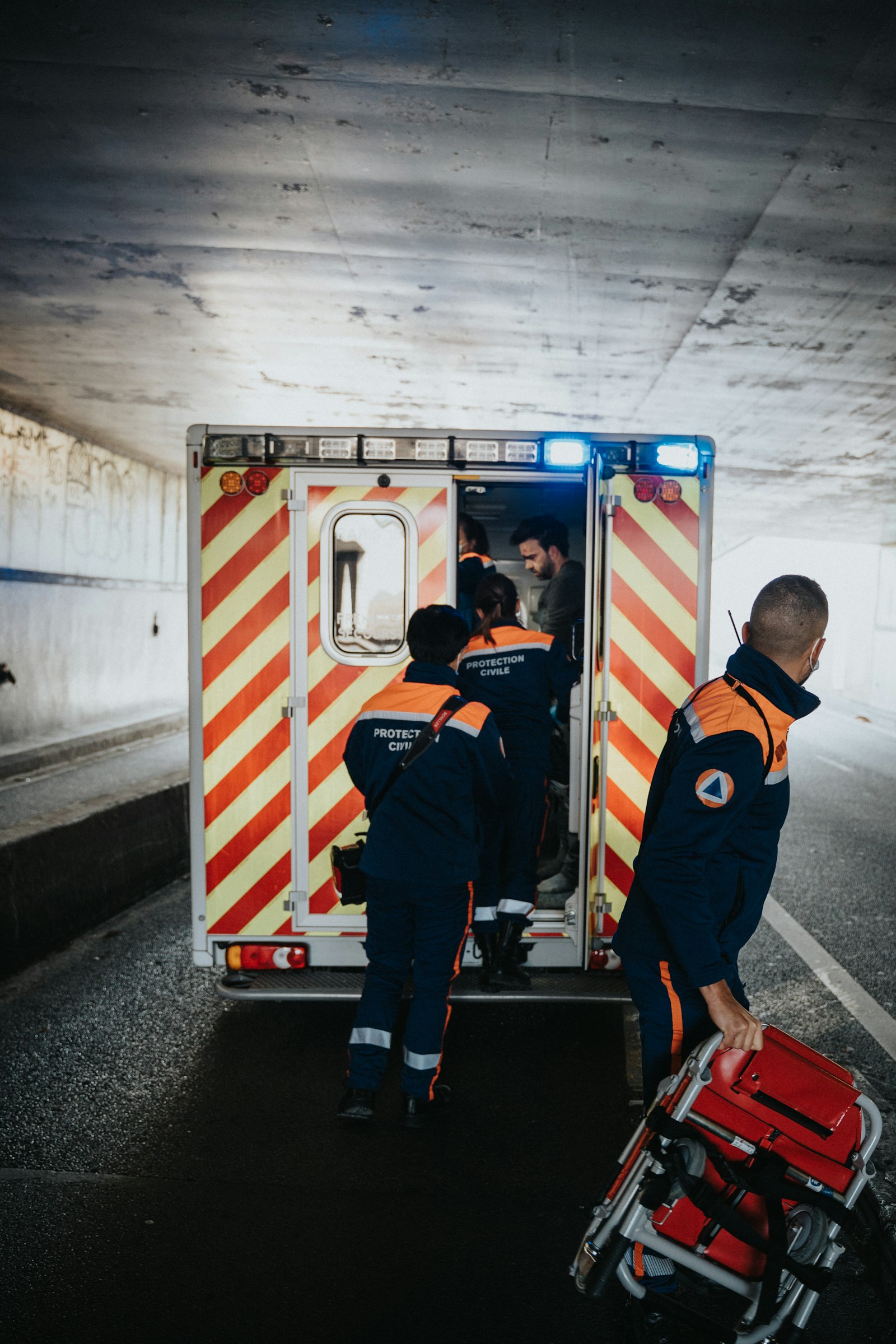
EMTs and paramedics cramp because nobody schedules the work and nobody schedules the break. Heat-related EMS activations cluster between late morning and early evening, which is exactly when the crew is already hottest, and every one of those calls means lifting, carrying, and stair work in the sun with no cool-down window before the next tone drops. Across a hot shift a heavy sweater can lose roughly 900 to 1,800 mg of sodium per hour, and plain water replaces none of it. A 3 oz Fast Pickle shot carries 570 mg of sodium, rides in a cargo pocket or the rig bag, and triggers a nerve reflex that quiets cramp signaling in about 85 seconds without needing a bottle, a mixing station, or a break you are not going to get.
Most hot-weather guidance is written for a job with a schedule. Work an hour, take fifteen. Rotate crews. Get out of the sun at the peak of the afternoon. That advice is good, and it is written for a world where somebody controls the tempo.
Nobody controls the tempo on a truck. The call comes when the call comes.
That single fact drives almost everything that goes wrong with hydration in emergency medical services. You cannot pre-load fluid before a lift, because you do not know a lift is coming. You cannot pace intake across a shift, because the shift is not evenly distributed. You cannot recover between exertions, because the recovery window is whatever is left after the paperwork, the restock, and the decon. The Bureau of Labor Statistics projects about 18,200 openings a year for EMTs and paramedics over the decade, which also means a large share of any given service is new enough that heat tolerance has not been built yet.
This article covers why the calls spike exactly when your crew is worst off, why the back of a rig is not the cool room people assume it is, what the sodium math actually looks like across a twelve or twenty-four hour tour, and why a 3 oz shot solves a problem that a case of water bottles does not.
The Calls Peak When You Are Hottest
There is a cruel overlap built into this job in summer.
Analyses of heat-related illness responses in the United States show that EMS activations for heat concentrate in the afternoon hours, roughly late morning through early evening. That is the window when ambient temperature, radiant load off pavement, and cumulative public exposure all peak together.
Which is to say: the hours when the public is most likely to go down from heat are the same hours when your crew has already been out in it. You are not arriving fresh to a heat call at four in the afternoon. You are arriving with whatever you have left after a morning of runs, and then you are the person doing the lifting in full sun while somebody else gets to lie down in the air conditioning you just made room for.
That inversion is worth naming because it is invisible from the outside. The patient gets the cooling. The crew gets the exertion. Both people were standing in the same parking lot.
The Rig Is Not A Cool Room
Ask most people outside the service and they will assume the ambulance is the relief. Get back in the box, crank the air, cool off between calls.
Prospective observational work on prehospital cabin temperatures has found that compartment temperatures run meaningfully higher in summer than in other seasons, and anyone who has worked a truck in August already knows why. The box sits on asphalt with the doors opening and closing. The patient compartment is climate-controlled for the patient, not for a medic in a uniform shirt and gloves doing a twelve-lead on a moving vehicle. Rear air handling in many units is undersized for what a hot box asks of it, and the compartment reheats every time the back doors open on scene.
So the recovery period is shorter and shallower than it looks on paper. You are not getting a genuine cool-down between exertions. You are getting a partial one, in a space that started the shift hot and never fully caught up.
Meanwhile the front cab does cool down, which produces the other classic pattern: driver comfortable, medic in the back soaked. Two people on the same run, two very different heat exposures, and only one of them is going to cramp at 3 a.m.
You Are Already Behind By Noon
There is a useful piece of evidence here from the adjacent side of the same house.
A study of emergency department physicians and nurses measured hydration status across a single shift and found participants finished the shift lighter and more concentrated than they started, with physician urine specific gravity averaging 1.025 against a commonly used dehydration threshold of 1.020. These were clinicians working indoors, in climate control, with a break room down the hall. They still ended the shift dehydrated, largely because the work does not pause to let you drink and because bathrooms cost time you feel you do not have.
Now take that same behavioral pattern, move it outdoors, add turnout weight on structure fire standbys, add stair carries, add August, and add a truck that does not have a break room at all. Field crews across trades commonly report starting the day already dehydrated, and EMS adds a specific accelerant most trades do not have: the deliberate under-drinking that comes from not wanting to need a bathroom mid-call.
On a twenty-four hour tour, that deficit does not reset at shift change. It rolls into the next day. A medic four shifts into a hot stretch is not in the same physiological state as the same medic on shift one, even though the runs look identical on the report.
Lifting Is The Load Nobody Counts
Heat guidance for outdoor work usually assumes steady moderate exertion. EMS is not that. EMS is long stretches of low output punctuated by short bursts of near-maximal effort, almost always awkward, almost always with a load, and almost always without warning.
A stair chair down three flights. A two-person lift out of a bathroom with no room to set your feet. A stretcher load in a gravel driveway. Research on power-lift stretchers found roughly a 50 percent reduction in patient-handling injury rate per thousand calls where they were deployed, which tells you plainly how much raw musculoskeletal load the manual version was putting on crews.
That burst profile matters for cramping specifically. Cramps favor muscles that are fatigued, working near their shortened range, and operating in a body that is already down on fluid and sodium. A stair carry at hour nineteen of a twenty-four checks every one of those boxes at once.
It also explains the timing that medics describe over and over. The cramp does not hit during the carry. It hits back at the station, in the recliner, in the shower, or at home in bed the next morning, in a calf or a hamstring that finally locks once the adrenaline is gone.
Why Water Alone Leaves You Cramping
Every rig has water. Water has never been the gap. The gap is what leaves the body alongside the water.
Sweat is not distilled. It carries sodium, and the concentration varies a lot between individuals. Across a hard hot shift a heavy sweater can lose somewhere in the range of 900 to 1,800 mg of sodium per hour. Over a twelve hour tour with several sustained exertions in it, that is a very large number, and plain water replaces exactly none of it.
Replacing fluid without replacing sodium dilutes what is left in circulation. You drink steadily all shift, you urinate clear, you feel like you did everything right, and you still cramp on the drive home. That is the pattern behind almost every "but I was drinking plenty" story in this trade. The volume was never the missing piece. The sodium was.
There is a second constraint specific to EMS: format. A strategy that requires a clean bottle, a second source of potable water, a free hand, and thirty uninterrupted seconds is a strategy for the day room. It is not a strategy for the six minutes between clearing one call and being dispatched to the next.
Sodium Per Ounce: What Fits In A Cargo Pocket
Total sodium on a label is only half the story when you are working out of a uniform pocket and a jump bag. The binding constraint is how much sodium arrives per ounce you had to carry, and whether the format survives a hot truck and opens one-handed with gloves on.
| Option | Serving | Sodium | Sodium per oz | Added sugar |
|---|---|---|---|---|
| Fast Pickle 3 oz shot | 3 oz | 570 mg | 190 mg | 0 g |
| LMNT (mixed) | 16 oz | 1,000 mg | 63 mg | 0 g |
| Liquid I.V. (mixed) | 16 oz | 500 mg | 31 mg | 11 g |
| Gatorade Thirst Quencher | 20 oz | 270 mg | 14 mg | 34 g |
| Water | 16 oz | 0 mg | 0 mg | 0 g |
At 190 mg of sodium per ounce, the 3 oz shot is three to thirteen times as sodium-dense per ounce as the mixed drinks. The powders also assume something a scene does not give you: a clean bottle, potable water, a flat surface, and a free hand to shake it. A sealed shot needs none of that. It is shelf stable, so it can live in the rig bag through a hot week, and it opens one-handed on the way back to the truck.
The Neural Reflex Behind A 3 oz Shot
The obvious objection to a 3 oz format is that 3 oz cannot rehydrate anybody. That is correct, and it is also not the mechanism.
In 2010, Kevin Miller and colleagues at North Dakota State University induced cramps in the flexor hallucis brevis of hypohydrated men using percutaneous tibial nerve stimulation, then gave them either pickle juice or water. Cramp duration was 84.6 seconds after pickle juice versus 133.7 seconds after water, a difference of about 49 seconds. That relief arrived far faster than the fluid could possibly have been absorbed and delivered to the muscle.
The explanation Miller proposed is a reflex. Acetic acid from the vinegar stimulates receptors in the oropharynx, at the back of the throat, and that signal reduces activity in the alpha motor neuron pool driving the cramping muscle. It is a nervous system event, not a plumbing event. The signal travels at nerve speed, which is why the timeline is seconds rather than the twenty to forty minutes absorption would require.
For a crew, that distinction is the whole practical case. You are not running a rehydration program on a porch with a patient waiting. You are looking for the fastest available way to quiet a cramp so you can finish the call on your terms instead of handing your partner a second problem.
The shot is the fast-acting piece. Water and real food across the tour are the daily plan. Both matter, and they are not the same tool.
What Does Not Work On A Truck
A few habits that sound reasonable at shift briefing fall apart in service.
- Mixing a powder between calls. It needs a clean bottle, water you trust, and both hands. Two of those are usually missing and the third is the one holding the radio.
- Under-drinking to avoid the bathroom. Common, understandable, and the single most reliable way to arrive at the afternoon heat calls already down. The fix is not to drink less, it is to make what you drink carry more sodium so less total volume does the same work.
- Relying on the station cooler. The cooler only helps when you are at the station. On a busy tour you are posted, not parked.
- Waiting for thirst. Thirst is a lagging indicator in everyone and a badly suppressed one in people running on adrenaline. By the time it registers, the deficit is already there.
- Treating the end of shift as the finish line. On a rotation, today's unreplaced sodium is tomorrow's cramp. The debt carries.
A Protocol That Fits Between Calls
- Start the tour topped off. Fluid and salt with the first meal, before the first tone. You cannot catch up mid-shift on a busy truck.
- Drink on a schedule, not on thirst. Small and frequent beats large and occasional, and it keeps you out of the bathroom-avoidance trap.
- Salt the big exertions, not the clock. After a stair carry, a long extrication, or a standby in full gear, that is the moment the sodium matters, not at some arbitrary hour mark.
- Keep the shot on your person, not in the station. A cargo pocket or the outside pouch of the jump bag. It has to be within reach when the twinge starts, which is rarely where you parked.
- Stock the rig, not just the fridge. A case in the truck is shelf stable and still there on day four of a heat wave, long after the station ice is gone.
- Rebuild after the tour. Sodium and fluid at the end of the shift are what carry you into the next one instead of starting it in a hole.
Frequently Asked Questions
How fast does a pickle shot work on a cramp?
In the Miller 2010 trial, induced cramps resolved in about 85 seconds with pickle juice compared to about 134 seconds with water. The relief comes from a nerve reflex triggered at the back of the throat rather than from absorption, which is why it works faster than any drink could be digested.
Why do I cramp at the station instead of on the call?
Cramping follows accumulated load rather than tracking it in real time, and adrenaline masks a lot during a run. The deficit builds quietly across the tour and the muscle locks once the stimulus drops off, which is why the recliner, the shower, and the drive home are the classic places medics report it.
I drink water all shift and still cramp. What am I missing?
Almost always sodium. Sweat carries sodium out at roughly 900 to 1,800 mg per hour in heavy sweaters, and water replaces fluid without replacing any of it. Drinking constantly and urinating clear while still cramping is the textbook signature of that mismatch.
Is 3 oz really enough to do anything?
It is not enough to rehydrate you, and it is not meant to be. It delivers 570 mg of sodium and the vinegar content that drives the oropharyngeal reflex. Treat it as fast-acting cramp support that fits in a uniform pocket, layered on top of the water you are already drinking.
Does it need refrigeration on the truck?
No. The shots are shelf stable, which is the practical reason they work in EMS. A case can live in a compartment through a hot week and still be usable on the fourth day, long after the station ice has gone.
Can a service buy these for the whole crew?
Yes. Supervisors and station captains commonly stock multi-packs per truck rather than one shared cooler at quarters, so every crew has them in service instead of at the station they are not sitting at.
The Science Behind The Bottle
Fast Pickle is a 3 oz shot of purpose-built brine: 570 mg of sodium, zero added sugar, under 1 g of carbohydrate, and the vinegar content that drives the oropharyngeal response documented in the cramp literature. It is fast-acting hydration support rather than a daily plan, sized for a job where the next exertion is unscheduled and the break is hypothetical.
For EMTs and paramedics the case is simple. The heat calls peak when your crew is already worn down. The box is not the cool room people think it is. The lifting is near-maximal, unplanned, and frequent. And the single most common hydration habit in the trade, drinking less so you do not need a bathroom, guarantees you arrive at the worst part of the day already behind. A format that delivers 190 mg of sodium per ounce, needs no water to prepare, survives a hot compartment, and works on a nerve-reflex timeline is built for exactly that shift.
*These statements have not been evaluated by the Food and Drug Administration. This product is not intended to diagnose, treat, cure, or prevent any disease. Individual results may vary. If you experience symptoms of heat exhaustion or heat stroke, stop work, move to a cool shaded area, and seek medical attention.