
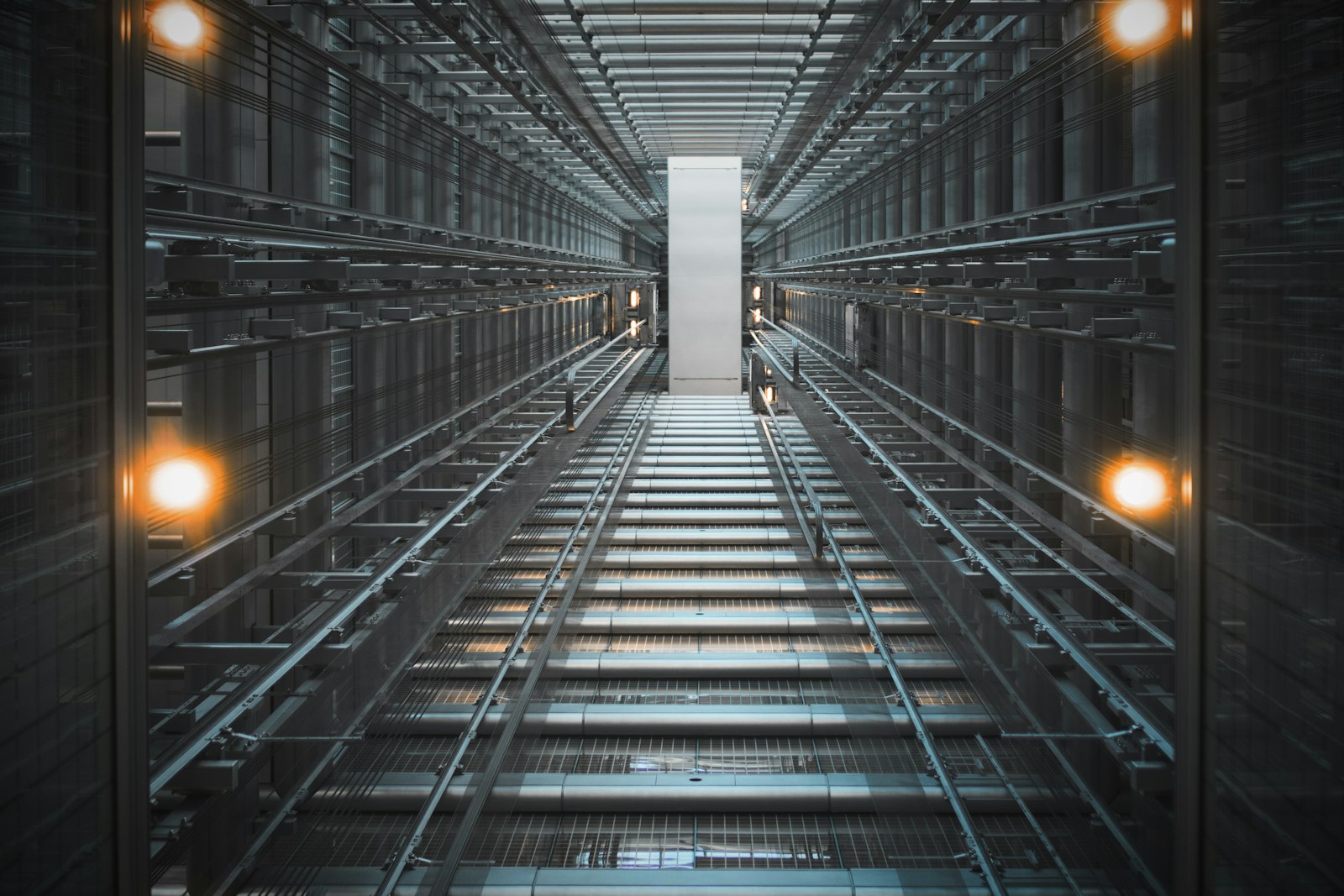
Elevator mechanics cramp because the heat in a hoistway is structural, not seasonal. A shaft is an unventilated vertical duct, and stack effect pulls warm building air upward, so overhead work sits in the hottest air in the building while the lobby forty floors below reads 72 degrees. Machine rooms are designed to stay under 90 degrees, and the ones you get called to are frequently well past it. A 3 oz Fast Pickle shot carries 570 mg of sodium and triggers a nerve reflex that quiets cramp signaling in roughly 85 seconds, which is faster than any drink can be absorbed.
Nobody outside the trade believes an elevator mechanic has a heat problem. The building has central air. The lobby is cold. The job title sounds like clean indoor work in a clean indoor place, and on paper it is: the Bureau of Labor Statistics counts roughly 24,000 elevator and escalator installers and repairers in the United States, working in exactly the kind of conditioned commercial buildings that are supposed to make heat stress somebody else's problem.
Then you climb onto the car top on the eighteenth floor in August and the air is noticeably hotter than the hallway you just left. That gap is the whole story, and it is not a fluke. It is physics the building was designed around, working exactly as intended.
This article covers why the hoistway concentrates heat at the top, why machine rooms run hot the moment their cooling slips, what pit and car-top work do to your ability to cool down at all, and why a 3 oz brine shot fits a job where the nearest break room is a keyed elevator ride away.
The Hoistway Is A Chimney, Not A Room
A hoistway is a sealed vertical shaft running the full height of a building. That geometry produces stack effect: warm air is less dense than cool air, so it rises through the shaft and is continuously replaced from below. The effect gets stronger as the shaft gets taller and as the difference between inside and outside air temperature grows. Building engineers spend real money fighting stack effect in the hoistway, because it drags conditioned air out of the occupied floors and up the shaft.
For a mechanic, that same physics has a simpler consequence. Whatever heat the building sheds into the shaft ends up at the top of the shaft. So does heat from the machine, the drive, the car lighting, and the ventilation fan on the car roof. The overhead is where all of it collects, and the overhead is where a large share of the work happens: sheave inspections, rope work, governor and overspeed checks, counterweight clearance.
This is why the temperature gap is not a rumor. You are not comparing the shaft to the outdoors. You are comparing the top of the shaft to the conditioned floor you stepped off of, and the shaft is the part of the building no thermostat is pointed at.
It matters in winter too. Stack effect scales with the indoor to outdoor temperature differential, which is largest on a cold day, not a hot one. Mechanics who assume cramps are a July problem get caught in February in a high rise, in a shaft moving a column of warm building air past them the entire shift.
Machine Rooms Are Rated To 90 Degrees. Yours Is Not.
ASME A17.1, the safety code for elevators and escalators, requires machine room temperature to be maintained at whatever the equipment manufacturer specifies. In practice, design guidance across the industry lands in a narrow band: keep the room between roughly 70 and 90 degrees Fahrenheit with relative humidity between 35 and 60 percent, in all weather. Many jurisdictions codify a hard ceiling around 90 degrees, and plenty of manufacturers prefer to sit well below it.
Note what that number is protecting. The 90 degree ceiling exists because drives, controllers, and regenerative units throw heat and start faulting when they cook. It is an equipment spec. Nobody wrote it thinking about the person standing in front of the controller with a meter in one hand.
Now consider when you actually get called to a machine room. Rarely because it is comfortable. You get called when the unit is shutting down on a thermal fault, when the room air conditioning has failed, when a building cut the machine room off the cooling loop to save money, or when a rooftop penthouse room has been baking under a dark membrane all afternoon. The condition that generates the service call is frequently the same condition that makes the room miserable to work in.
That is the trap. The equipment has a temperature limit and an alarm. You do not. The room tells the controller when it has had enough. It does not tell you.
Pit Work, Car Top, And Nowhere To Cool Down
Heat load is only half of a heat problem. The other half is whether you can shed the heat you generate, and elevator work is unusually bad at that.
- You cannot leave quickly. Coming off a car top on the twentieth floor is not a thirty second walk to a cooler. It is a controlled sequence with a lockout, a hoistway door, and often a partner. The cost of stopping is high enough that people push through the early warning signs.
- There is no airflow. A pit is a concrete box at the bottom of a sealed shaft. Air does not move through it in any useful way. Sweat that does not evaporate does not cool you, and in a still, damp pit very little of it evaporates.
- The work is static and loaded. Holding a position on a car top, pulling rope, or working overhead with arms above the heart is sustained isometric effort. That is the loading pattern most associated with exercise-associated muscle cramps, and it is why the cramp usually lands in a forearm, a calf, or the small of the back rather than somewhere convenient.
- You are carrying and wearing weight. Harness, tool pouch, meter, long-sleeve FR on many jobs. Every layer is one more barrier between your skin and moving air that was already not moving.
Federal regulation is not going to solve this soon. OSHA published a proposed Heat Injury and Illness Prevention rule covering both indoor and outdoor work in August 2024, hearings wrapped in late 2025, and the post-hearing comment period closed on October 30, 2025. As of now no final rule has been issued and no target date has been set. The proposal would set an initial trigger at a heat index of 80 degrees and a high-heat trigger at 90 degrees, which would land squarely on machine room and overhead work if it is ever finalized. Until then, indoor equipment heat is handled under the general duty clause and whatever your shop decides to do.
The guidance that already exists is worth following regardless: heat from equipment cannot be read off a weather forecast, so hot indoor workplaces are supposed to be measured on site rather than estimated. If your shop has never put a wet bulb globe thermometer in a penthouse machine room in August, nobody actually knows what that room is.
Why Water Alone Leaves You Cramping
Sweat is not water. It carries sodium, and the amount varies enormously between people. Normative data on sweat composition puts sodium concentration around 40 mmol per liter on average, roughly 900 mg of sodium per liter of sweat, with individual values ranging from well under half that to more than double it. Sweat rates under real work load commonly run half a liter to two liters per hour.
Run that arithmetic on a mechanic doing overhead work in a hot shaft and you get somewhere between about 500 and 1,500 mg of sodium out per hour. Replace it with plain water and you are refilling volume while continuing to dilute what is left. That is how people end up drinking steadily all day, cramping anyway, and concluding they must not have drunk enough.
If your hard hat liner dries with white crust on it, or your safety glasses sting your eyes by mid-afternoon, you are on the salty end of that range and water alone is not going to hold you.
Sodium Per Ounce: What Fits In A Tool Pouch
The constraint in this trade is not only how much sodium a product carries. It is how much volume you have to swallow to get it, and how much of that you can realistically carry onto a car top. Sixteen or twenty ounces of mixed drink is a bottle you have to stage somewhere, and it is not going up the shaft in a tool pouch.
| Option | Serving | Sodium | Sodium per oz | Added sugar |
|---|---|---|---|---|
| Fast Pickle 3 oz shot | 3 oz | 570 mg | 190 mg | 0 g |
| LMNT (mixed) | 16 oz | 1,000 mg | 63 mg | 0 g |
| Liquid I.V. (mixed) | 16 oz | 500 mg | 31 mg | 11 g |
| Gatorade Thirst Quencher | 20 oz | 270 mg | 14 mg | 34 g |
| Water | 16 oz | 0 mg | 0 mg | 0 g |
At 190 mg of sodium per ounce, the 3 oz shot is three to thirteen times as sodium-dense per ounce as the mixed drinks, in a bottle that fits a pouch pocket and does not need to be mixed with anything at a jobsite where the nearest tap is in a mechanical room two floors down.
The Neural Reflex Behind A 3 oz Shot
The reason a small volume works at all is that cramp relief from brine is not a replacement mechanism. It is a nerve mechanism.
In the controlled study most often cited on this, Miller and colleagues induced cramps in the toe flexor muscles and compared pickle juice against deionized water. Cramp duration was 84.6 seconds with pickle juice versus 133.7 seconds with water, roughly 37 percent shorter. The finding that mattered most was what did not change: blood plasma sodium, potassium, magnesium, and calcium were statistically unchanged at five minutes after ingestion. The cramp had already stopped before any electrolyte could have been absorbed and delivered to the muscle.
The accepted explanation is an oropharyngeal reflex. Acid and strong flavor stimulate receptors in the mouth and throat, and that signal inhibits the runaway alpha motor neuron firing driving the cramp. The vinegar is doing the work in the throat, not in the bloodstream. Sodium still matters across a shift, but the fast part of the effect is a switch, not a refill.
This is why the format makes sense for elevator work specifically. Eighty-five seconds on a car top is a pause. Twenty minutes waiting for a sports drink to absorb is a job you have to come down from.
What Does Not Work On A Service Route
- Chugging water at the truck. Volume without sodium dilutes what you have left. It is the most common approach and the one most likely to leave a salty sweater cramping at 2 p.m.
- Waiting for the cramp to pass. On a car top or in a pit, a cramp is not just painful, it is a control problem in a place with moving equipment and a drop below you. Shut the cramp down, then decide whether to keep working.
- Sugary sports drinks as the main plan. Thirty-four grams of sugar buys you 270 mg of sodium and an afternoon crash on a route where you still have four more calls.
- Salt tablets on an empty stomach. Common, and a reliable way to end up nauseated in a machine room with no bathroom on the floor.
- Assuming the building's air conditioning covers you. The lobby temperature has almost nothing to do with the overhead temperature. The only number you can act on is the one measured where you are standing.
Quick Reference: Hoistway Heat Protocol
- Front-load before the first call. Fluid and salted food in the truck before the route starts, not after the first machine room.
- Treat the overhead as the hottest point in the building. Plan rope and sheave work for the earliest part of the day you can get access.
- Measure the machine room once. If a room is a repeat offender, an on-site reading is what turns "it is hot up there" into a work order the building will actually act on.
- Carry the shot on you, not in the truck. A cramp on a car top is not a problem you can solve from the parking garage. One 3 oz shot in the pouch is the whole point of the format.
- Use it at the twitch, not at the lockup. Early fasciculation in a calf or forearm is the signal. Waiting until the muscle seizes means working through the full cramp before relief lands.
- Salt the meal, not just the shift. The shot is the off switch. Real food with real sodium is the baseline that keeps you off the switch.
Frequently Asked Questions
How fast does a pickle shot work on a cramp?
In the controlled study, cramp duration averaged 84.6 seconds after pickle juice compared with 133.7 seconds after water. Call it about a minute and a half, and understand it is a nerve reflex triggered in the mouth and throat, not absorption.
Why do elevator mechanics cramp inside an air-conditioned building?
Because the hoistway is not part of the conditioned space. Stack effect moves warm air up the shaft and concentrates it at the top, where a lot of the work happens, and machine rooms carry their own equipment heat. The lobby thermostat has no bearing on the overhead.
Is a machine room really hotter than outside?
It can be, and that is the point of the 90 degree design ceiling most manufacturers and jurisdictions apply. Drives and controllers reject heat into a small enclosed room. When the room's dedicated cooling fails, which is often exactly why you were called, the temperature climbs past the equipment limit and keeps going.
How many shots does a service route take?
Most mechanics use one at the first sign of a twitch and a second later in the day on a bad route or a hot penthouse call. It is a targeted tool rather than something on a schedule. Water and salted food across the day do the baseline work.
Do the shots need refrigeration?
No. They are shelf stable, which is what makes them practical in a service truck that sits in a parking garage all morning. They live in a pouch pocket, a gang box, or the door bin. Cold is more pleasant, not required.
Can a shop buy these for the whole crew?
Yes. Supers and service managers commonly stock the 12-pack in the shop or the truck for summer routes and modernization jobs. For larger crews the 24-pack is the usual step up.
The Science Behind The Bottle
Fast Pickle is a 3 oz shot of purpose-built brine: 570 mg of sodium, zero added sugar, under 1 g of carbohydrate, and the vinegar content that drives the oropharyngeal response documented in the cramp literature. It is fast-acting hydration support, not a daily plan, sized for a job where the nearest break room is behind a locked hoistway door.
For the roughly 24,000 elevator and escalator mechanics working in the United States, the case is straightforward. The heat is generated by the building and the equipment, so it never goes out of season and it does not show up on a forecast. The shaft concentrates it exactly where the overhead work is. The job makes stopping expensive enough that people push past the early warning. A format that delivers 190 mg of sodium per ounce, fits in a tool pouch, and works on a nerve-reflex timeline is built for that set of constraints.
*These statements have not been evaluated by the Food and Drug Administration. This product is not intended to diagnose, treat, cure, or prevent any disease. Individual results may vary. If you experience symptoms of heat exhaustion or heat stroke, stop work, get to a cool area, and seek medical attention.