
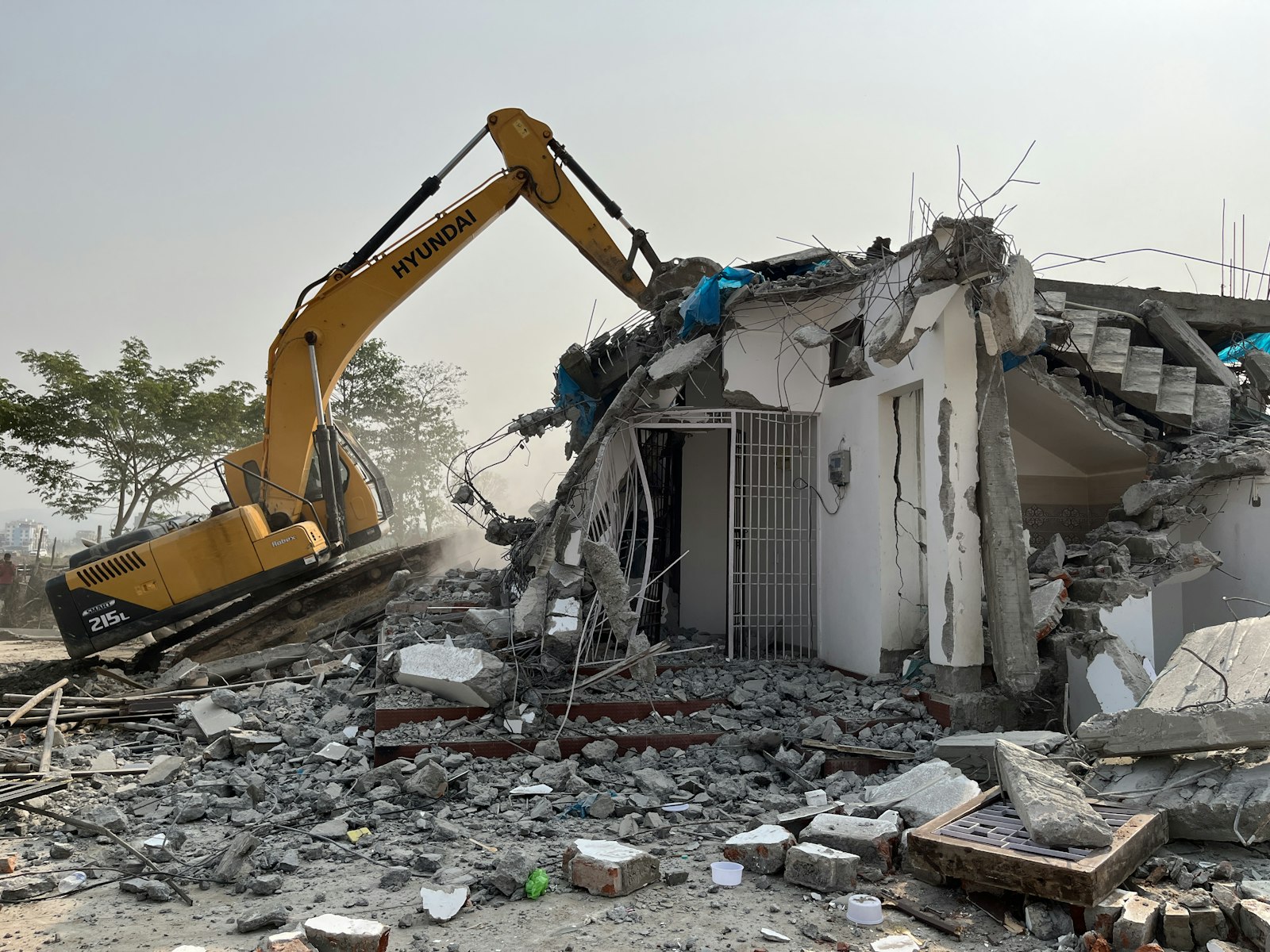
Demolition workers cramp because a gutted building is hotter than the street outside it. The power is cut, so the HVAC is dead, the windows are boarded, and the only ventilation is whatever opening the crew made that morning. Layer on the respirator, hood, and long sleeves that OSHA's silica standard effectively requires for handheld breaking and chipping, and sweat rates climb while evaporative cooling drops. A 3 oz Fast Pickle shot carries 570 mg of sodium and triggers a nerve reflex that quiets cramp signaling in roughly 85 seconds, which is faster than any sports drink can absorb.
Nobody who has run a breaker on the third floor of a gut job describes the heat as weather. They describe it as the building. The forecast said 88 and the third floor said something else entirely, because the third floor has no airflow, no shade strategy, and a hundred years of brick that has been soaking up sun since June.
This article covers why the cramp pattern on a demolition site behaves differently from open-air construction, what the PPE stack does to your sweat rate, what the sodium math actually looks like across a ten-hour teardown, and why a 3 oz brine shot fits a job where a cooler cannot follow you up a temporary stair.
You Cut The Power, So You Cut The Air
Every heat article written for the trades starts with the sun. Demolition breaks that assumption on day one, because the worst heat exposure on most teardowns happens indoors, in a structure that has been deliberately disconnected from every system that used to make it habitable.
Utility disconnection comes first on a demolition job. OSHA's demolition standard requires that all electric, gas, water, steam, sewer, and other service lines be shut off, capped, or otherwise controlled outside the building line before work starts. That is the right sequence for safety, and it also means the mechanical ventilation, the air conditioning, and the exhaust fans are gone before the first wall comes down. What you are left with is a sealed masonry box with people swinging tools inside it.
Then the envelope gets closed further. Windows get boarded for debris control. Openings get sheeted for dust and negative-air containment. Interior partitions still stand in the early phases, so there is no cross-draft even where there is an opening. The building holds heat overnight and gives it back all day, which is why the second and third days of a summer gut job are usually worse than the first.
The practical result is that the site thermometer, if there is one, is nailed to a shaded post by the gate. It is not measuring the room you are working in.
Where The Heat Actually Comes From On A Teardown
A demolition site is not one environment. It is four or five, and one worker can rotate through several of them before lunch.
Interior gut work. Stripping plaster, lath, drywall, ductwork, and flooring in an unconditioned building. Highest heat, lowest airflow, heaviest dust load, and therefore the most respiratory protection. This is where the cramps cluster.
Handheld breaking and chipping. Jackhammers, chipping guns, and handheld powered demolition hammers on concrete and masonry. High metabolic load, constant vibration, and a task that sits squarely on OSHA's silica Table 1 with both dust controls and respiratory protection attached to it.
Torch and saw work. Cutting structural steel or rebar adds a radiant heat source a few feet from your face, on top of ambient. Cutting goggles, a leather jacket, and gloves are not optional and are not breathable.
Roof and upper-floor removal. Full sun, no shade, and a hot deck radiating up at you. This is the one exposure that behaves like a normal outdoor trade, and it is often the exposure people plan for while ignoring the other three.
Ground and haul-off. Loading chutes, dumpsters, and trucks in the open. Moderate heat, but continuous exertion with almost no natural stopping point, because the chute does not stop until the floor above stops.
The PPE Penalty Nobody Budgets For
Here is the part that separates demolition from most other heat trades: the gear that keeps your lungs safe makes the heat problem worse, and you cannot take it off to fix that.
OSHA's respirable crystalline silica standard for construction, 29 CFR 1926.1153, lists demolition-adjacent tasks in Table 1 and pairs them with specified engineering controls, work practices, and respiratory protection. Handheld powered demolition hammers, chipping tools, jackhammers, and handheld grinders all carry respirator requirements once the task runs long enough or moves indoors. On a typical gut job, respiratory protection is not a judgment call. It is the plan.
NIOSH is direct about what that costs you thermally. The more encapsulating the PPE a worker wears, the greater the risk of heat stress and physiological strain, and core body temperature rises accordingly. Tight-fitting respirators restrain respiratory heat flow and limit its release into the environment, which removes one of the body's small but real cooling pathways. Add coveralls, a hood, long sleeves, gloves, and a hard hat and you have wrapped a working furnace in insulation.
Sweat is still produced. It just has nowhere to go. Sweat that does not evaporate does not cool you, and it still costs you the sodium it carried out.
Why Water Alone Leaves You Cramping
The standard answer on a demo site is a water buffalo by the gate and a reminder to use it. Water is necessary and it is required. It is also incomplete.
Sweat is not distilled water. It carries sodium out with it, and on a hot day in heavy PPE you can shed a meaningful fraction of a gram every hour. Replacing only the water half of what you lost moves you toward dilution rather than recovery, which is why some of the worst cramping happens to the guy who swears he has been drinking all day.
Two more things work against a demolition crew specifically. The first is acclimatization. It takes up to two weeks of graduated exposure to build heat tolerance, and demolition work is project-based, which means crews rotate on and off sites and pick up new hands mid-job. The person on the breaker in the hottest room may be on day two. The second is the schedule itself. Demo runs against a hand-off date to the next trade, so the pressure is always to push through the afternoon rather than pull back from it.
The Sodium Math On A Ten-Hour Teardown
Sweat rates in heavy work in the heat commonly land between roughly half a liter and a liter and a half per hour, and heavily encapsulating PPE pushes you toward the top of that range rather than the bottom. Sweat sodium concentration varies widely between individuals, with reported values spanning a few hundred to well over two thousand milligrams per liter and an average around 950 mg per liter.
Run conservative numbers on interior gut work and you land somewhere around 600 to 1,400 mg of sodium lost per hour. Across a ten-hour day that is several grams out the door. A water-only plan replaces exactly none of it. That is why the cramp shows up in hour six or seven instead of hour one. The deficit is cumulative, and it does not care how many times you filled your jug.
The other half of the problem is format. Whatever you use has to survive a dust environment, gloved hands, a gang box, and a break clock measured in minutes. A 3 oz shot takes about four seconds, needs no bottle, no mixing, and no clean water source, which matters on a site where the water was capped before you got there.
Sodium Per Ounce: What Is Actually In The Gang Box
Total sodium on a label is only half the story. What matters on a teardown is how much sodium you get per ounce you have to swallow, because the constraint is time and carrying capacity, not shelf space.
| Option | Serving | Sodium | Sodium per oz | Added sugar |
|---|---|---|---|---|
| Fast Pickle 3 oz shot | 3 oz | 570 mg | 190 mg | 0 g |
| LMNT (mixed) | 16 oz | 1,000 mg | 63 mg | 0 g |
| Liquid I.V. (mixed) | 16 oz | 500 mg | 31 mg | 11 g |
| Gatorade Thirst Quencher | 20 oz | 270 mg | 14 mg | 34 g |
| Water | 16 oz | 0 mg | 0 mg | 0 g |
A 3 oz shot carries more than twice the sodium of a 20 oz bottle of Gatorade in one-seventh the volume. When you are three floors up with a respirator on and ten minutes of break, density is the whole argument.
The Neural Reflex Behind A 3 oz Shot
The reason a small volume of brine works faster than a large volume of sports drink has nothing to do with absorption. It is a nerve response, and it was measured directly.
In a 2010 study published in Medicine & Science in Sports & Exercise, Miller and colleagues induced cramps in hypohydrated subjects and compared pickle juice against deionized water. Cramp duration after pickle juice averaged about 85 seconds, compared with roughly 134 seconds after water. Critically, the researchers found plasma electrolyte concentrations were essentially unchanged five minutes after ingestion, which rules out absorbed sodium as the mechanism. The timeline is far too short.
What they proposed instead was a reflex originating in the oropharyngeal region, the back of the mouth and throat, triggered by the acetic acid in the vinegar. That reflex reduces firing in the alpha motor neuron pool serving the cramping muscle. In plain terms: the sour hit at the back of your throat tells the overfiring nerve to settle down. The sodium arriving behind it addresses the underlying deficit on a slower clock.
That two-stage behavior is why format matters more than volume. You do not need to drink a liter to get the reflex. You need the brine to reach the back of your throat. A 3 oz Fast Pickle shot is built for that: small enough to ride in a vest pocket, fast enough to take without breaking down and re-donning a full PPE stack, and carrying 570 mg of sodium behind the reflex.
What Does Not Work On A Demo Site
Water alone. Addresses volume, not sodium. Drinking heavily from a water-only source while losing close to a gram of sodium every hour pushes you toward dilution, which is its own problem on a long day.
Sugary sports drinks. A 20 oz bottle delivers 14 mg of sodium per ounce and 34 g of added sugar. That is a lot of volume and a lot of sugar for very little of the mineral you actually lost.
Salt tablets. Tablets deliver sodium and nothing else, they are rough on an empty stomach, and they do nothing for the reflex that shortens an active cramp. They also require water you may not have within reach three floors up.
Powder sticks. Fine at a desk. On a demo floor they need a clean bottle, a clean water source, and a minute of shaking with gloves off in a dust environment. The open bottle then collects everything in the air for the rest of the shift.
Just take a break. Rest and shade are required and they work, and they are still not sodium. A break lowers your core temperature. It does not put back what you sweated out.
Quick Reference: Demo Day Protocol
- Before the shift. Water with a salted meal. If you are new to the crew, new to the site, or coming back from a stretch of days off, treat yourself as unacclimated and take the cooler assignments early if the foreman allows it.
- Hours one through four. Water on a schedule, not on thirst. Thirst lags the deficit badly under a respirator, where you cannot feel your face sweating and you are not going to break the seal to check.
- Mid-shift, before the cramp. One 3 oz shot around the halfway mark of a hot interior rotation. This is the sodium replacement piece, taken while you still feel fine.
- At the first twitch. Take a shot immediately. The reflex works best on early signaling, not on a locked calf you have been fighting for ten minutes on a temporary stair.
- Rotate out of the box. The interior gut is the hottest station on most sites. Rotating people through it beats leaving one person on the breaker all afternoon.
- End of shift. Water plus a salted meal. The building will be just as hot tomorrow, and recovery for tomorrow starts with what you replace tonight.
- If symptoms escalate. Dizziness, nausea, confusion, blurred vision, or skin that has stopped sweating are not cramp problems. Get out of the structure, get to a cool area, and get medical help.
Frequently Asked Questions
How fast does a pickle shot work on a cramp?
In the Miller 2010 study, cramp duration after pickle juice averaged about 85 seconds, versus roughly 134 seconds after water. That speed comes from a nerve reflex in the back of the throat rather than from absorption, which is why the volume can be small and still work.
Why is it hotter inside the building than outside?
Because the utilities are capped before demolition begins, so there is no mechanical ventilation or air conditioning, and the openings that would create a draft are usually boarded or sheeted for debris and dust control. Masonry also stores heat overnight and releases it through the next day, so the interior lags the outdoor temperature instead of tracking it.
Does wearing a respirator really make cramping more likely?
It contributes. NIOSH notes that more encapsulating PPE raises heat stress risk and core body temperature, and that tight-fitting respirators restrict respiratory heat release. Higher heat load means a higher sweat rate, and a higher sweat rate means more sodium out per hour. The respirator is not optional on silica tasks, so the right response is to plan the replacement rather than skip the protection.
How many shots does a ten-hour teardown take?
Most people on a hot interior rotation use one mid-shift and keep a second within reach for the first sign of a cramp. Heavy sweaters running a breaker in July often run two. It is a targeted tool for the hot part of the day, not something you sip continuously.
Do the shots need refrigeration or a cooler?
No. They are shelf-stable, which is the point on a site where there is no power, no water, and no reliable place to keep ice past noon. A shot lives in a gang box, a truck door, or a vest pocket and is ready when you need it.
Can a contractor buy these for the whole crew?
Yes. Foremen and superintendents commonly stock multi-packs in the gang box or the job trailer so a shot is within reach of the hot floors rather than a stair climb away.
The Science Behind The Bottle
Fast Pickle is a 3 oz shot of purpose-built brine: 570 mg of sodium, zero added sugar, under 1 g of carbohydrate, and the vinegar content that drives the oropharyngeal response documented in the cramp literature. It is not a daily hydration plan. It is the fast-acting piece that sits on top of one, sized for a job where your carrying capacity is a vest pocket and your break is measured in minutes.
For the crews doing this work, close to a million people in the United States work as construction laborers, the Bureau of Labor Statistics category that absorbs most demolition, and the case is straightforward. The heat comes from the structure rather than the sky, so it does not follow the forecast. The PPE that keeps silica out of your lungs also keeps heat in. Project-based staffing keeps putting unacclimated people on the hottest floor. A format that delivers 190 mg of sodium per ounce and works on a nerve-reflex timeline is built for exactly that problem.
*These statements have not been evaluated by the Food and Drug Administration. This product is not intended to diagnose, treat, cure, or prevent any disease. Individual results may vary. If you experience symptoms of heat exhaustion or heat stroke, stop work, get to a cool area, and seek medical attention.