
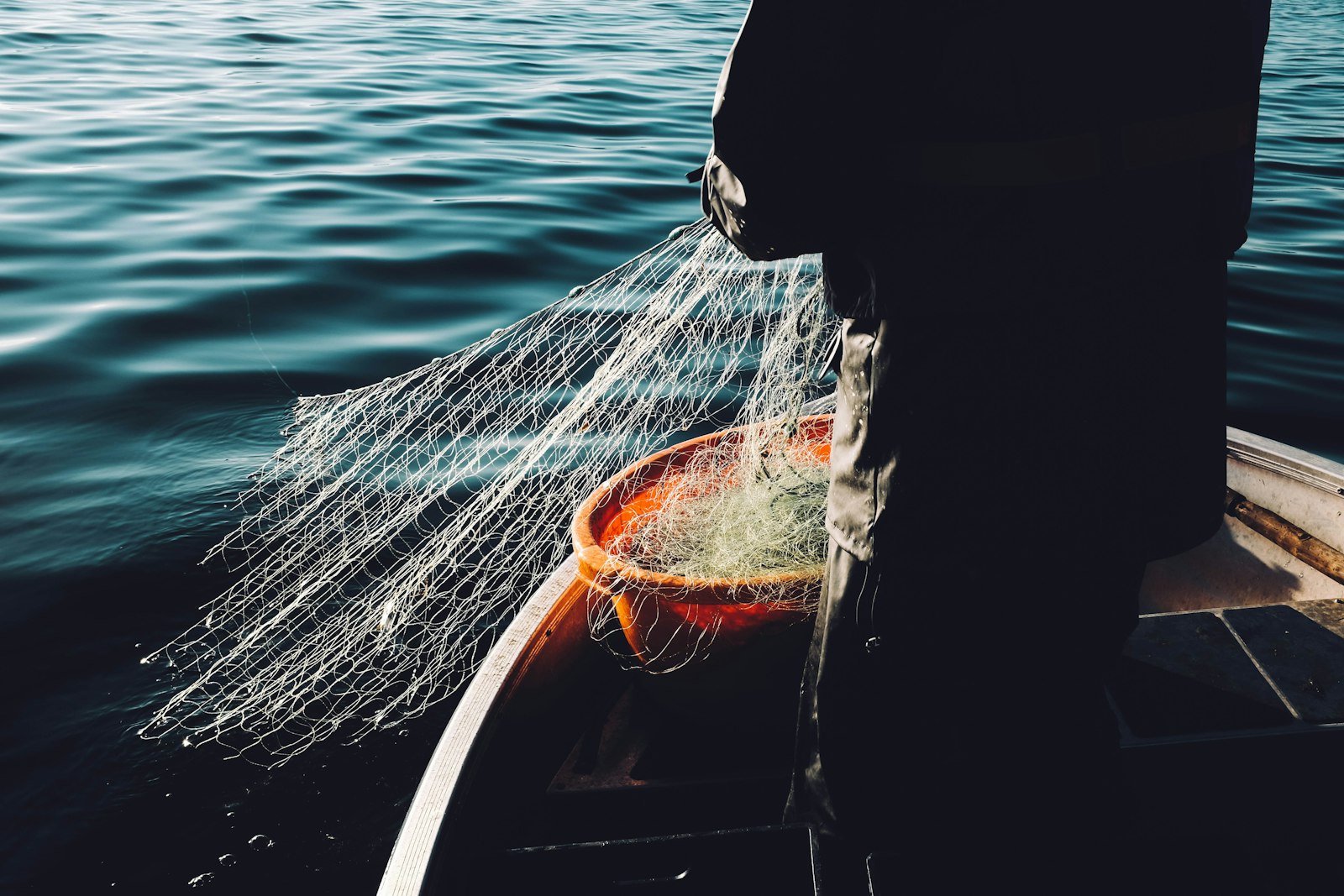
Commercial fishermen cramp because a trip is measured in days rather than hours, so the sodium deficit never gets a reset. Wind and spray evaporate sweat before you ever look wet, common seasickness medication reduces sweating on purpose, and fresh water on a boat is a rationed store rather than a tap. A 3 oz Fast Pickle shot carries 570 mg of sodium and triggers a nerve reflex that quiets cramp signaling in roughly 85 seconds, which is faster than any drink can be absorbed.
Every other hot trade has a back door. The roofer comes down at four. The welder walks out of the shop. The tow operator goes home, eats a real dinner, salts it, sleeps, and starts the next day somewhere near even. Whatever they burned through gets partly put back overnight, every night, whether they plan it or not.
Fishing does not have that door. A trip runs days to weeks. Boats work ten to eighteen hour days, six or seven days a week, and on a hard opening crews run eighteen to twenty hours and sleep four or five before the gear goes back in the water. NIOSH has documented twelve to eighteen hour shifts running for weeks at a time in Alaska fisheries, and the National Research Council flagged sleep deprivation as a chronic problem in this industry back in 1991. Nothing about that has gotten easier.
That structure is the whole story. It means a deficit that would be a bad afternoon in any other trade becomes a compounding balance across day three, day four, day nine. It is also why the guy who cramps offshore usually cramps on the back half of the trip, not the first haul, and then blames the muscle instead of the arithmetic.
This article covers why sweat loss at sea is nearly invisible, why the seasickness patch in your kit works against your cooling system, why a life jacket is a heat garment, why the cramp shows up in your hands before your legs, and what actually fits in a sea bag.
The Only Trade Where The Deficit Never Resets
Start with the numbers on the job itself. Commercial fishing sits at or near the top of every fatality table published. BLS preliminary data for 2024 put fishing and hunting workers at 88.8 deaths per 100,000 full time equivalent workers, second only to logging at 110.4. NIOSH counted 878 commercial fishermen killed by traumatic injury between 2000 and 2019, an average of more than 43 deaths a year, with roughly 47 percent of them tied to a vessel disaster.
Those numbers get quoted for a reason, but they also crowd out the slower problem. Nobody writes a report about the deckhand who was six percent down on fluid by day four, locked a forearm reaching for a rail, and got a hand between a block and a line. That shows up in the injury column as a struck-by or a caught-in. The dehydration that set it up never gets recorded.
Heat guidance is built around a shift. Start hydrated, drink through the day, recover overnight, repeat. Every piece of that assumes you go somewhere else at the end of the day. On a trip there is no somewhere else. The recovery window is four hours in a bunk that is still moving, and the next watch starts whether or not you used it.
Wind And Spray Hide The Sweat
Here is the part that catches experienced hands. Sweat only cools you when it evaporates, and air movement drives evaporation hard. On a moving deck you have constant apparent wind, salt spray, and cool air. Sweat leaves your skin the moment it arrives.
The physical result is that you can be losing a liter an hour and never once look sweaty. There is no soaked shirt, no dripping forehead, none of the visual cues that make a guy on a roof reach for a jug. Your brain is running a simple check, which is whether you look hot, and at sea that check returns a false negative all day long.
Add foul weather gear and it gets worse in the other direction. Bibs and a jacket are waterproof, which means they are also vapor proof. Inside the gear the sweat cannot evaporate at all, so it pools and you cook. Outside the gear, on your face and neck and hands, it evaporates instantly. You get both failure modes on the same body at the same time, and neither one gives you a useful signal.
This is why a 55 degree day in the North Pacific produces cramps that look like a July day in Texas. Cool air temperature is not the same thing as low sweat loss when the work is hauling gear and the gear is a sealed shell.
The Seasickness Patch Works Against Your Cooling System
This one is worth reading twice, because it is documented and most crews have no idea.
Scopolamine, the transdermal patch sold as Transderm Scop and worn behind the ear for motion sickness, is an anticholinergic. On June 18, 2025 the FDA issued a safety warning about serious heat related complications with the patch. The mechanism is plain: it can raise body temperature and decrease sweating, and the agency listed confusion, loss of consciousness, hospitalization and in some cases death among the outcomes. The FDA guidance is that if your body temperature climbs or you are not sweating in warm conditions, remove the patch and contact a clinician.
Meclizine, the other standard in every wheelhouse drawer, stacks onto that. Taken together with scopolamine, the documented interaction includes heat intolerance, decreased sweating, flushing, dry mouth and blurred vision.
Put that on top of a job where sweat evaporation is already invisible and fluid intake is already low. You have a medication that reduces your ability to shed heat, worn on a body that is already behind, doing heavy work with no way to leave. This is not an argument for throwing the patch over the side, because being violently seasick offshore is its own serious hazard. It is an argument for knowing what it does, reading the label, and treating your fluid and sodium plan as more important on patch days rather than less.
If you take either of these regularly and work in the heat, that is a conversation worth having with your doctor before the season rather than during it.
The Life Jacket Is Also A Heat Garment
Research on Gulf of Mexico shrimp fishing found that perceived and physiological heat strain during simulated fishing tasks in hot humid conditions while wearing a personal flotation device is a real barrier to PFD use in that fleet. Read that plainly. The thing most likely to save your life in the water is uncomfortable enough in the heat that people take it off.
A PFD covers the torso, which is where a large share of your evaporative cooling surface lives. Blocking it has the same effect as body armor on a correctional officer or a harness on a tower climber, except here the tradeoff is against drowning, which is the leading way this trade kills people.
That makes cramp and heat management a safety multiplier rather than a comfort item. A crew that is not fighting heat strain is a crew that keeps the vest on. Keeping a shot in the galley is a small lever on a large outcome.
Fresh Water Is Ship's Stores, Not A Utility
On shore, water is infinite and free. On a boat it is a finite tank that has to last the trip, and on smaller vessels there is no watermaker to top it up. Crews ration it without really deciding to, because everyone on board knows the tank has a bottom.
It also tastes like the tank. Warm, plastic, faintly metallic by day six. That is a small thing that produces a large behavioral effect, which is that people drink less than they need because the water is unpleasant and there is a reason to save it.
Then there is space. A sea bag is small, the galley is small, and the fridge is full of bait, food and product. Anything that requires a shaker bottle, a clean cup of fresh water, a free hand, or refrigeration is a plan that will get abandoned by day two. What survives on a boat is shelf stable, small, opens with one wet glove on, and takes four seconds. That is the entire reason the 3 oz shot format exists.
Why It Shows Up In Your Hands First
Most trades cramp in the calf. Fishing cramps in the forearm and the hand, and that catches people off guard because it does not look like the cramp they were expecting.
The reason is what the work is. Hauling, picking, sorting, gaffing, mending, coiling, running a knife through a shift of dressing fish. It is sustained grip at high repetition, hour after hour, which loads the forearm flexors harder than almost any other trade loads any single muscle group. Add the fatigue of hour fourteen and you get the classic offshore version, which is a hand that closes around a line and does not want to open again.
On a deck with a working winch, a moving pot, and a line under load, a hand that will not open is not a cramp story. It is the setup for the injury that goes in the report. That is the practical reason to treat the first twitch in a forearm on day three as information rather than as something to shake out and ignore.
What You Are Actually Losing
Sweat is not just water. Published normative data puts sweat sodium concentration across a wide range, commonly cited between roughly 200 and 2,000 mg per liter, with most people landing somewhere in the middle. Sweat rates during hard work commonly run 1 to 1.5 liters per hour.
Multiply it out and a heavy sweater working gear can be shedding on the order of 900 to 1,800 mg of sodium per hour. Now stretch that across a sixteen hour day and then across six days, with four hours of sleep between them and no grocery store. Even a conservative estimate builds a deficit that no amount of tank water will touch.
Water alone puts none of it back. Drinking plain water and nothing else actually dilutes what is left in circulation, which is why the hand who is careful about drinking can still be the one who locks up on the last set. If the inside of your hood liner is stiff with salt at the end of a trip, you are a salty sweater, and the plan has to include salt.
Sodium Per Ounce, Compared
| Option | Serving | Sodium | Sodium per oz | Added sugar |
|---|---|---|---|---|
| Fast Pickle 3 oz shot | 3 oz | 570 mg | 190 mg | 0 g |
| LMNT (mixed) | 16 oz | 1,000 mg | 63 mg | 0 g |
| Liquid I.V. (mixed) | 16 oz | 500 mg | 31 mg | 11 g |
| Gatorade Thirst Quencher | 20 oz | 270 mg | 14 mg | 34 g |
| Water | 16 oz | 0 mg | 0 mg | 0 g |
At 190 mg of sodium per ounce, the 3 oz shot is three to thirteen times as sodium dense per ounce as the mixed drinks. More to the point on a boat, every one of those competitors spends your fresh water to work. A powder stick is 16 oz out of the tank per serving. The shot costs the tank nothing.
The Reflex Behind A 3 oz Shot
The obvious objection to a 3 oz format is that 3 oz cannot rehydrate anybody. That is correct, and it is also not the mechanism.
In the controlled study most often cited on this, Miller and colleagues induced cramps in the toe flexor muscles and compared pickle juice against deionized water. Cramp duration averaged 84.6 seconds with pickle juice versus 133.7 seconds with water. The detail that matters is what the blood work showed. Plasma electrolyte concentrations were unchanged at five minutes, meaning the relief arrived well before anything could have been absorbed and delivered to a muscle.
The working explanation is neural. Receptors in the mouth and throat respond to the acetic acid in the brine and fire a reflex that appears to inhibit the runaway alpha motor neuron activity driving the cramp. In plain terms, the acid hits the back of your throat and the signal telling the muscle to keep clenching gets interrupted.
That gives you two tools in one bottle. The 570 mg of sodium addresses the deficit you are building across the trip. The reflex addresses the cramp that has already started, on a timeline that matters when you are on deck with gear coming aboard.
What Does Not Work On A Trip
- Tank water alone. Fixes volume, adds nothing back, and past a certain point makes the concentration problem worse.
- Powder sticks. They spend 16 oz of rationed fresh water per serving, need a clean bottle, and need a dry free hand. On a wet deck you have none of the three.
- A 20 oz sports drink. 270 mg of sodium and 34 g of sugar, in a bottle that takes up cold space you do not have for the sodium it delivers.
- Dry salt tablets. Common in the fleet and a reliable way to be nauseated offshore, which is the last thing you want stacked on top of motion.
- Coffee and energy drinks as the fluid plan. They are how most crews get through hour fifteen. They are not a sodium plan and were never meant to be one.
- Waiting until it locks. A cramp is late information. By the time a forearm goes on day four, the deficit has been building since day one.
A Trip Protocol For A Multi-Day Run
- Load out with sodium, not just calories. The provisioning run is the one moment you have real choice. Buy for the trip, not the first day.
- Salt the galley food deliberately. On a trip, meals are the main lever you control. Salting them is free and it works.
- Set a drinking rhythm tied to the work, not to thirst. Thirst is a poor gauge at the best of times and worse when wind is hiding your sweat. Aim for something regular you can actually hit between sets.
- Take a shot on the heavy sets. Long hauls, hot engine room work, a full day dressing fish in gear, or anything where you are in bibs for hours earns one.
- Answer the first twitch. A flicker in a forearm or an arch on day three is the warning shot. Take one there rather than after the hand locks.
- Treat patch days as higher risk, not lower. If you are wearing scopolamine or taking meclizine, follow the label, watch for a rising temperature or dry skin in warm conditions, and be more deliberate about fluid and sodium than you would be otherwise.
- Use the turnaround. The few hours in port between trips is your only real reset. Salt, fluid and sleep in that window buy you the back half of the next trip.
Why The 12-Pack Goes In The Sea Bag
Format decides whether a plan survives contact with a real trip. The 12-pack runs $28.99, which works out to $2.42 per shot, and it clears the free shipping threshold on its own. Twelve shots covers a standard multi-day run at a shot a day with room for the heavy sets, and it fits in a sea bag next to the gloves without displacing anything that matters.
The part that actually matters offshore is that it is shelf stable. It does not need cold storage you cannot spare, it does not spend water from a tank that has to last the trip, and it does not care that the boat sat in the sun at the dock for three days before you left.
Boats that stock it tend to buy for the crew rather than the person, the same way they buy gloves and knives. If you run a vessel, the honest version of this is that it costs less than one lost set to keep a case in the galley.
Frequently Asked Questions
How fast does a pickle shot work on a cramp?
In the Miller study, cramp duration averaged 84.6 seconds with pickle juice against 133.7 seconds with water. That is roughly a minute and a half, and the relief arrives before absorption could explain it, which is why the effect is attributed to a reflex in the mouth and throat rather than to replacing electrolytes in the blood.
Why would a fisherman cramp in cold weather?
Because air temperature is not the same as sweat loss. Foul weather gear is vapor proof, so sweat cannot evaporate inside it, and constant apparent wind evaporates whatever reaches exposed skin instantly. You end up losing a normal hot-work volume of fluid without ever looking or feeling sweaty, which removes the cue that would normally make you drink.
Does the seasickness patch really make heat cramps more likely?
Scopolamine is an anticholinergic, and the FDA issued a safety warning in June 2025 about serious heat related complications, specifically that the patch can raise body temperature and decrease sweating. That does not mean stop using it, because seasickness offshore is its own hazard. It means read the label, follow the guidance about removing it if you stop sweating in warm conditions, and talk to your doctor about how it fits your work.
Do the shots need refrigeration?
No. They are shelf stable, which is exactly what makes them work in a sea bag, a galley locker or a wheelhouse drawer. Cold is nicer. Cold is not required, and cold space on a boat is expensive.
Does this replace drinking water?
No, and it is not meant to. A 3 oz shot is a sodium and reflex tool, not a fluid plan. Water handles volume and the shot handles what water cannot. Skipping either one leaves a gap.
Can a boat buy these for the whole crew?
Yes. Multi-pack orders are common with crews and shops that provision the way they provision gloves and foul weather gear. Reach out through the site for volume on a vessel order.
The Bottom Line
Commercial fishing gets studied for the ways it kills people quickly, and those numbers deserve the attention they get. The slower problem runs underneath all of it. This is the one trade where the shift does not end, where the sweat is invisible, where the standard motion sickness medication reduces your ability to shed heat, where the vest that saves your life traps it, and where fresh water is a store rather than a tap.
Every one of those pushes the same direction, which is a sodium balance that trends down across a trip with nothing built in to bring it back. A format that carries 190 mg of sodium per ounce, opens with a wet glove on, needs no cold storage and spends none of your fresh water is built for exactly that. Put them in the bag before you leave the dock, because there is no store where you are going.
*These statements have not been evaluated by the Food and Drug Administration. This product is not intended to diagnose, treat, cure, or prevent any disease. Individual results may vary. Nothing here is medical advice. Do not start or stop any medication based on this article. If you experience symptoms of heat exhaustion or heat stroke, stop work, get to a cool area, and seek medical attention.