
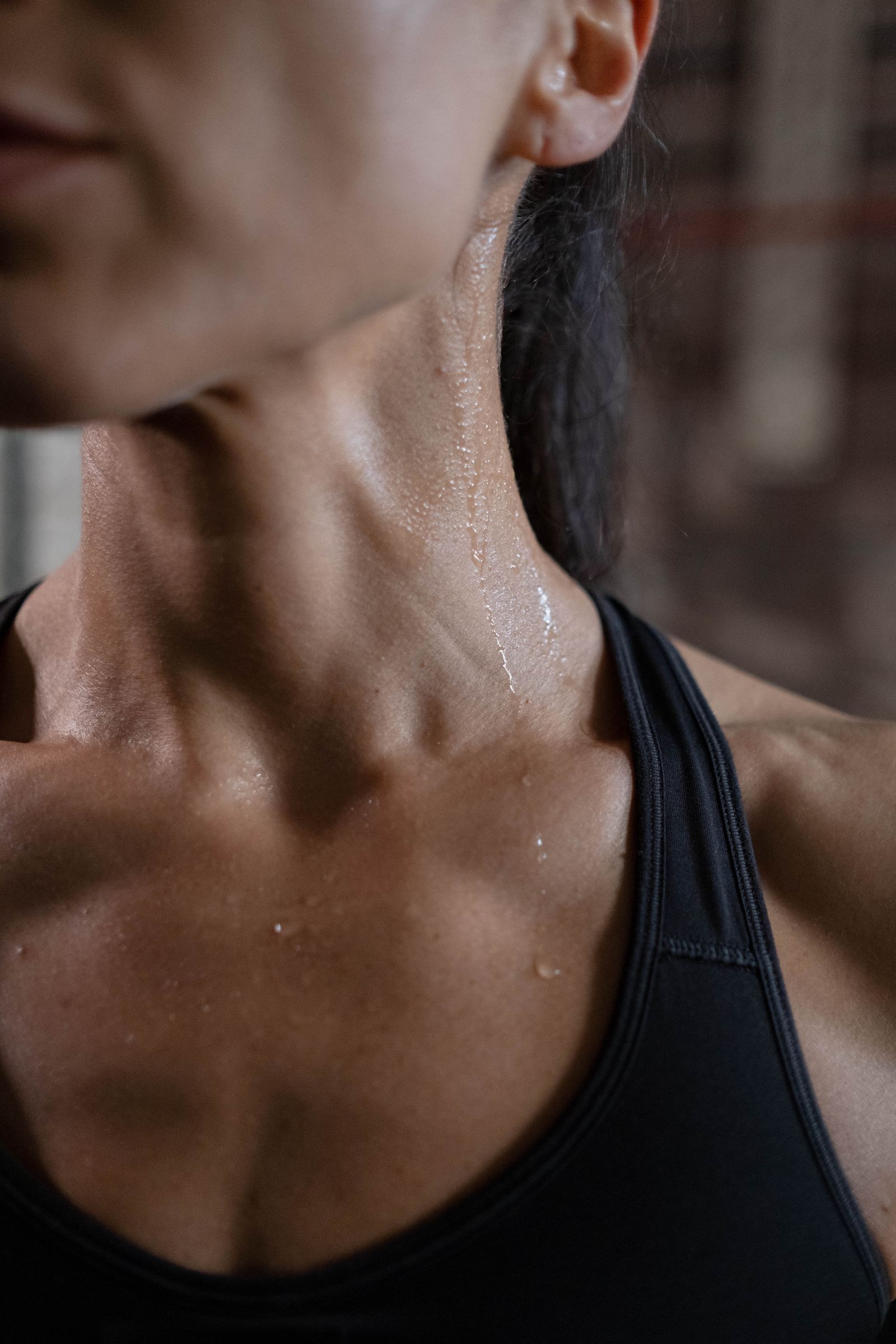
If you’ve ever wiped sweat from your face and noticed a sharp, briny taste on your lips, you’re not imagining things. That taste is sodium chloride, the same salt that seasons food, and your body is pushing it out through your skin at a rate that varies wildly from person to person.
The short answer to the question is: yes, salty-tasting sweat is a real signal. It means you’re a “salty sweater,” and depending on how hard and how long you’re working, you could be losing sodium at a rate that most sports drinks simply can’t keep up with.
Here’s the part most coverage misses: the problem isn’t just how much you sweat. It’s the combination of high sweat volume AND high sodium concentration in that sweat. When both are elevated, standard hydration advice falls dangerously short.
This article breaks down the science behind salty sweat, the warning signs that your sodium is running low, and what actually works to replace it.
Why Does Sweat Taste Salty?
Sweat is produced by eccrine glands distributed across your skin. As your core temperature rises, these glands draw fluid from your bloodstream and push it to the surface, where evaporation cools you down. That fluid isn’t pure water. It carries electrolytes, primarily sodium and chloride, which is exactly why it tastes like the ocean.
The saltiness of your sweat is determined by your sweat sodium concentration, a number measured in milligrams per liter (mg/L). This figure is largely genetic, and it doesn’t change much regardless of how fit you are or how often you train.
The Range Is Enormous
According to research published in Sports Medicine, sweat sodium concentration varies dramatically between individuals:
| Sweat Type | Sodium Concentration |
|---|---|
| Low-sodium sweater | Under 200 mg/L |
| Average athlete | ~950 mg/L |
| High-sodium (salty) sweater | 1,500 to 2,300+ mg/L |
That’s more than an 11-fold difference between the lowest and highest ends. If your sweat tastes noticeably salty, you’re almost certainly sitting in the upper half of that range.
What Makes Sweat Saltier?
Several factors push sodium concentration higher:
- Genetics: The single biggest driver. Some people’s sweat glands simply reabsorb less sodium before it reaches the skin surface.
- Heat acclimatization: Counterintuitively, well-acclimatized athletes often have lower sweat sodium because their glands become more efficient at conserving it. Unacclimatized individuals tend to lose more.
- Exercise intensity and duration: Higher intensity means higher sweat rates, which can increase total sodium loss even if concentration stays the same.
- Body size: Larger athletes produce more total sweat volume, amplifying losses at any given concentration.
The taste test isn’t a lab measurement, but it’s a reliable proxy. If your sweat consistently tastes like a bag of pretzels, your sodium losses during hard sessions are almost certainly above average.
How Much Sodium Are Heavy Sweaters Actually Losing?
This is where the numbers get alarming. Most people assume they can replenish sodium with a sports drink and call it a day. For light sweaters, that’s probably fine. For heavy, salty sweaters, it’s nowhere close.
A landmark NIH study on workers in the heat found that individuals working in moderately hot conditions for a 10-hour shift lost between 4.8 and 6 grams of sodium on average, equivalent to 12 to 15 grams of table salt. And that’s the average. Individual losses were substantially higher.
The football player case study is the most extreme example on record. A 2010 study published in PMC tracked NFL players during preseason training and found:
- Daily sodium losses ranged from 2.3 grams to a staggering 30 grams in a single day
- The highest-loss player had a sweat rate of 2.94 liters per hour and a sweat sodium concentration nearly double the average
- To replace 30 grams of sodium using a standard sports drink, that player would need to drink approximately 65 liters of fluid, which would cause hyponatremia (dangerously low blood sodium) before he got anywhere close
That’s not a hydration problem a sugary drink can solve. It’s a sodium density problem.
The Two-Variable Problem
Total sodium loss is the product of two numbers:
Total sodium lost = Sweat rate (L/hr) × Sweat sodium concentration (mg/L) × Hours of activity
If you sweat 2 liters per hour at 1,500 mg/L for two hours, you’ve lost 6 grams of sodium. Drinking water replaces the fluid but leaves a 6-gram sodium hole. Drinking a typical sports drink at roughly 400 mg of sodium per 16 oz bottle would require you to consume about 15 bottles to fill that same gap. At that volume, you’d be flooding your system with water and sugar long before you’d replaced the sodium.
This is why salty sweaters can’t just “drink more.” They need concentrated sodium, delivered efficiently.
Signs Your Sodium Is Running Low
Sodium depletion doesn’t announce itself with a blinking warning light. The early symptoms are easy to dismiss as general fatigue or dehydration, which is exactly what makes it dangerous. According to StatPearls via the NCBI, exercise-associated hyponatremia (EAH) is defined as a serum sodium level below 135 mmol/L developing during or within 24 hours of physical activity, and its incidence is increasing across a wide range of athletes.
Early Warning Signs (Easy to Miss)
- Unusual fatigue or a “heavy legs” feeling that doesn’t match your effort level
- Headache during or after exercise
- Nausea or an unsettled stomach
- Lightheadedness or dizziness
- Muscle cramps, particularly during or after long sessions
- A strong craving for salty foods after training
That last one is your body talking. Research has shown that sodium-depleted individuals consistently gravitate toward saltier foods, an unconscious appetite correction mechanism. If you finish a long run and immediately want a bag of chips or a pickle, your body is telling you something.
When It Gets Serious
As sodium continues to drop, symptoms escalate:
- Confusion or disorientation
- Vomiting
- Seizures (in severe cases)
- Loss of consciousness
Critical distinction: Drinking large amounts of plain water while sodium-depleted makes things significantly worse, not better. It dilutes whatever sodium remains in your bloodstream. This is why “just drink more water” is dangerous advice for heavy sweaters who haven’t replaced their electrolytes.
The real risk for most active people isn’t the extreme end. It’s the chronic, low-grade sodium deficit that builds up across days of training or long work shifts in the heat. Performance drops, recovery slows, and cramping becomes a regular occurrence, all without ever hitting a clinical threshold.
Why Standard Sports Drinks Fall Short for Salty Sweaters
The sports drink industry was built around the average athlete. And for the average athlete, a drink with 100 to 200 mg of sodium per serving is probably adequate. But “average” is a statistical abstraction. If you’re a heavy, salty sweater, the product designed for the middle of the bell curve isn’t designed for you.
Here’s the core problem: to get meaningful sodium replacement from a typical sports drink, you have to consume enormous volumes of fluid. That fluid itself becomes the issue. Your stomach has a limited absorption rate, excess fluid slows gastric emptying, and you’re adding sugar and calories at a time when your body needs sodium most.
The math doesn’t work for heavy sweaters. Consider someone losing 1,500 mg of sodium per liter of sweat at a rate of 1.5 liters per hour over a two-hour workout. That’s 4,500 mg of sodium to replace. A standard 20 oz sports drink at roughly 270 mg of sodium means drinking over 16 bottles to break even. That’s nearly 2.5 gallons of liquid.
What You Actually Need: Concentration, Not Volume
The solution isn’t more fluid. It’s more sodium per ounce. This is the principle behind hypertonic sodium replacement: delivering a concentrated dose that your body can absorb and use without requiring you to drink yourself waterlogged.
This is exactly where pickle brine has a legitimate, science-backed advantage. Pickle juice is naturally high in sodium, and its acidity and electrolyte profile make it an efficient delivery vehicle. Athletes have used it for muscle cramps since the 1990s, and the practice has moved from locker room folklore to peer-reviewed research.
The practical question is whether you’re getting enough sodium in a form your body can actually use, or whether you’re drinking a lot of lightly salted water and calling it hydration.
Fast Pickle: Built for the Salty Sweater
Fast Pickle was built around a simple premise: if you’re losing serious sodium, you need a serious sodium replacement. Not a sports drink. Not a powder you mix with 16 oz of water. A concentrated shot that delivers what you actually lost.
Each 3 oz Fast Pickle shot contains 570 mg of sodium in real pickle brine. That’s more sodium per ounce than the leading electrolyte packets, tablets, and ready-to-drink bottles on the market, without the sugar load that makes high-volume consumption impractical.
Why Concentration Matters
The hypertonic formulation isn’t just a marketing angle. It’s the functional point. A hypertonic solution has a higher solute concentration than your body fluids, which means it pulls fluid into the gut and supports rapid electrolyte absorption. You get the sodium hit without needing to consume a liter of liquid to get it.
For a heavy sweater losing 4 to 6 grams of sodium over a training session or a long work shift, that concentration means you can meaningfully supplement your losses in a format that’s:
- Portable: 3 oz fits in a pocket, a gym bag, or a work truck
- Fast: No mixing, no measuring, no prep
- Sugar-free: Real brine, no added sugar, so you’re not spiking insulin while trying to rehydrate
- Stackable: Take one shot before, one during, one after, and you’ve covered the sodium math without drinking gallons of anything
Real Pickle Brine, Not a Lab Approximation
There’s a reason athletes have been reaching for pickle juice for decades. The combination of sodium, acidity, and naturally occurring electrolytes in fermented brine does something that synthetic electrolyte drinks don’t replicate exactly. The acidity has been linked in research to interrupting muscle cramp signals faster than sodium replacement alone, which is why pickle juice has become a go-to in locker rooms for cramping athletes.
Fast Pickle uses real pickle brine, not a reconstituted powder or a flavored salt solution. If you’ve ever noticed that craving for something salty and sour after a hard effort, that’s your body pointing you toward exactly this.
If you’re a heavy sweater who’s been relying on standard sports drinks and still dealing with cramps, fatigue, or sluggish recovery, the issue isn’t how much you’re drinking. It’s how much sodium is actually in what you’re drinking. The 12-pack is a good starting point for athletes training multiple days per week, and the 24-pack makes sense for anyone with a high daily sweat output.
How to Know If You’re a Salty Sweater
You don’t need a lab test to get a reasonable read on your sweat sodium. These are the signals that consistently correlate with above-average sodium loss:
| Signal | What It Means |
|---|---|
| Sweat tastes strongly salty or briny | High sodium concentration in sweat |
| White residue on skin or clothing after drying | Salt crystals left behind as sweat evaporates |
| Frequent muscle cramps during or after exercise | Sodium depletion disrupting nerve-muscle signaling |
| Strong craving for salty food post-workout | Body’s appetite correction for sodium loss |
| Feeling wiped out despite adequate sleep and hydration | Chronic low-grade sodium deficit affecting performance |
| Headaches after long sessions in the heat | Early sign of electrolyte imbalance |
If three or more of these apply to you consistently, you’re almost certainly losing more sodium than the average athlete and you need a replacement strategy that reflects that.
The good news: this is a solvable problem. The body is remarkably good at recovering when it gets the right inputs. The key is matching your sodium replacement to your actual sodium loss, not to what a label designed for the median consumer says is a serving.
For most heavy sweaters, that means moving away from volume-based hydration and toward concentrated, efficient sodium delivery. Your sweat has been trying to tell you this for years.
Frequently Asked Questions
Why does my sweat taste salty?
Your sweat carries sodium and chloride from your bloodstream out through eccrine glands in your skin. The taste is sodium chloride — the same salt that seasons food. The saltier it tastes, the higher your sweat sodium concentration is, which is largely genetic and ranges from under 200 mg/L in light sweaters to 1,500 to 2,300+ mg/L in heavy salty sweaters.
How do I know if I am a heavy salty sweater?
The classic signals are: noticeably salty or briny-tasting sweat, white salt residue on skin or clothing, frequent muscle cramps, strong cravings for salty food after training, headaches after hot workouts, and feeling wiped out despite hydrating. Three or more of these consistently is a strong indicator.
How much sodium can a heavy sweater lose in one session?
Workers in moderate heat over a 10-hour shift have been measured losing 4.8 to 6 grams of sodium on average. NFL players in preseason have been recorded losing as much as 30 grams in a single day. Total loss equals sweat rate × sweat sodium concentration × hours of activity.
Why are standard sports drinks not enough for salty sweaters?
Most sports drinks contain about 100 to 270 mg of sodium per serving. To replace 4,500 mg of sodium, a heavy sweater would need to drink roughly 16 to 45 bottles — impractical, calorie-heavy, and a fluid-overload risk. Heavy sweaters need concentration, not volume. A single 3 oz Fast Pickle shot delivers 570 mg of sodium without the sugar load.
Can I just eat salt or take salt tablets instead?
You can — and many endurance athletes do — but salt alone misses two things real pickle brine offers: the natural electrolyte profile of fermented brine and the acidity that has been linked to faster nerve-muscle responses during cramping. Tablets also hit the stomach in a single concentrated dose, which can cause GI distress. A 3 oz brine shot is gentler on the gut and easier to time around effort.
The Bottom Line
If your sweat tastes salty, you’re a heavy-sodium sweater — and standard hydration advice was not written for you. The solution isn’t more water or another sports drink. It’s concentrated sodium in a format your body can actually absorb. Real pickle brine has been doing exactly that for decades, and a 3 oz shot is the cleanest way to deliver it.